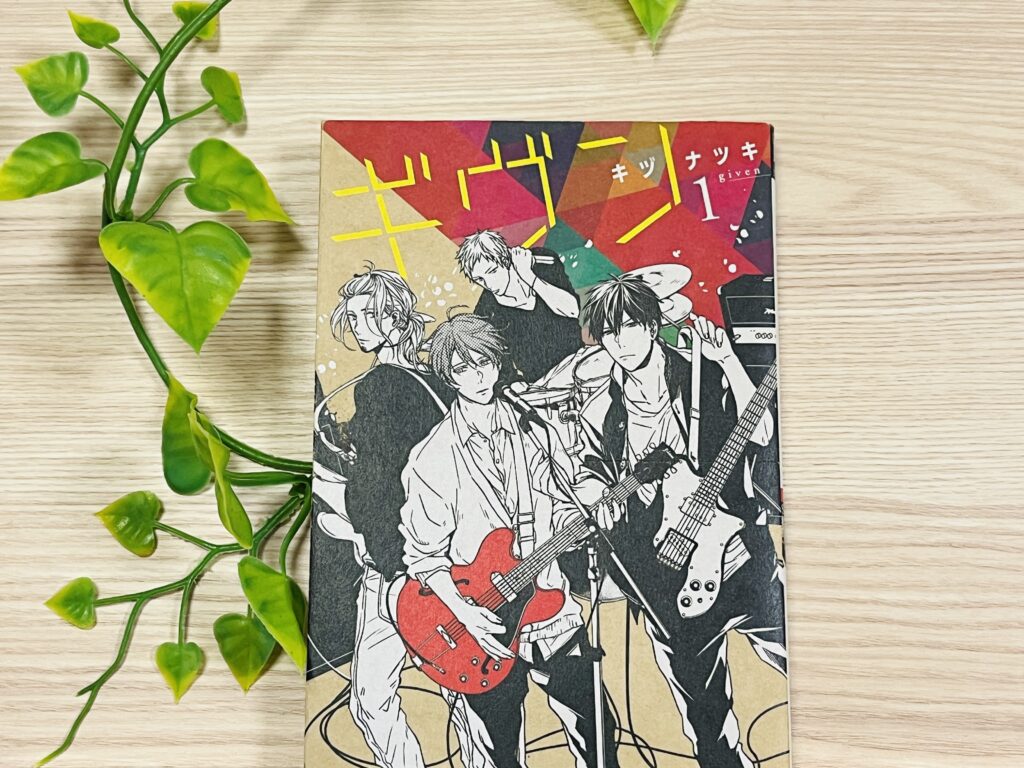
Mafuyu Sato still goes to school.
He still carries a guitar—the broken one, the one that used to be Yuki’s. He moves through his days. He functions, in the way people are expected to function.
But somewhere inside him, time stopped the moment the fight with Yuki went unfinished.
For a long time, I assumed every grief story was eventually reaching for the same destination: the moment right before healing begins. Given never reaches for that moment. And the longer I sat with the series, the more I understood that this wasn’t a gap in the story.
It was the whole point.
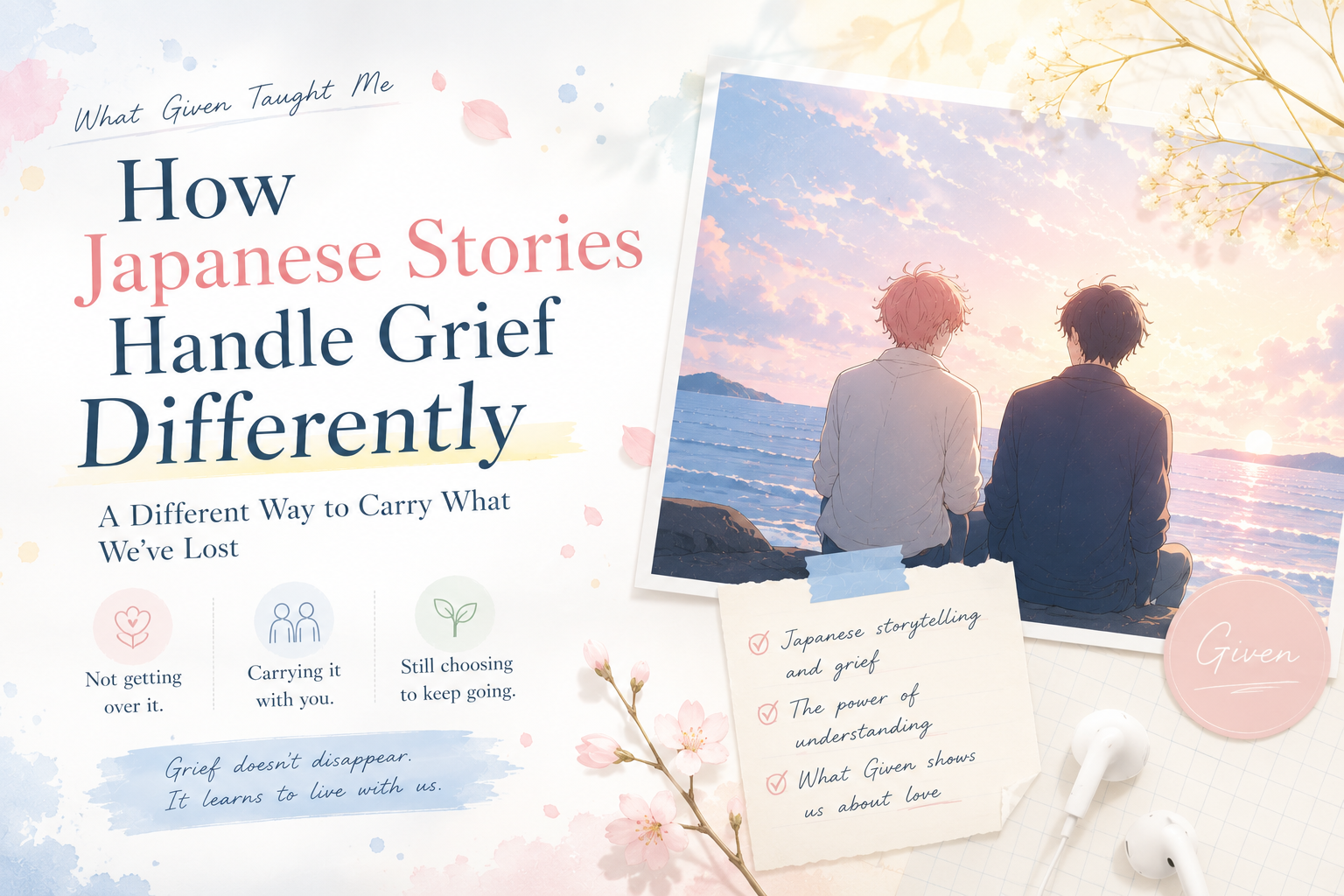
In much of Western storytelling, grief tends to resolve. The loss happens, the character struggles, and eventually something shifts—a new purpose, a new love, a morning where they wake up and feel, for the first time in a while, that they might be okay. It’s a generous shape for a story to offer. But it can also flatten something true: some losses don’t heal. They just become part of you.
Japanese storytelling often imagines grief differently—not as something to move through, but as something to move with. The person you lost doesn’t disappear once you start to feel better. They stay. They travel alongside you into new mornings, new relationships, new versions of your life. Carrying them isn’t a failure to heal. It’s proof of how deeply you loved them.
The goal isn’t to be over it.
The goal is to keep going anyway.
What Given Did With This
Mafuyu Sato, when we first meet him, has stopped.
Not literally. He goes to school. He carries a broken guitar. He moves through his days.
But inside, time has frozen. The relationship with Yuki ended mid-sentence — in the middle of a fight, before anything could be resolved — and Mafuyu has been standing at that unfinished moment ever since.
Given never tells him to get over it.
It never suggests that healing means leaving Yuki behind.
What it offers instead is something quieter and more honest: the possibility of moving forward with Yuki still present. Of carrying the grief into a new life rather than setting it down before you’re allowed to begin one.
By the time Given: To the Sea arrives — when Yuki’s song finally reaches Mafuyu — what breaks open is not the end of grief.
It is the realisation that grief and love can coexist. That Yuki can remain inside him. That Ritsuka has not asked him to arrive without the weight.
That moving forward doesn’t require forgetting.
For the full portrait of what Mafuyu was carrying — and what it meant when it finally arrived: ✅ Mafuyu Sato from Given: What His Silence Is Actually Made Of
For what it cost Ritsuka to make that moment possible: ✅ Ritsuka Uenoyama from Given: The Boy Who Acts Before He Thinks
The People Left Behind — Hiiragi and Shizusumi
Given: Hiragi Mix extends this further.
Hiiragi and Shizusumi lost Yuki too. From a different angle, with a different kind of grief — the grief of friends, of people who knew him longest, who carry memories of him that Mafuyu never had access to.
Hiiragi’s realisation — that what he felt for Yuki was admiration rather than romance — doesn’t resolve his grief. It clarifies it. He understands the shape of the loss more precisely. But the loss remains.
And yet he moves toward Shizusumi anyway. Not because he has finished grieving. But because grief and love are not, it turns out, mutually exclusive.
For a deeper look at Hiiragi and what he was carrying: ✅ Hiiragi Kashima from Given: The Boy Who Was Pretending to Be Fine
For the full portrait of Shizusumi’s quiet endurance: ✅ Shizusumi Yagi from Given: The Person Who Understood Everything — and Said Nothing
Why This Way of Handling Grief Feels True
There is something honest about the Japanese approach to grief in fiction that the Western arc sometimes misses.
It acknowledges that some people never fully get over a loss. Not because they are broken or stuck, but because the person they lost was genuinely irreplaceable — and pretending otherwise would be a kind of lie.
It makes space for grief that doesn’t resolve neatly. For love that continues past death. For the complicated, unglamorous reality of carrying something heavy while still trying to build a life.
And it suggests — quietly, without making a speech about it — that this is not failure.
That carrying your loss with you is its own form of survival.
That you don’t have to be over it to keep going.
What Loving Someone in Grief Looks Like
There is one more thing Given understands about grief that I find particularly rare.
It shows what it looks like to love someone who is still carrying a loss.
Ritsuka doesn’t ask Mafuyu to be finished grieving before their relationship can begin. He doesn’t wait for Mafuyu to arrive at some healed version of himself.
He arrives into the middle of Mafuyu’s grief and stays.
He even carries part of it himself — completing Yuki’s song, holding Yuki’s love carefully, delivering it to the person it was always meant for.
This is not self-sacrifice. It is what genuine love looks like when grief is part of the picture.
You don’t love the person despite what they’re carrying.
You love them — and what they’re carrying — together.
For a deeper exploration of what this kind of love requires: ✅ When the Person They Loved Didn’t Leave — They Died
A Final Note
Given didn’t teach me that grief gets better.
It taught me something I think is more useful:
That grief doesn’t have to get better for life to keep going.
That the people we’ve lost can stay with us — not as wounds that haven’t healed, but as part of who we are and how we love.
That carrying them forward is not the same as being stuck.
It is, maybe, the most honest form of remembering.
If this resonated with you, these go deeper:
✅ Guilt Without Closure: Why Given’s Unresolved Endings Feel So Japanese
✅ When the Person They Loved Didn’t Leave — They Died
✅ Mafuyu Sato from Given: What His Silence Is Actually Made Of
✅ Yuki from Given: The Character Who Isn’t There — and Never Really Leaves
✅ When Your Partner Finishes Their Ex’s Love Song — What Given: To the Sea Understands About Love
✅ What Is Given? — Where to start if you’re new to the series
✅ Why Music Becomes the Voice in Japanese Storytelling: What Given Understands About Feeling
✅ The Beauty of Silence in Japanese Fiction
✅ Why Japanese Characters Never Say “I Love You” (And Why That Makes It Hit Harder)
I also share the small manga moments that stay with me long after reading—the pauses, glances, and choices that never fully leave.
You can follow those weekly reflections on Substack.
✅ My Substack Here!

If this resonated with you — I wrote a short book about exactly this feeling.
Why Japanese Romance Feels Different explores what makes Japanese love stories hit differently, through the lens of Given: silence as love, sincerity over perfection, and carrying the past forward.