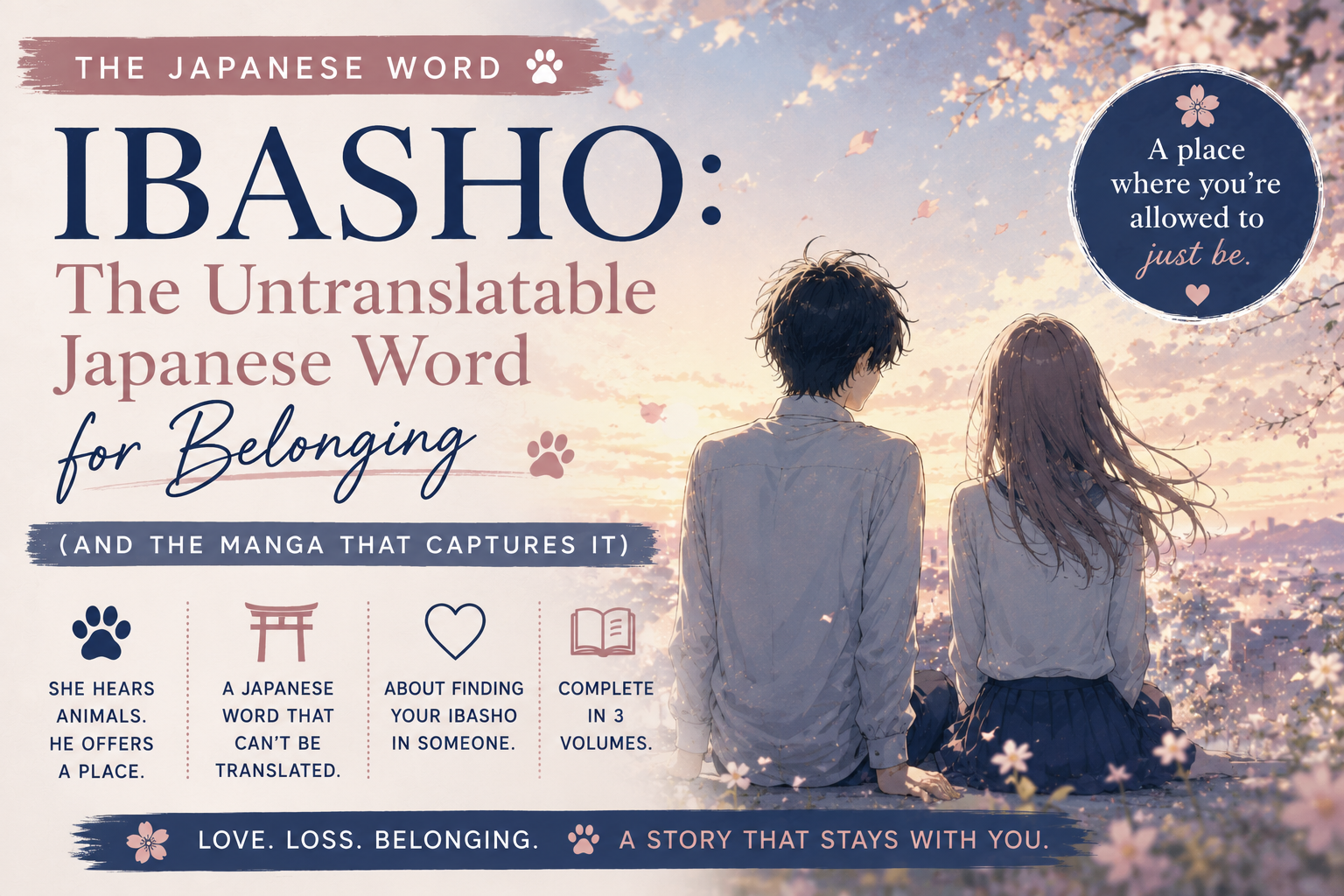
A completed, unlicensed shoujo manga about a girl who hears animals, and the dog-turned-boy who breaks her heart open.
Spoiler warning: this piece discusses key story beats, including the ending.
Japanese has a handful of words that resist translation. Komorebi, the dappled light filtering through leaves. Mottainai, the ache of wasted potential. And ibasho — a word that looks simple on paper and turns out to be almost impossible to pin down in English.
The literal translation is something like “a place to be.” That’s not wrong, but it’s not enough. Ibasho isn’t about physical space. It’s the feeling of being somewhere without needing anyone’s permission to exist there. You can be surrounded by family, by friends, and still not have it. You can find it in a single person.
There’s a manga that captures this feeling with more care than almost anything else I’ve read — a completed, three-volume shoujo series that has never been officially translated into English.
✅New to this manga? Start with the complete, spoiler-free guide before diving into this one.
What Ibasho Actually Means
Part of why ibasho is hard to translate is that it’s not quite the same as “belonging,” and not quite the same as “safety” either.
Belonging is about whether a group accepts you. Safety is about whether you’re threatened. Ibasho is quieter and more personal than either. It’s the sense that the version of you occupying a space isn’t a performance — that you don’t have to shrink yourself, hold your breath, or manage anyone’s expectations just to remain there.
And people often only notice it by its absence. It usually takes betrayal, or abandonment, to realize you may never have had a place like that at all.
The two leads of this manga are exactly those kinds of people.
The Manga: A Spoiler-Free Introduction
The story follows Nobara Morimura, a high school girl who lost most of her hearing in a car accident back in sixth grade. In exchange, she gained the ability to hear the voices of animals.
Wary of people after the accident, Nobara’s quiet life is interrupted when a strange boy shows up claiming to be the dog that was hit by the same car — now somehow human. Half-convinced, half-humoring him, she names him Ro, and the two end up living together while searching for two things: a way to fix Nobara’s hearing, and a way to turn Ro back into a dog.
The manga is Kimi to Wonderland (君とワンダーランド) by Kana Watanabe, serialized in Shueisha’s Bessatsu Margaretfrom 2017 to 2018, and wrapped up in three volumes. Nothing about the premise screams “emotional gut-punch.” That’s part of why it sneaks up on you.
The Scene That Hooked Me: Ro and the Abandoned Cat
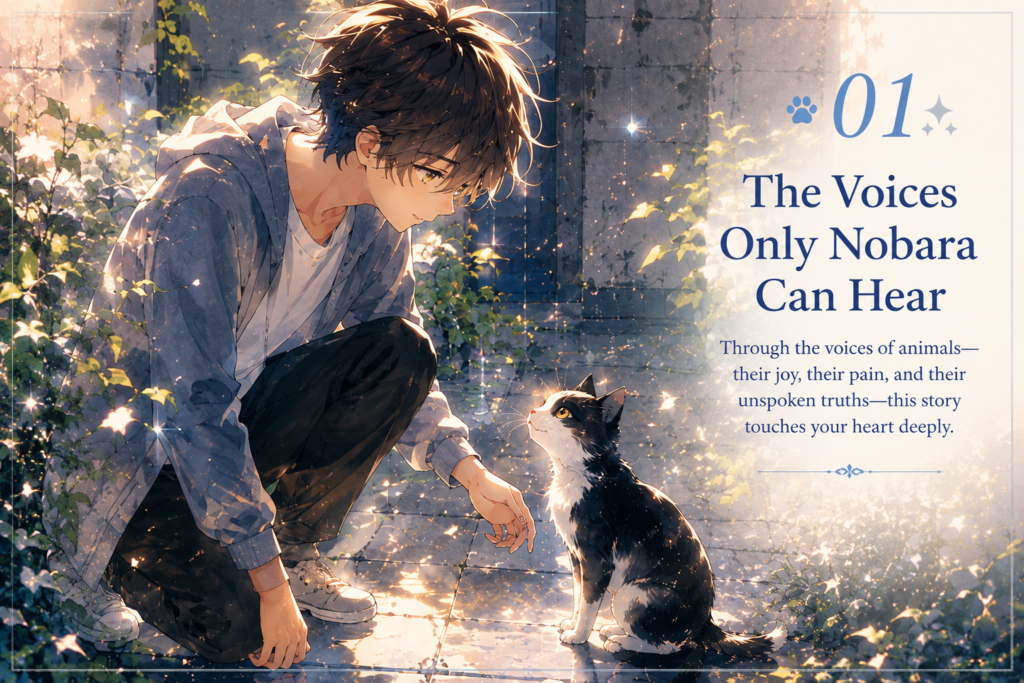
The moment that stayed with me longest isn’t a big plot twist or a romantic confession. It’s a quiet scene where Ro talks to a stray cat who was abandoned by its owner.
The cat is grieving. Ro, who has his own history of being left behind, tells it something like this: being abandoned hurt, and it was lonely — but thinking about why it hurt so much led him to a realization. He was sad because he’d loved his owner. The love and the pain were the same size, sitting inside him in equal measure. So instead of resenting the hurt, he decided to hold on to the part of him that had loved.
It reads like comfort offered to the cat. It’s really Ro speaking a conclusion he’d already reached about his own life. And that single scene quietly sets up the choice he makes at the very end of the series.
If you’ve ever loved an animal, or spent time around rescue work, this scene lands differently. The manga never treats its animals as a device for cheap comfort. It lets them carry the emotional weight of the story directly.
Why Ibasho Is the Real Subject of This Story
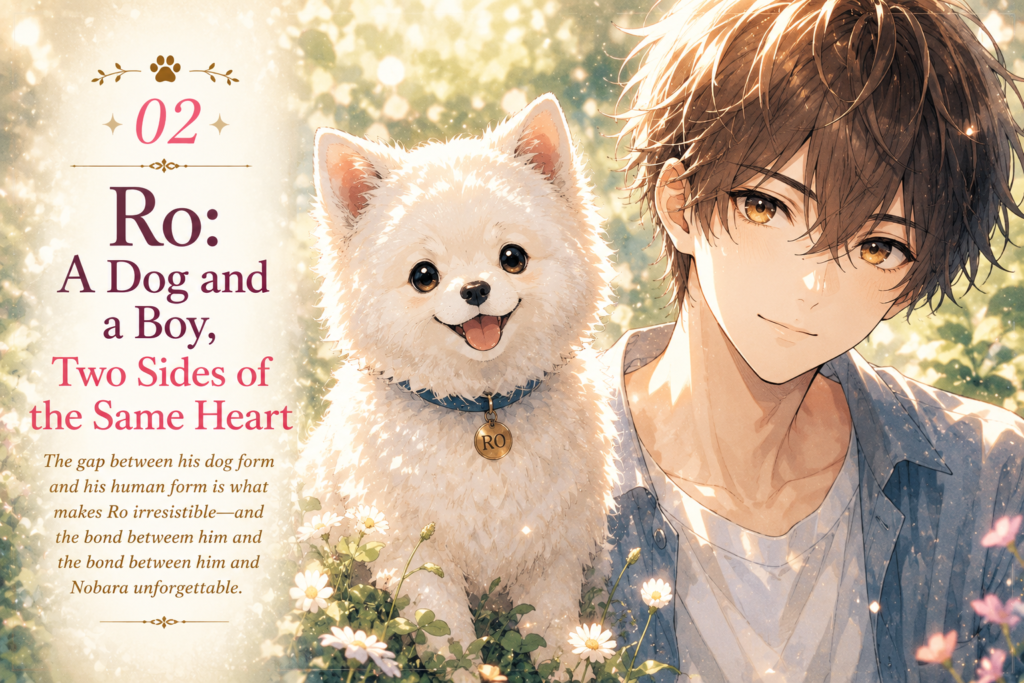
On the surface, Nobara and Ro look like opposites. She’s human and closed-off; he’s a former dog and painfully open. But they share the same wound: neither of them has ever had a place where they felt they were allowed to simply exist.
Nobara was betrayed by someone she considered her closest friend, and the experience taught her to keep people at arm’s length. Her ability to hear animals — ironically — became a way to avoid people even further. Animals couldn’t hurt her the way humans could.
Ro, meanwhile, was once a house pet named Kuro before he was abandoned. Underneath his stated goal of “returning to normal” is a loneliness he can’t quite put into words.
When Nobara gives him a new name — Ro, not Kuro — it’s more than a naming scene. It’s an acceptance of who he is now, not who he was when he was thrown away.
As the story moves forward, the two of them slowly become each other’s ibasho. It builds to a moment, late in the series, where Nobara asks Ro if she can hug him. It’s a small line, not a grand declaration — but it’s the first time she has ever moved toward someone on her own. And notably, she asks. Not “I’m going to,” but “can I?” — a small detail that says everything about how much she has come to see him as his own person, worthy of that kind of respect.
A Bit of Japanese Culture: Why Is There a Fox God?
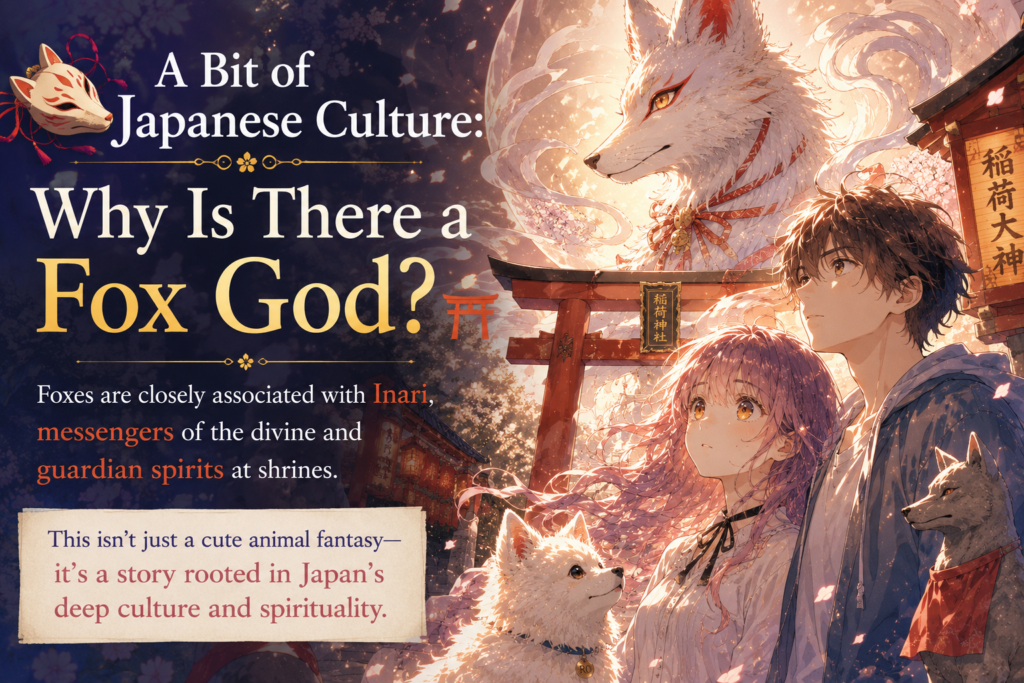
Partway through the story, a fox-shaped deity shows up, tied to the mysterious forces behind Ro’s transformation. It might read as a random fantasy flourish if you’re not familiar with the context.
In Japan, foxes are closely associated with Inari, one of the country’s oldest and most widespread folk beliefs. Foxes are considered messengers of the god Inari and are enshrined as guardian spirits at shrines across the country — seen as intermediaries between the human world and the divine. So a fox god quietly overseeing a story about an animal turning human isn’t an arbitrary choice; it’s drawing on a mythological framework that would feel completely natural to a Japanese reader.
It’s a small detail, but it’s a nice reminder that this isn’t just a “cute animal fantasy” — it’s built on a specific cultural relationship between animals, nature, and the divine.
The Part That’s Genuinely Frustrating: It’s Still Not Translated
I want to be upfront about something. As of now, there is no official English translation of this manga.
It already has a small but genuine following among English-language readers — there’s a modest cluster of ratings and reviews on Goodreads from people who read it in Japanese. But no major publisher has picked it up for an English release.
It’s a complete trilogy. It’s an easy length to license and produce. Its themes are universal. There’s no shortage of reasons it should get translated — it just hasn’t happened yet.
If you can read Japanese, the original is available digitally through Japanese ebook platforms. If you can’t, the honest answer right now is: add it to your want-to-read list, and hope that enough attention eventually makes the case for an official release.
Closing Thoughts
Strip away the premise, and Kimi to Wonderland is a story about ibasho, wearing a fantasy plot as a light disguise.
Ro’s words to that abandoned cat. Nobara quietly asking if she’s allowed to hug someone. The slow, unspectacular way these two people become each other’s place to exist — none of it is loud, and all of it stays with you long after you finish.
If you’ve ever loved an animal. If you’ve ever been betrayed by someone you trusted. If you’ve ever known the feeling of ibasho without having a word for it — this one is worth seeking out.
Here’s hoping it finds an English translation someday.
Related Reading
✅ The Dog Who Chose to Stay Human: Why Ro Might Be Shoujo’s Best-Written Male Lead Right Now
✅ She Chose Silence for Years — Then Asked If She Could Hug Him: Nobara’s Quiet Rebellion
I also share the small manga moments that stay with me long after reading—the pauses, glances, and choices that never fully leave.
You can follow those weekly reflections on Substack.
✅ My Substack Here!
This essay is part of a wider comparison: Why Manga Characters Find Ibasho in the People Who Chose Them: Given, Choking on Love, and Kimi to Wonderland Compared