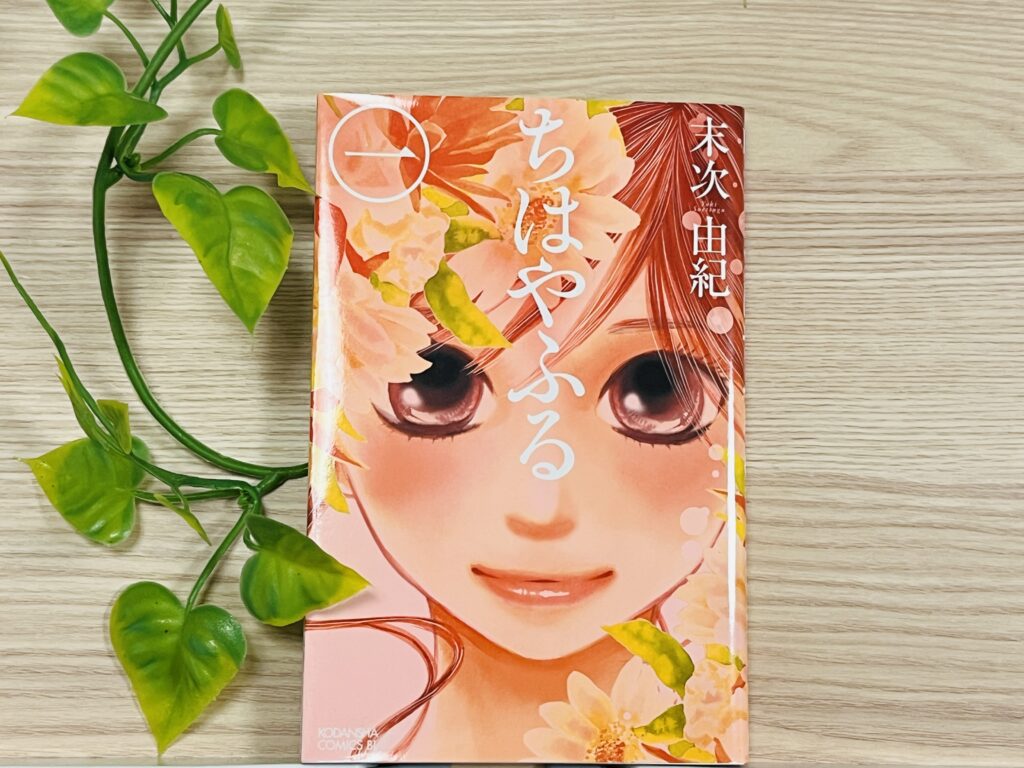
When you’re reading the manga, it’s easy to forget.
This isn’t a fictional sport.
What Chihayafuru depicts is a real competition.
And at the heart of that competition is a collection of 100 poems, written 800 years ago.
First, Here’s How It Actually Works
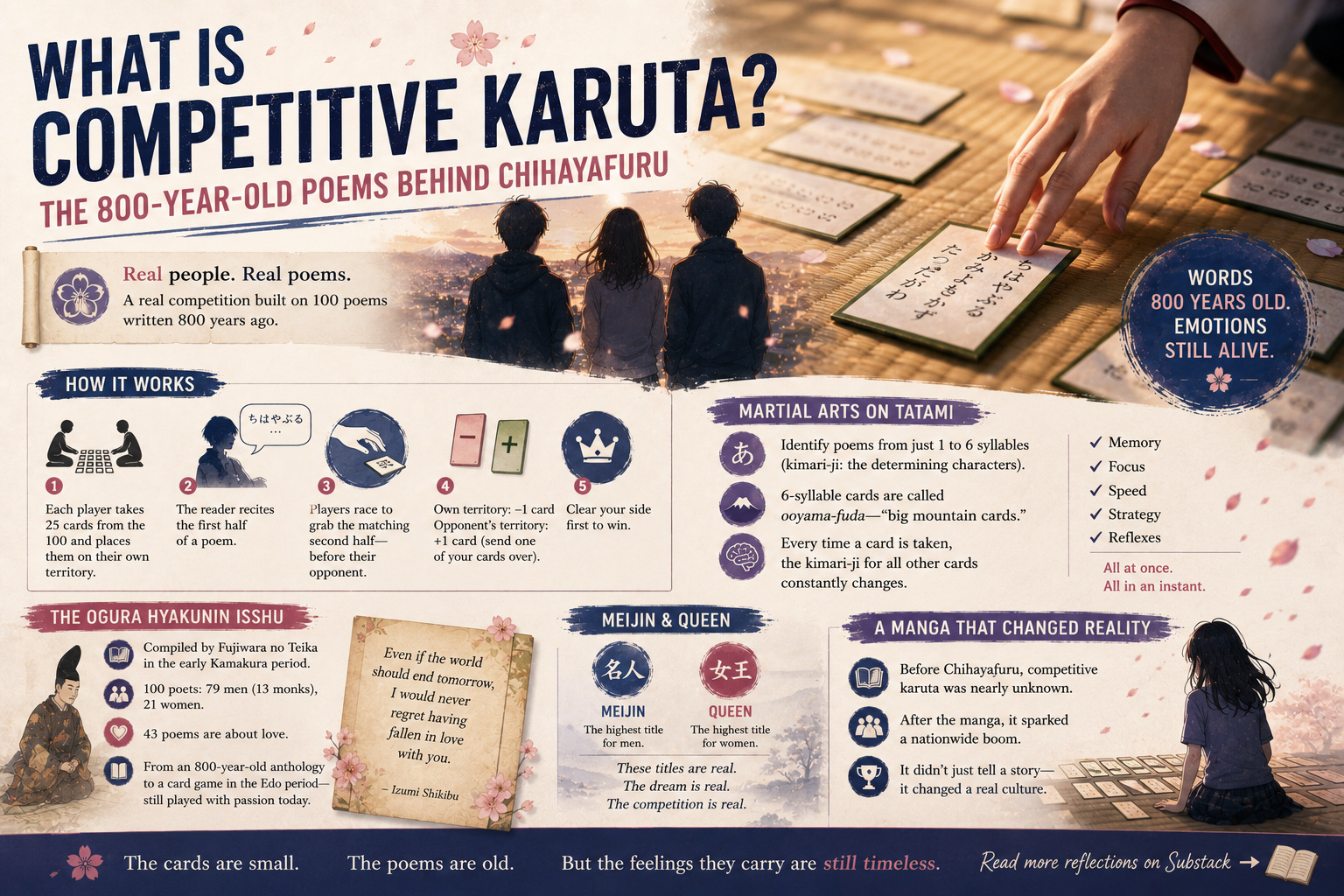
Competitive karuta uses a set of 100 cards from the Ogura Hyakunin Isshu.
Matches are one-on-one.
Each player draws 25 cards at random from the full set of 100, and arranges them on their own side—called their “territory.”
The reader recites the first half of a poem.
Players race to grab the card holding the second half—before their opponent does.
If you grab a card from your own territory, your card count drops by one.
If you grab a card from your opponent’s territory, you get to send one of your own cards over to their side.
Whoever clears their own territory first wins.
That’s the entire rule set.
It sounds simple.
This is where the real difficulty begins.
Why People Call This “Martial Arts on Tatami”
Every one of the 100 poems can be identified after hearing just the first few syllables.
This identifying portion is called the kimari-ji—the “determining characters.”
The shortest is a single syllable.
The longest is six.
Cards that need all six syllables before you can tell which one it is are nicknamed ooyama-fuda—”big mountain cards.” The name comes from the old habit of “betting on the mountain,” gambling on which card it might be before you could actually confirm it.
And here’s the part that makes this genuinely brutal: the kimari-ji keeps shifting as the match goes on.
Every time a poem gets read and removed from play, any other poem that shared its opening syllables suddenly becomes identifiable sooner than before.
Which means players are constantly updating, in real time, the current kimari-ji for every single one of the hundred poems—in their heads, mid-match.
On top of that: split-second reaction time. Physical speed.
Memorization.
Focus.
Reflexes.
All of it has to come together at once.
That’s why this sport gets called “martial arts on tatami mats.”
Where These 100 Poems Actually Came From
Every card in competitive karuta comes from a single anthology: the Ogura Hyakunin Isshu.
It was compiled by Fujiwara no Teika, a poet working in the early Kamakura period.
The whole thing started because someone asked Teika to choose poems to decorate the sliding doors of a mountain villa.
Teika selected one poem each from 100 different poets, spanning from the Asuka period all the way to the early Kamakura era.
79 of them were men (13 of those were monks). 21 were women.
If you sort the poems by theme, one category dominates by far: love. 43 of the 100 poems are about romantic longing.
So underneath everything, this deck of 100 cards is, more than anything else, a collection of words about love.
By the Edo period, this anthology had transformed into a card game.
And in this era, that same 800-year-old language is still being fought over—seriously, competitively—by teenagers.
Meijin and Queen — The Top of the Sport
Competitive karuta has two highest titles.
For men, it’s Meijin.
For women, it’s Queen.
These aren’t something the manga made up.
They’re real titles that genuinely exist in the world of competitive karuta.
What the characters in Chihayafuru are chasing isn’t an imaginary version of glory. It’s the actual top of a real sport.
When Fiction Reshaped a Real Sport
Before Chihayafuru, competitive karuta was a niche world that very few people knew anything about.
After it started running, that changed dramatically.
Countless people picked up karuta for the first time because of this manga.
Plenty of middle and high schoolers walked into a real karuta club for the first time after watching the anime or the films.
Fiction reshaped a real-world culture.
Very few stories can actually claim that.
Chihayafuru is one of them.
About the People at the Center of This Story
This article covered the rules and the history.
What Chihaya, Taichi, Arata, and Shinobu were each carrying inside this sport—that’s covered in their own essays.
✅ Character Essay: Taichi Mashima — The Person Who Stayed Beside a Dream That Was Never His
✅ Character Essay: Arata Wataya — The Person Who Never Asked, Because He Was Afraid of the Answer
✅ Character Essay: Chihaya Ayase — The Person Who Never Noticed, Because Her Mind Was Always Somewhere Else
✅ Character Essay: Wakamiya Shinobu — The Person Who Chose Solitude Before Anyone Could Choose to Leave Her
To see how the whole story fits together:
✅ Chihayafuru Explained: Story, Characters & Why the Ending Still Divides Fans
Final Reflection
Words written 800 years ago are still moving people today.
There’s something quietly strange about that.
The 100 poems Teika chose were the product of his own aesthetic instincts, tangled up with the political pressures of his time.
And now, someone is staring down at that same complicated set of 100 cards, holding their breath.
Fingertips barely lifted off the floor.
Chihayafuru is a story that captured that exact tension more carefully than almost anything else.
I also share the small manga moments that stay with me long after reading—the pauses, glances, and choices that never fully leave.
You can follow those weekly reflections on Substack.
✅ My Substack Here!