Silence, in a lot of stories, is something to be filled.
Someone gets quiet, and then someone else says something. Feelings get named. Explanations get offered. The silence doesn’t last, because the story needs to keep moving.
Given works differently.
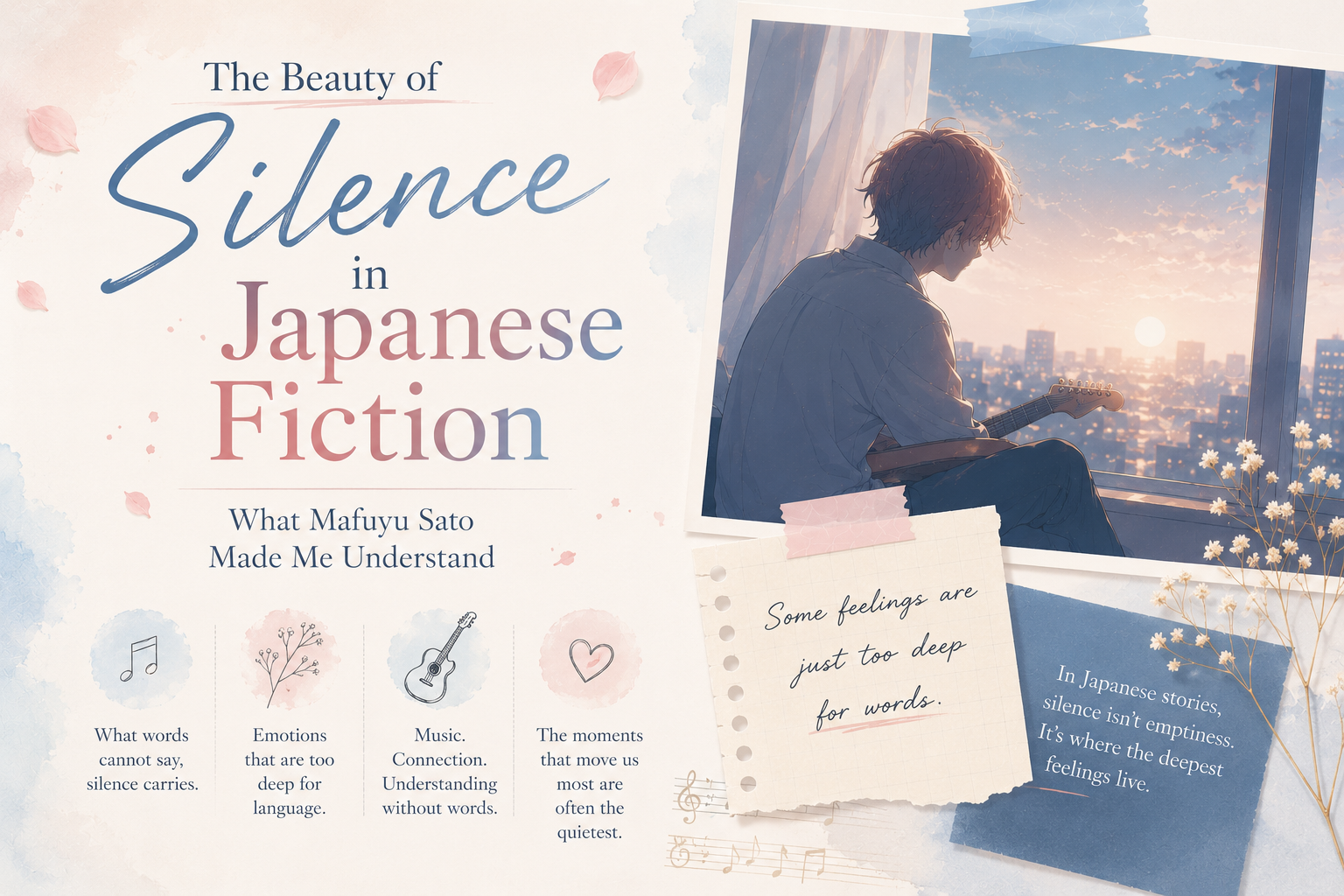
In Given, silence is not a gap between meaningful moments.
It is the meaningful moment.
What Japanese Fiction Does With Silence
There is a saying in Japanese: chinmoku wa kin (沈黙は金).
Silence is gold.
It is not simply a proverb about knowing when to stop talking. It reflects something deeper — the idea that silence, in the right context, communicates more than words can. That the absence of language is not emptiness but a different kind of fullness.
Japanese fiction has inherited this. In a tradition where reading between the lines is expected, where understanding without being told is a form of intimacy, silence becomes a carrier of meaning rather than an absence of it.
The most important moments in a Japanese story are often the quietest ones.
Not the declaration. The pause before it.
Not the explanation. The look that means one isn’t needed.
Mafuyu’s Silence — Not Empty. Overfull.
Mafuyu Sato’s silence doesn’t look like much at first.
He’s quiet. Distant. Easy to mistake for someone who simply doesn’t have much going on inside.
But his silence isn’t empty.
It is overfull — with things that have no way out.
A childhood in which speaking led to punishment. The loss of the one person who understood him without words. A guilt that can’t be resolved because the person who might have resolved it is gone.
All of that lives inside his silence.
Which is why the live performance scene — the first time Mafuyu sings in front of people — is not just a musical moment.
It is the moment when everything that had been locked inside him finally finds an exit.
And there is one detail in that scene that I find quietly devastating.
Throughout the series, Mafuyu’s internal voice tends toward denial. I’m not lonely. I’m fine. Things are okay.
But in that performance — in the middle of singing, in front of an audience, with the feeling finally moving through him — something different surfaces.
I’m lonely.
Not: I’m not lonely. Not the denial he had been offering himself for years.
Just: I’m lonely.
For the first time, he let himself feel what was actually there.
Music gave him permission to say the thing he had never been able to say — even to himself.
For the full portrait of what Mafuyu was carrying inside that silence: ✅ Mafuyu Sato from Given: What His Silence Is Actually Made Of
Two Kinds of Silence — Mafuyu and Shizusumi
Given contains more than one kind of silence.
Mafuyu’s silence came from not knowing how. He had the feelings. He didn’t have access to the words, or the safety to use them.
Shizusumi Yagi’s silence is something different.
He knew exactly what he felt. He understood the situation with clarity. He had the words available.
He simply chose not to use them.
Not because he had given up. But because speaking would have changed the one thing he wasn’t willing to lose — his closeness to Hiiragi. Staying quiet, staying present, staying beside him without asking for anything in return — that was the form his love took.
Mafuyu couldn’t say it.
Shizusumi chose not to.
Both silences are deep. But they are different depths, from different places.
For a deeper look at what Shizusumi was holding inside his silence: ✅ Shizusumi Yagi from Given: The Person Who Understood Everything — and Said Nothing
The People Who Could Receive the Silence
What Given understands — and what makes it so affecting — is that silence only becomes communication when someone is able to receive it.
Yuki received Mafuyu’s silence for years. He didn’t ask for explanations. He didn’t need Mafuyu to perform normalcy. He simply stayed, and in staying, told Mafuyu that his silence was acceptable. That he was acceptable.
Ritsuka received it differently — not because he understood Mafuyu’s history, but because he didn’t need to. He heard Mafuyu sing and responded to what was there, without asking what it meant or where it came from.
Haruki received Kaji’s silence for years — the silence of someone who was confused and avoidant and not ready to arrive. And he waited, without making his waiting into a demand.
In each case, the ability to receive silence without filling it — to stay present with someone who can’t yet speak — is portrayed as one of the deepest forms of love available.
For a deeper look at how Haruki held that silence for so long: ✅ Haruki Nakayama from Given: The Person Who Always Put Everyone Else First
Why This Lands Differently for Western Viewers
For viewers raised on stories where feelings get spoken — where the emotional climax is the declaration, the confession, the moment someone finally says the thing — Given can feel disorienting at first.
Things happen that seem important, but no one names them. Feelings are present, but no one announces them. The most charged moments are the ones with the least dialogue.
And then something shifts.
You start to read the silence. You start to feel what’s inside it rather than waiting for it to be explained. You notice the glance, the choice, the small gesture that carries the weight of everything unsaid.
And when a moment lands — when the feeling arrives without a single word — it lands harder than a declaration would have.
Because you had to find it yourself.
Because it trusted you to understand without being told.
That trust — the story’s willingness to leave space rather than fill it — is, I think, the deepest form of respect a narrative can offer its audience.
Silence as the Shape of Something Real
The silence in Given is never decorative.
It is never there because the story ran out of things to say.
It is there because what is inside the characters is too large for language. Because the most honest response to certain feelings is not to name them but to hold them. Because sometimes the only true thing you can offer is your presence, without explanation.
Mafuyu’s silence was overfull with grief and guilt and love that had nowhere to go.
Shizusumi’s silence was a choice made out of care, sustained over years.
Haruki’s silence was patience given as a gift.
None of them were empty.
All of them were, in their own way, saying everything.
If the silence in Given stayed with you, these go deeper:
✅ Mafuyu Sato from Given: What His Silence Is Actually Made Of
✅ Shizusumi Yagi from Given: The Person Who Understood Everything — and Said Nothing
✅ Haruki Nakayama from Given: The Person Who Always Put Everyone Else First
✅ Why Japanese Characters Never Say “I Love You” — And Why That Makes It Hit Harder
✅ What Is Given? — Where to start if you’re new to the series
✅ Why Music Becomes the Voice in Japanese Storytelling: What Given Understands About Feeling
✅ Guilt Without Closure: Why Given’s Unresolved Endings Feel So Japanese
✅ How Japanese Stories Handle Grief Differently: What Given Taught Me
I also share the small manga moments that stay with me long after reading—the pauses, glances, and choices that never fully leave.
You can follow those weekly reflections on Substack.
✅ My Substack Here!

If this resonated with you — I wrote a short book about exactly this feeling.
Why Japanese Romance Feels Different explores what makes Japanese love stories hit differently, through the lens of Given: silence as love, sincerity over perfection, and carrying the past forward.
This essay is part of a wider comparison: Why Do Manga Characters Choose Silence Over Confession? (Given, Chihayafuru, and A Sign of Affection Compared)