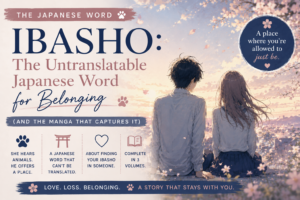
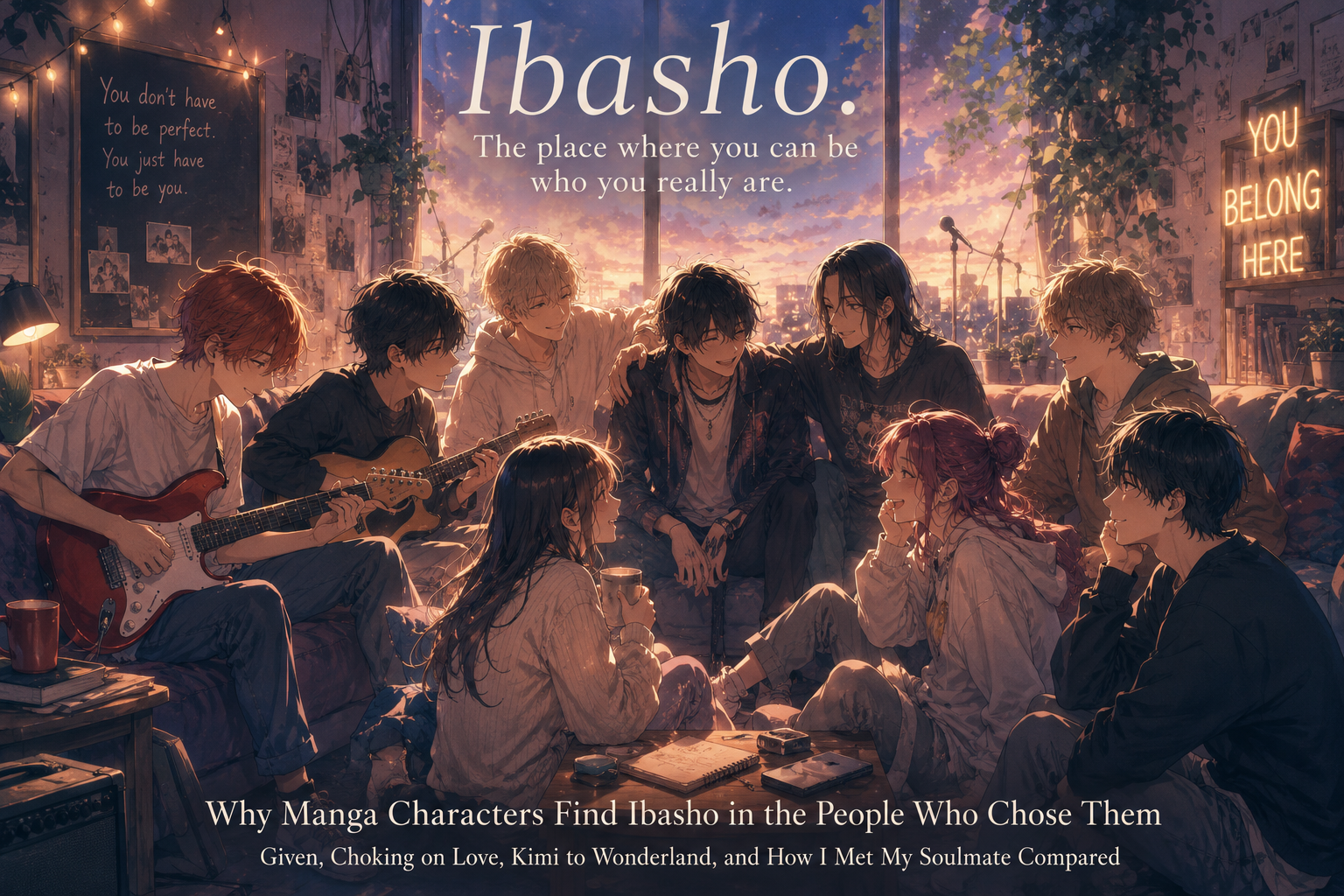
There is a Japanese word, ibasho (居場所), that does not translate cleanly into English. Literally, it means “the place where one is.” Practically, it means something closer to: the place where you are allowed to exist as you actually are, without performing, without earning it, without being told to leave.
Across very different shoujo and BL manga, a strikingly similar structure keeps appearing. A group of people — a band, a pair of strangers, a whole circle of friends — becomes the thing that finally answers the question of where a character belongs. Not a family they were born into. A family they found.
Given, Choking on Love, and Kimi to Wonderland each tell a version of this story. So does How I Met My Soulmate, from a slightly different angle. Read side by side, they reveal something specific about what Japanese romance and coming-of-age manga believe belonging actually requires.
Given — The Band as the First Place That Didn’t Ask Them to Explain Themselves
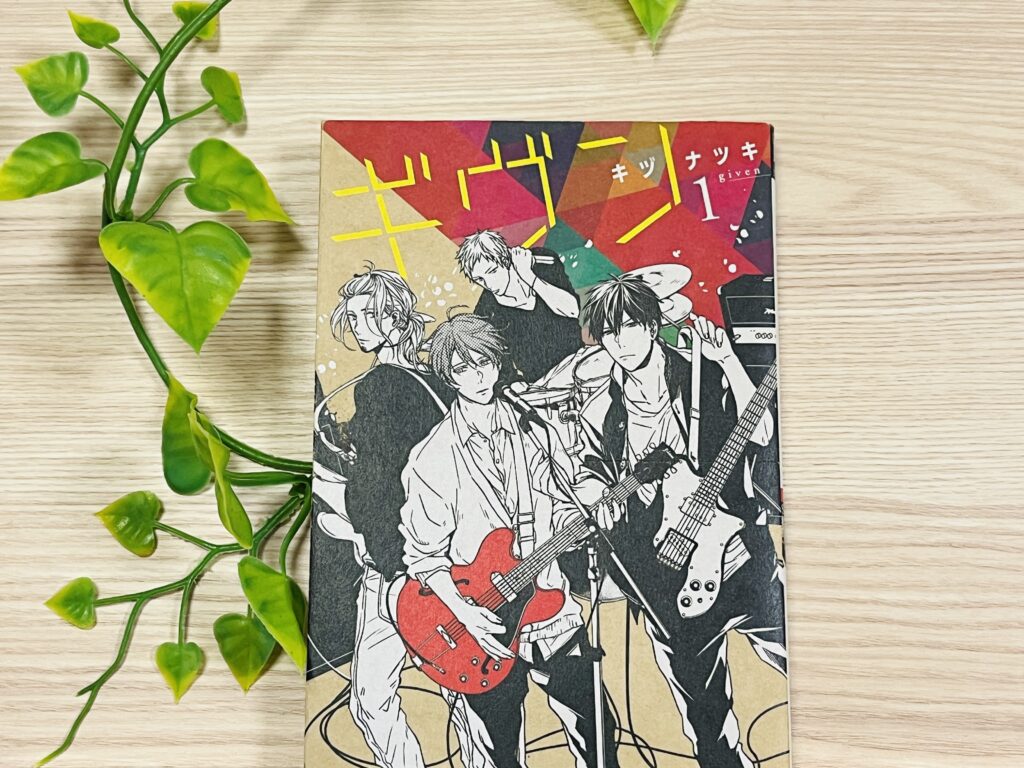
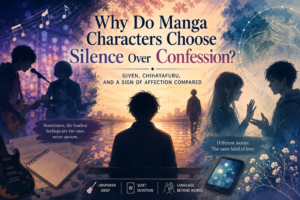
On the surface, the band in Given is just four people making music together. But for Mafuyu, Ritsuka, Akihiko, and Haruki, it becomes the one place where carrying something unresolved doesn’t disqualify you from staying. Nobody in the band demands that the others explain their grief, their guilt, or their fear before they’re allowed in the room. The music becomes the proof of belonging that words never had to supply. That is what makes the band more than a band: it is the first place in the story that holds all of them without asking them to be finished healing first.
Choking on Love — When a “Place” Quietly Becomes a “Future”
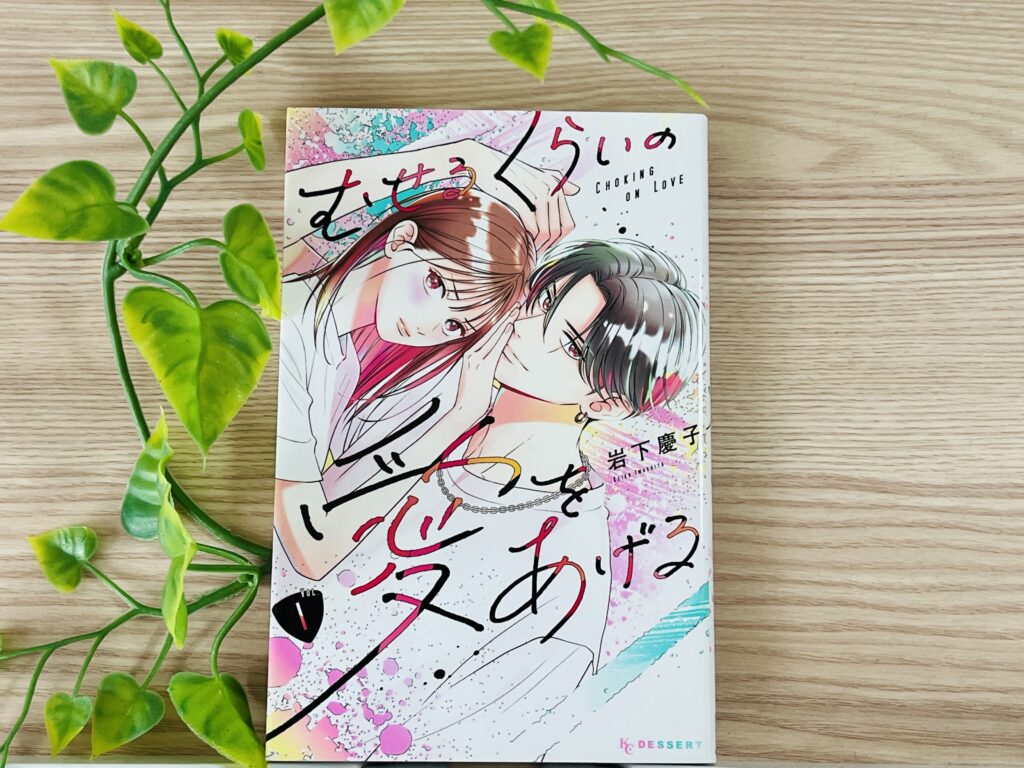
PANTERA NEGRA, the band at the center of Choking on Love, doesn’t start out as anyone’s found family. It starts as a group with a goal. But somewhere in the process of showing up for each other — not because the story requires it, but because they keep choosing to — the band stops being just a place they occupy and starts being a future they’re building together. The shift is subtle, almost accidental. Nobody announces that the group has become something worth protecting. It simply becomes true, and by the time it does, staying the same is no longer possible for any of them.
Kimi to Wonderland — Naming the Thing Directly
Where Given and Choking on Love show belonging through a band, Kimi to Wonderland is unusual in that it names the concept outright: ibasho. For a heroine who hears what animals are thinking and has spent her life feeling out of step with everyone around her, the manga is explicit about what she is actually searching for. Not romance first. Not adventure first. A place. Somewhere the parts of her that don’t fit anywhere else are not a problem to be solved.
How I Met My Soulmate — When Love Has to Make Room for Other People

How I Met My Soulmate approaches the same idea from a different direction. Jin Seno’s story starts out looking like a simple two-person romance, but it becomes something else once it acknowledges that no relationship exists in isolation. Real belonging, the manga suggests, isn’t just about being chosen by one person. It’s about gathering the wider circle of people who make that choice sustainable. Love, here, is only as strong as the community around it.
Why This Pattern Keeps Repeating
It’s not a coincidence that so many Japanese coming-of-age and romance stories reach for a group — a band, a circle of friends, a found family — instead of resolving belonging through a single romantic pairing alone. In a culture where individual identity is often understood in relation to the group you belong to, ibasho carries weight that a Western “found family” trope only partially captures. It isn’t just comfort. It’s permission to exist without constantly justifying yourself.
That’s why these stories linger. The moment a character finds their ibasho is rarely loud. There’s no confession, no dramatic reveal. Just a quiet realization that, for the first time, they don’t have to earn the right to stay.
Go Deeper
→ Why the Band in Given Is More Than a Band
→ When Staying the Same Becomes Impossible (Choking on Love)
→ Ibasho: The Untranslatable Japanese Word for Belonging
→ Jin Seno: Gathering Allies in Romance (How I Met My Soulmate)
If this idea stayed with you, I share weekly manga moments, emotional reflections, and the quiet scenes I can’t stop thinking about on Substack.