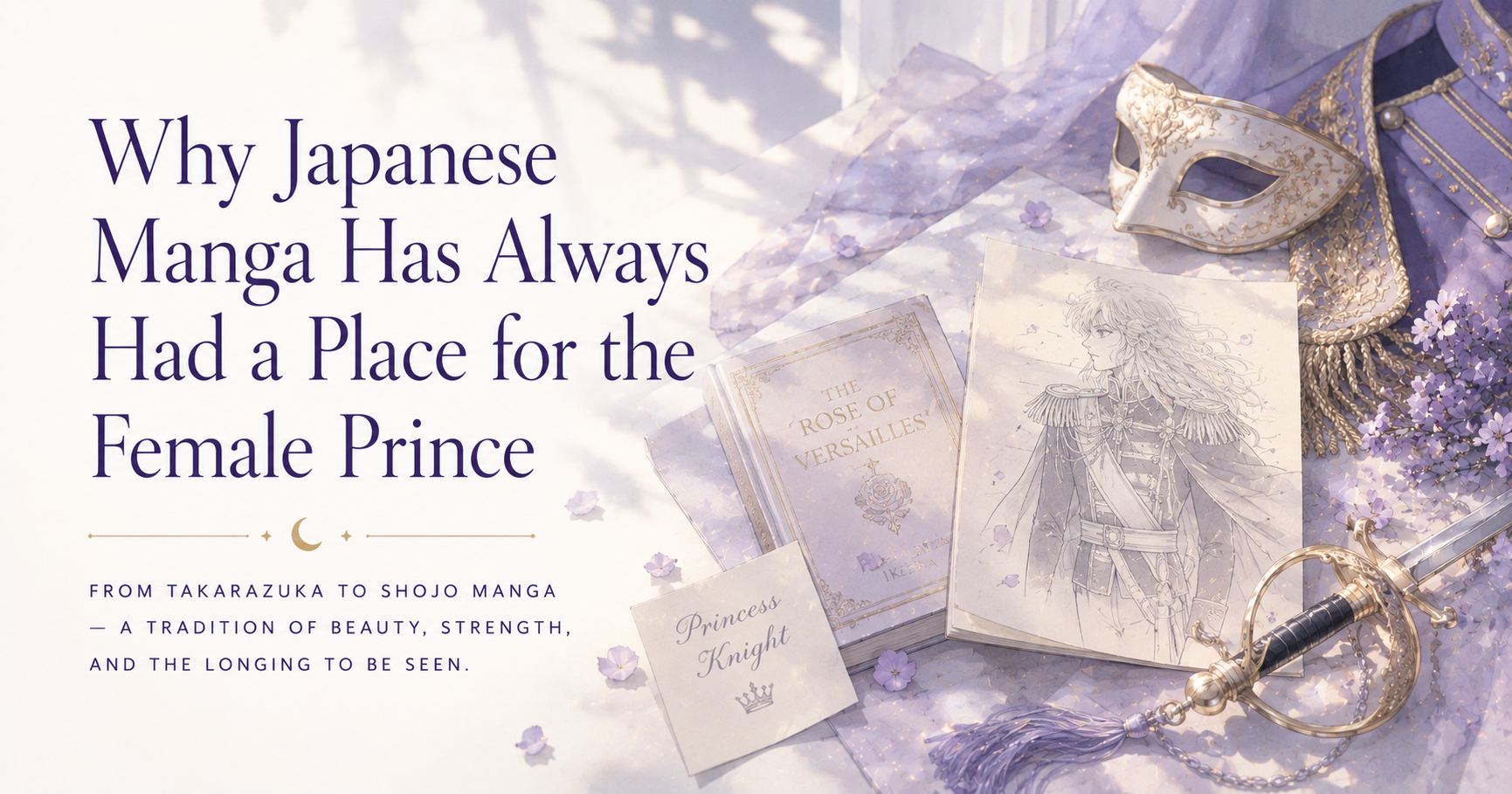
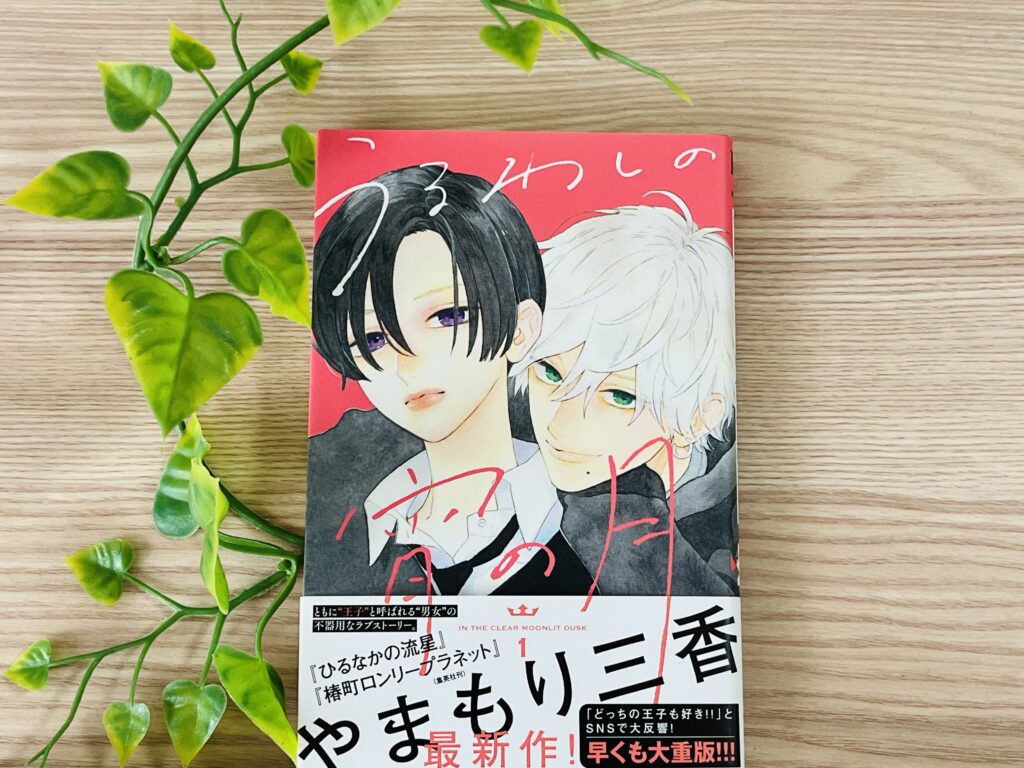
Yoi Takiguchi is called a prince.
But she is not the first.
Japan has a long history of this — women who perform the prince, women who are drawn to the prince, women who stand at the center of a story as the prince.
Yoi is the latest in a line that stretches back further than most readers realize.
This essay traces that line — and asks why this kind of character has been so deeply loved in Japan, and why she continues to resonate with readers who know nothing of her origins.
Takarazuka — Where It Began
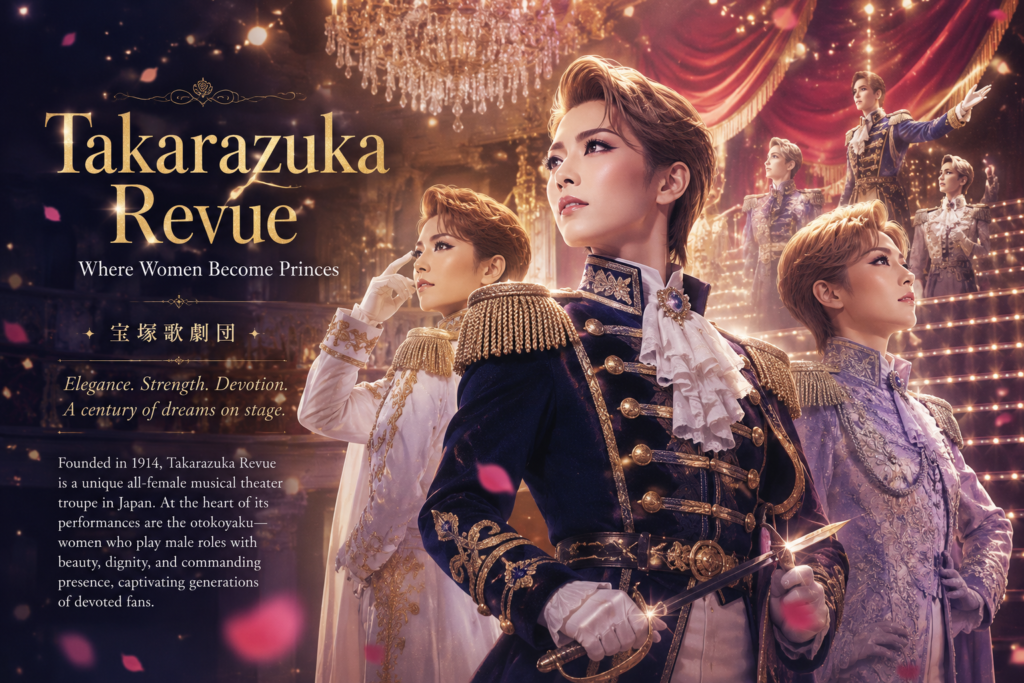
Any serious conversation about women playing princes in Japan has to begin with the Takarazuka Revue.
Founded in 1914, Takarazuka is a musical theater company with an entirely female cast. It has been performing continuously for over a century — and it remains, to this day, one of the most distinctive cultural institutions in Japan.
At the heart of the Takarazuka aesthetic is the otokoyaku — the male role player.
The otokoyaku is a woman who performs masculinity on stage: tall, low-voiced, dressed in suits or military uniforms, commanding the stage with a presence that draws intense devotion from a predominantly female audience.
This is not simply cross-dressing or theatrical convention.
The otokoyaku represents something more specific: a version of the ideal man constructed entirely by and for women.
Not the man as he is, but the man as female desire imagined him — refined, elegant, attentive, and achingly beautiful.
Takarazuka gave Japanese women not only permission to admire the prince, but permission to become one.
That permission traveled.
What Shojo Manga Inherited
The aesthetic that Takarazuka cultivated on stage found a new home in shojo manga — the genre of Japanese comics written for and about young women.
Princess Knight — Osamu Tezuka (1953)

Often cited as the origin point of the female prince in manga, Princess Knight follows Sapphire, a princess raised as a prince, who fights as a knight while concealing her true identity.
The story is not subtle about its themes. Sapphire carries two hearts — one male, one female — and the tension between them drives the entire narrative.
What Tezuka created, perhaps without fully knowing it, was a template: the woman who lives as a prince, who is admired for her strength and beauty, and who carries, quietly, the weight of an identity that does not entirely fit.
The Rose of Versailles — Riyoko Ikeda (1972)

If Princess Knight built the foundation, The Rose of Versailles constructed something that would last for generations.
Oscar François de Jarjayes — a noblewoman raised as a man, commander of the royal guard, impossibly beautiful and heartbreakingly principled — became one of the most iconic characters in the history of Japanese popular culture.
The Rose of Versailles crossed every boundary its genre had previously observed. It was adapted for the Takarazuka stage — where it has been performed repeatedly across decades — completing a circle between the two traditions that had always been in conversation.
Oscar is not a woman pretending to be a man. She is something the story never quite names, because the story understood that naming it would make it smaller than it was.
The legacy of The Rose of Versailles in shojo manga cannot be overstated. It established that a female character could occupy the prince’s position not as a temporary disguise or narrative trick, but as the true and permanent center of the story.
The Line That Followed
The characters who came after — in titles across decades of shojo manga — inherited something from Oscar and Sapphire, even when their creators may not have been conscious of it.
The archetype had been established: the woman who is called a prince, who carries that designation with a complexity that simple admiration cannot account for.
What It Means to Be Called a Prince
Before arriving at Yoi, it is worth pausing on what this label actually means in the Japanese cultural context — because it is not simply a compliment.
The loneliness inside the admiration
Characters who are called princes in shojo manga are almost always lonely in a specific way.
They are admired, but not approached. They are looked up to, but not across at. They are told they are cool — kakkoii — but rarely that they are lovely, or soft, or someone another person wants to take care of.
The admiration keeps its distance. And the distance, over time, becomes its own kind of isolation.
This loneliness mirrors something that many readers — particularly women who have been told, repeatedly, that they are strong, or reliable, or the one everyone depends on — recognize from their own lives.
The prince archetype in shojo manga has always been, in part, a way of making that experience visible.
The ambivalence at the center
What is striking about so many of these characters is that they do not simply embrace the prince role.
They are ambivalent about it.
They carry pride and discomfort simultaneously. They perform the expected image while quietly wondering what it would mean to exist outside of it.
This ambivalence is not a flaw in the archetype. It is the point.
For a closer look at how Yoi carries this ambivalence, see: ✅ [Why Yoi Takiguchi Is Not Your Typical Shojo Heroine]
What Yoi Inherits — and Where She Goes Further
Yoi Takiguchi stands on this long tradition.
She inherits the height, the composure, the low voice, the quality of being admired from a distance that has belonged to this archetype since Sapphire first lifted her sword.
But Yoi’s story moves somewhere that her predecessors did not quite reach.
Oscar and Sapphire were, in their different ways, structurally required to be princes. Their identities were assigned before the story began, and the narratives built around those assignments.
Yoi’s story is about something else.
It is about what happens when someone who has been called a prince for long enough that it started to feel permanent meets a person who looks at her and sees something different.
Not the cool one. Not the admirable one. Not the prince.
Just her.
Yoi’s journey is not about embracing the prince role or rejecting it. It is about discovering that the label — however long it has been in place, however many people have agreed to it — was never the whole of her.
In the history of this archetype, that is something new.
For a full introduction to the story and both main characters, see: ✅ [What Is In the Clear Moonlit Dusk? Plot, Characters & Why Fans Love It]
Why This Reaches Readers Who Don’t Know the History
The Takarazuka Revue is not widely known outside Japan. The Rose of Versailles has its international admirers, but it remains far more culturally central in Japan than elsewhere.
A reader coming to In the Clear Moonlit Dusk through the anime or through a recommendation may have no knowledge of any of this.
And yet the story reaches them anyway.
Because what Yoi carries — the experience of being seen only as an image, of being admired in a way that keeps people at arm’s length, of quietly wondering whether there is a version of herself that exists outside the expectations — is not a Japanese experience.
It is a human one.
The particular word prince belongs to a specific cultural tradition. But the feeling beneath it — the weight of being the strong one, the reliable one, the one who is never allowed to need anything — travels without translation.
Japanese shojo manga has spent decades developing the tools to render that feeling precisely.
Yoi is what those tools, fully developed, look like.
Closing
The female prince is not a recent invention.
She was born on a stage in 1914, refined across decades of manga pages, and she arrived, in her latest form, as a first-year high school student who just wants someone to see past the image.
Reading Yoi is, among other things, an encounter with a very long tradition — one that has been asking the same question in different ways for over a century:
What does it cost to be the prince? And what might it feel like to finally be seen as something else?
In the Clear Moonlit Dusk does not answer those questions quickly. But it takes them seriously. And that seriousness is its inheritance from everything that came before.
✅ Curious about this one? Check it out here! →In the Clear Moonlit Dusk 1
I also share the small manga moments that stay with me long after reading—the pauses, glances, and choices that never fully leave.
You can follow those weekly reflections on Substack.
✅ My Substack Here!