
This article contains spoilers through Given: To the Sea (2024).
Some stories end cleanly.
The apology is delivered. The misunderstanding is resolved. The people who hurt each other find their way to a moment of forgiveness, and the audience is allowed to leave feeling that things have been set right.
Given is not that kind of story.
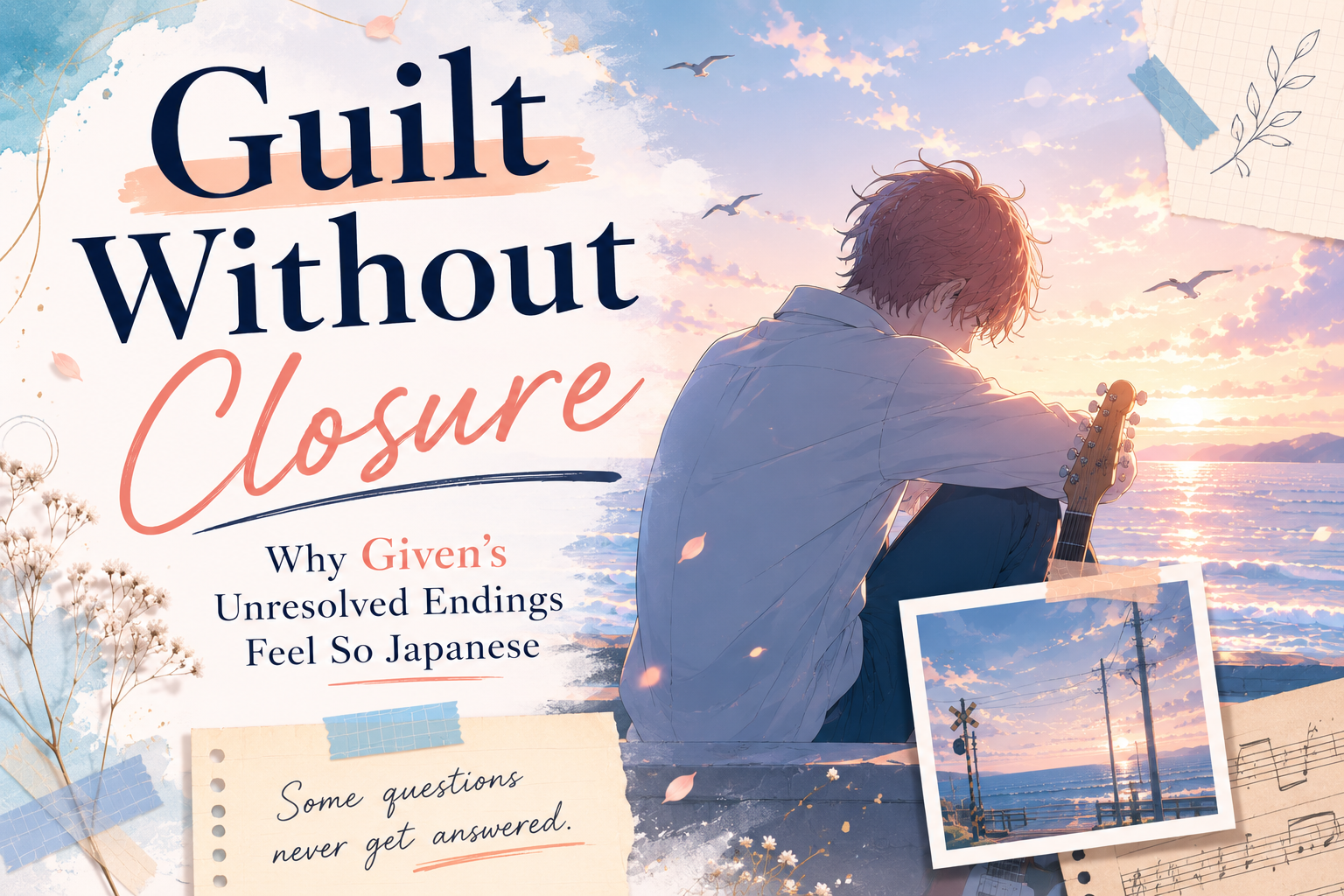
What Happened Between Mafuyu and Yuki
Mafuyu and Yuki had a fight.
They didn’t make up. They didn’t get a chance to. Before anything could be resolved — before the right words could be found, before either of them could soften — Yuki was gone.
And the reason Yuki died is never fully explained.
Was it connected to the fight? Was it something else entirely? The story doesn’t say. It leaves the question open — deliberately, permanently, without resolution.
What Mafuyu is left with is something very specific and very painful:
I don’t know if it was my fault.
Not: it wasn’t my fault. Not: it was my fault. Just the not-knowing. The inability to prove it either way. The guilt that has no verdict attached to it.
This is the kind of guilt that doesn’t soften with time the way other grief can. Because there is nothing to push against. No answer to arrive at. No moment of absolution that could finally release it.
He simply has to carry it.
How Much of Western Fiction Tends to Handle This
In much of Western storytelling, guilt tends to move toward resolution.
Someone did something wrong — or believes they did. They struggle with it. But eventually, the truth comes out. Someone tells them it wasn’t their fault. Or they find a way to make amends. Or they receive forgiveness from the person they hurt.
The guilt has somewhere to go. It resolves. The character is released from it, or at least given the tools to begin releasing themselves.
This is a generous impulse in storytelling. It offers the audience — and perhaps the person carrying guilt in real life — a model for how pain might eventually find its end.
But it can also feel, in certain moments, slightly dishonest.
Because some guilt doesn’t resolve. Some questions never get answered. Some apologies never arrive. Some people disappear before the story has a chance to finish.
What Japanese Fiction Tends to Do Instead
Japanese fiction has a different relationship with resolution — or the absence of it.
Stories don’t always end cleanly. Feelings don’t always get named. Relationships don’t always arrive at the moment of understanding that would allow everyone to move on.
This isn’t carelessness. It is a different kind of honesty.
The logic seems to be: reality often doesn’t resolve. People leave in the middle of things. Words go unsaid. Guilt accumulates without a verdict. And a story that pretends otherwise — that engineers a resolution because the audience deserves one — may be offering comfort at the cost of truth.
Given chose truth.
The fight between Mafuyu and Yuki stays unresolved. The reason for Yuki’s death stays unknown. The guilt stays without a verdict.
And the story asks: can you live inside that? Can you keep going, not because the question has been answered, but because you have to?
What the Song Gives — and Doesn’t Give
When Yuki’s song finally reaches Mafuyu in Given: To the Sea, something shifts.
Mafuyu learns that Yuki’s feelings for him were real. That the love existed, that it was deep, that it had been trying to find its way to him all along.
This is not nothing. It matters enormously.
But it does not answer the question Mafuyu has been living inside.
Was it my fault?
That question remains. It will always remain. There is no one left who could answer it, and even if there were, the answer might not be the one Mafuyu needs.
What the song offers instead is something different from resolution.
It offers company.
Yuki’s love, arriving at last, doesn’t release Mafuyu from his guilt. It gives him something to stand beside it. The guilt and the love exist together — neither cancelling the other out.
And perhaps that is enough to keep going.
For a deeper look at what that moment meant — and the four kinds of love that converged in it: ✅ When Your Partner Finishes Their Ex’s Love Song — What Given: To the Sea Understands About Love
Hiiragi, Shizusumi, and the Question That Has No Answer
Given: Hiragi Mix extends this further.
Hiiragi and Shizusumi lost Yuki too. And they, like Mafuyu, are left with a question that will never be answered:
Why did he go?
The film doesn’t answer it. It doesn’t try to.
What it shows instead is two people learning to live alongside the unanswered question. To build something real — a relationship, a future, a life — while the question remains, unresolved, in the background.
This is not moving on. It is moving forward, with the unresolved thing still present.
For a deeper look at what Hiiragi was carrying: ✅ Hiiragi Kashima from Given: The Boy Who Was Pretending to Be Fine
For the full portrait of Shizusumi’s quiet endurance: ✅ Shizusumi Yagi from Given: The Person Who Understood Everything — and Said Nothing
Why Unresolved Stories Stay With You Longer
There is something that clean resolutions can accidentally do.
They close the door.
The story ends, the feeling resolves, and you move on. The narrative has done its work and released you.
Unresolved stories don’t release you.
You leave the story still holding the question. Still thinking about what might have been. Still turning over the moments that didn’t get to finish.
Did Mafuyu ever stop wondering if it was his fault?
What was Yuki thinking in those final days?
If they had made up — if the timing had been different — what would have happened?
These questions have no answers. But they stay. They keep the story alive inside you long after it has ended.
That is, I think, part of why Given is so hard to put down — even after the credits roll on To the Sea. The unresolved parts of it keep asking to be thought about. Keep asking to be felt.
The Honesty of Not Resolving
Given didn’t tie things up cleanly.
It didn’t tell Mafuyu his guilt was wrong. It didn’t explain Yuki. It didn’t deliver the apology or the absolution or the moment of complete understanding that would have allowed everyone to fully exhale.
And I think that is one of the most honest things about it.
Because real loss often works this way. Real guilt often works this way. The questions don’t get answered. The apologies don’t always arrive. The people we hurt, or who hurt us, or who left before things could be resolved — they don’t always come back to give us what we need to move on.
We just have to keep going anyway.
Given understood that. And it trusted its audience to understand it too.
That trust — the willingness to leave things unfinished because life leaves things unfinished — is part of what makes it so difficult to forget.
If this resonated with you, these go deeper:
✅ Mafuyu Sato from Given: What His Silence Is Actually Made Of
✅ Yuki from Given: The Character Who Isn’t There — and Never Really Leaves
✅ When the Person They Loved Didn’t Leave — They Died
✅ How Japanese Stories Handle Grief Differently — What Given Taught Me
✅ What Is Given? — Where to start if you’re new to the series
✅ Why Music Becomes the Voice in Japanese Storytelling: What Given Understands About Feeling
✅ The Beauty of Silence in Japanese Fiction
✅ Why Japanese Characters Never Say “I Love You” (And Why That Makes It Hit Harder)
I also share the small manga moments that stay with me long after reading—the pauses, glances, and choices that never fully leave.
You can follow those weekly reflections on Substack.
✅ My Substack Here!

If this resonated with you — I wrote a short book about exactly this feeling.
Why Japanese Romance Feels Different explores what makes Japanese love stories hit differently, through the lens of Given: silence as love, sincerity over perfection, and carrying the past forward.