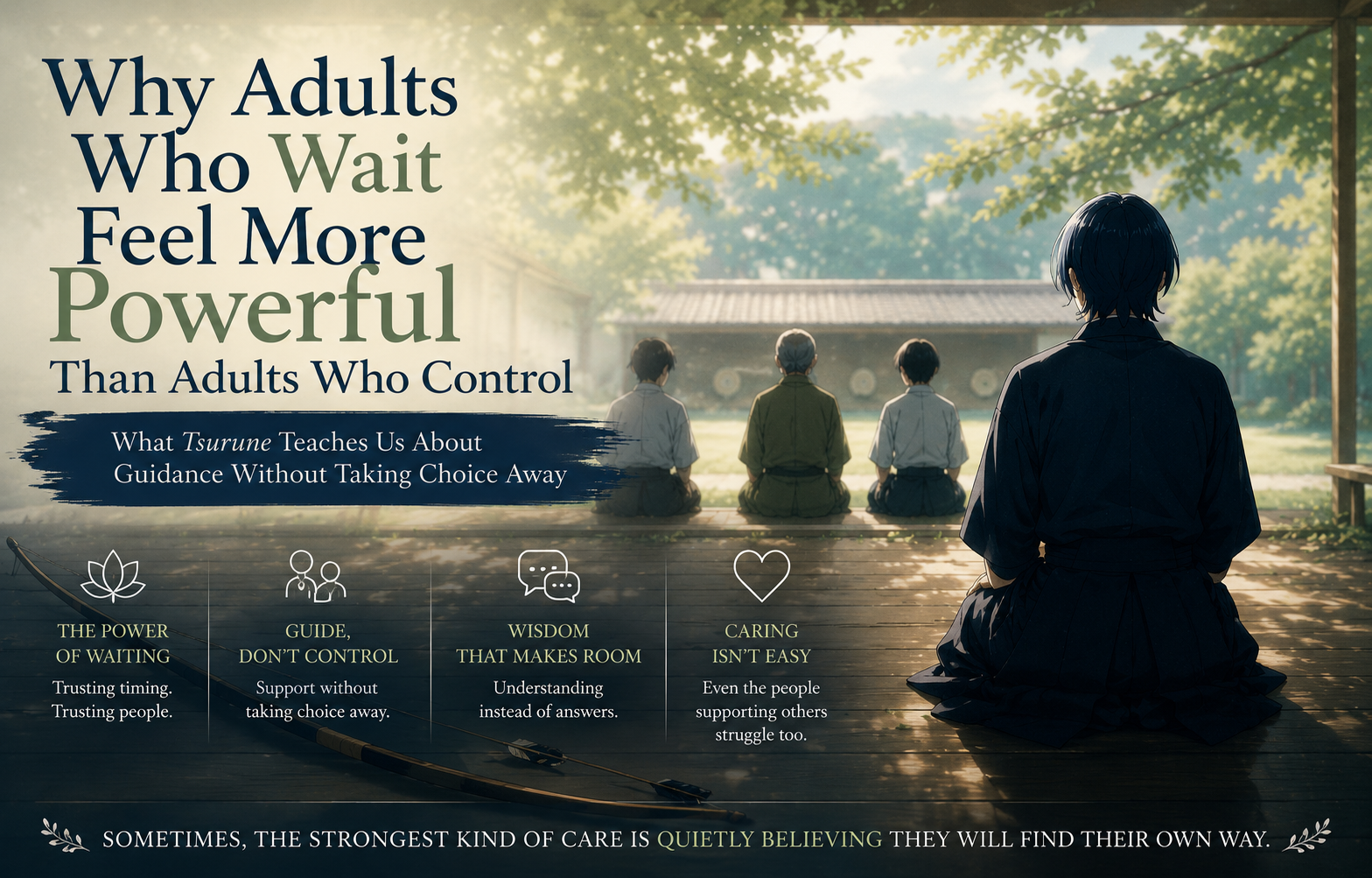
What Tsurune Teaches Us About Guidance Without Taking Choice Away
When we are younger, we tend to admire people who seem to have all the answers.
The teacher who knows exactly what to say.
The mentor who pushes us forward.
The adult who steps in, solves problems, and tells us what to do next.
Stories often teach us to admire strength through action—the coach who demands discipline, the mentor who refuses excuses, the adult who changes someone’s life through sheer determination.
But growing older changes the way we see people.
Sometimes, the adults who stay with us the longest are not the ones who pushed us hardest.
They are the ones who waited.
The ones who trusted us before we trusted ourselves.
The ones who resisted the urge to control our choices and instead quietly stayed nearby while we figured things out.
Watching Tsurune made me think about that kind of person.
Because beneath its beautiful animation and coming-of-age story, Tsurune is quietly asking a much deeper question:
What does it really mean to support someone?
If you are new to the series, you may want to begin with the works article:
✅Tsurune: More Than Archery — A Story About Facing Yourself Through Kyudo
Tsurune Is Not a Story About Being Fixed
At first glance, Tsurune looks like a sports anime.
There is competition.
Training.
Improvement.
Failure.
Growth.
But unlike many sports stories, Tsurune is not built around force.
No one grows because someone aggressively changes them.
No one heals because an authority figure simply tells them what to do.
Instead, people grow because someone quietly creates the space for change to happen.
That difference matters.
Because in real life, people rarely change simply because someone gives them the “right answer.”
Most of us change when we feel safe enough to choose something for ourselves.
And Tsurune understands that deeply.
Masaki Takigawa: The Kind of Adult Who Refuses to Rescue
Masaki Takigawa is perhaps the clearest example of this.
At first, it seems easy to describe him as the mentor who brings Minato back to kyudo.
But that description feels incomplete.
Masaki does not save Minato.
He waits for him.
Minato is not someone who simply lost motivation. He is someone who was hurt by something he once deeply loved.
And people rarely return to painful things because someone pressures them.
They return because something begins to feel safe again.
Masaki seems to understand this intuitively.
He does not push.
He does not lecture.
He does not tell Minato to “move on” or “try harder.”
Instead, he quietly stays nearby, creating the kind of environment where returning becomes possible.
That choice—to guide without controlling—is one of the most emotionally powerful things in Tsurune.
If Masaki stayed with you long after watching, you may enjoy this deeper character essay:
✅ Masaki Takigawa — The Person Who Guided Without Controlling —
Morioka Tomio: Wisdom That Makes Room for Uncertainty
Then there is Morioka Tomio.
If Masaki supports the students, Morioka often supports the people doing the supporting.
And what makes him memorable is not authority.
It is patience.
When Masaki struggles with his complicated feelings toward his grandfather, Morioka does something quietly extraordinary.
He does not solve the emotion.
He does not simplify it.
Instead, he offers a sentence:
“Attachment and admiration… respect and longing are often very similar things.”
What makes this moment powerful is not certainty.
It is possibility.
Morioka never tells Masaki what to feel.
He simply offers language that helps him continue thinking.
That kind of support feels rare.
Especially as adults.
Because life becomes emotionally complicated.
You can admire someone and still feel hurt by them.
You can love something and still struggle with it.
And sometimes, the people who help us most are not those who give us answers—but those who make room for reflection.
If this quiet kind of wisdom speaks to you, you may enjoy:
✅ Tomio Morioka — The Person Who Offered Understanding Instead of Answers —
Even the People Who Support Others Need Someone
What makes Tsurune even more emotionally honest is that it also shows the cost of being supportive.
Seiya Takehaya is one of the clearest examples of this.
He notices everything.
He protects relationships.
He quietly carries emotional responsibility for the people around him.
But care, when left unspoken, can slowly become burden.
And Tsurune does not ignore that.
It understands that the people holding others together are often struggling too.
That emotional honesty makes the series feel unusually compassionate.
Because support is not easy.
Waiting is not easy.
Caring quietly is not easy.
And yet, the story treats those struggles with remarkable gentleness.
✅ Seiya Takehaya — The Person Who Carried Too Much Responsibility —
Why Waiting Feels So Powerful
Waiting sounds passive.
But in reality, it may be one of the hardest things people can do.
When someone we care about is hurting, we want to help immediately.
We want to fix the situation.
Offer advice.
Protect them from pain.
Change things.
But Tsurune suggests something uncomfortable:
Sometimes, helping too quickly can take away the very thing someone needs most—their own choice.
Real growth rarely happens because someone forces it.
It happens when someone feels safe enough to move forward on their own.
That is why the adults in Tsurune feel so memorable.
They trust timing.
They trust emotional pacing.
And perhaps most importantly, they trust people.
Not blindly.
But patiently.
Maybe We Are Crying for Something We Needed
Watching Tsurune, I kept returning to the same thought.
Maybe we are not only crying for the struggling teenagers.
Maybe we are crying for the adults beside them.
The ones who stay.
The ones who wait.
The ones who understand that support is not always loud.
Perhaps part of us wishes we had met someone like that.
Or maybe we are hoping to become someone like that ourselves.
Because sometimes the strongest form of care is not changing someone.
Sometimes, it is quietly believing they will find their own way.
And perhaps that is why Tsurune feels so gentle—even when it hurts.
Related Reading on This Blog
If you enjoyed this essay, you may also like:
→ Tsurune: More Than Archery — A Story About Facing Yourself Through Kyudo
→ Masaki Takigawa — The Person Who Guided Without Controlling —
→ Tomio Morioka — The Person Who Offered Understanding Instead of Answers —
→ Seiya Takehaya — The Person Who Carried Too Much Responsibility —
→ Quiet Men in Manga — Why Restraint Makes Japanese Romance So Powerful
When Silence Is the Point:
→ What Tsurune Understands About Japanese Emotional Expression
I also share the small manga moments that stay with me long after reading—the pauses, glances, and choices that never fully leave.
You can follow those weekly reflections on Substack.
✅ My Substack Here!
This essay is part of a wider comparison: Why Manga Characters Choose to Wait Instead of Rush Love