If you have watched Japanese anime for a while, you may have noticed something.
Characters rarely say what they feel directly.
They hesitate.
They hold back.
They stand beside someone in silence instead of speaking.
And sometimes, just when you expect them to finally say something — they don’t.
For viewers from outside Japan, this can feel frustrating at first.
Why won’t they just say it?
Why does everyone keep waiting?
Why is so much left unspoken?
But Tsurune quietly offers an answer to those questions.
Because in this series, silence is not the absence of feeling.
It is the feeling itself.
If you are new to the series, you may want to start here first:
✅ Tsurune: More Than Archery — A Story About Facing Yourself Through Kyudo
When Not Saying Something Is the Expression
In Japanese culture, emotion does not always travel through words.
There is a concept called ishin denshin — a kind of wordless understanding between people, where feelings are communicated without being spoken aloud.
It is not simply a poetic ideal.
It reflects something real about the way relationships are built and maintained in Japan.
Sometimes, putting a feeling into words changes it.
It makes something fragile feel fixed.
It places weight on something that was still finding its shape.
And so people choose silence instead.
Not because they feel nothing.
But because they feel too much to reduce it to words.
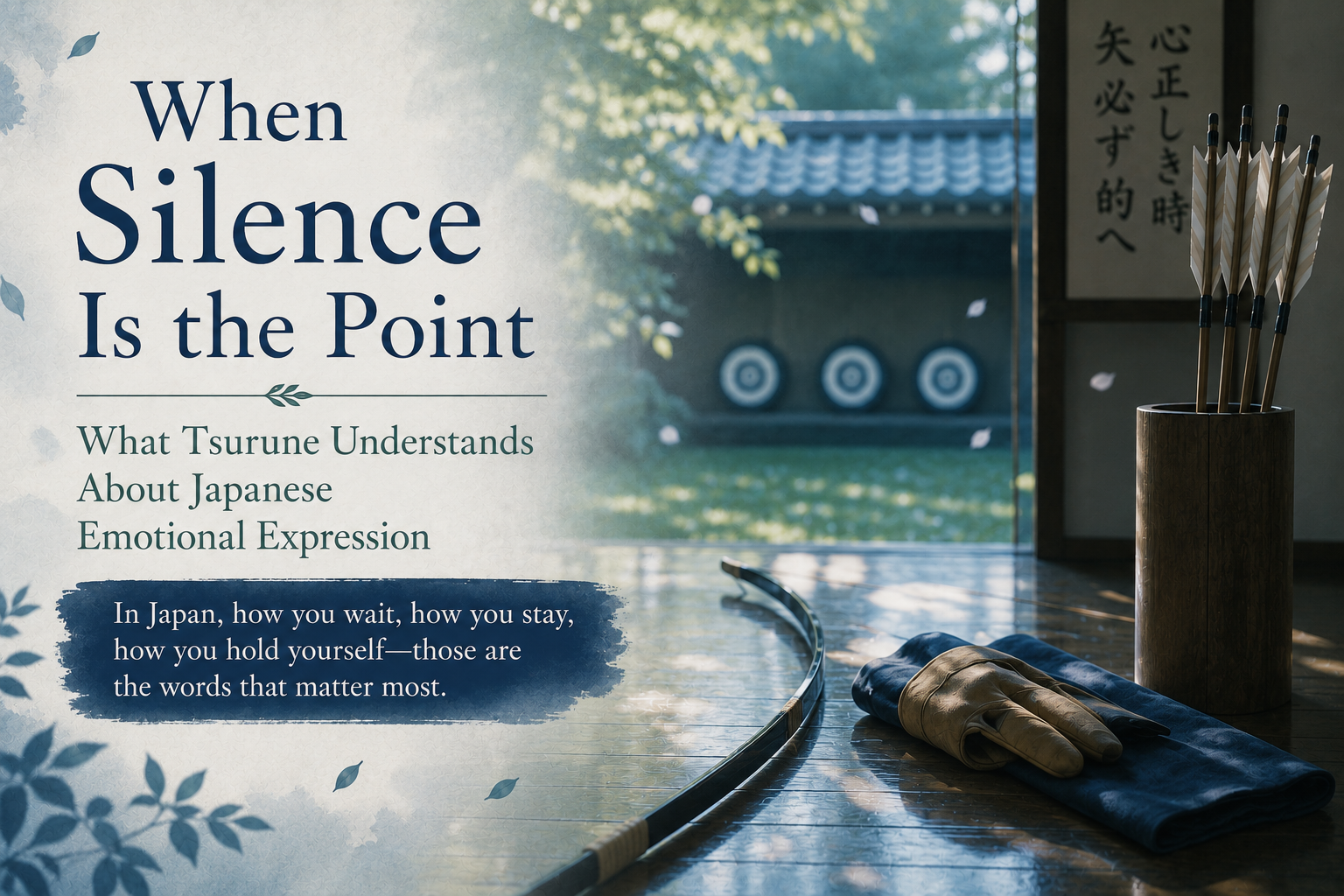
In Japan, how you wait, how you stay, how you hold yourself beside someone — these carry meaning.
Silence, in this context, is not empty.
It is full.
Seiya — What Silence Protects
Seiya Takehaya rarely expresses what he is feeling directly.
His worry for Minato goes unspoken.
The weight he carries quietly goes unspoken.
The loneliness of always being the steady one goes unspoken.
And yet, his presence is felt by everyone around him.
Seiya’s silence is not indifference.
It is almost the opposite.
He does not speak because speaking might place something heavy on Minato — something Minato is not ready to carry.
Holding back becomes a form of respect.
Staying quiet becomes a form of care.
His silence says: I am here, and I trust you to find your own way.
That is not the absence of love.
That is love expressed through restraint.
✅ Seiya Takehaya — The Person Who Carried Too Much Responsibility
Masaki — Waiting as Expression
Masaki Takigawa does not tell Minato to come back to kyudo.
He does not say “you can do this” or “stop being afraid” or “it is time to try again.”
He says very little.
But he stays.
And that staying — that quiet, consistent presence — is its own form of expression.
In Japanese, there is a concept called ma — the pause, the space between things.
It is the silence between notes that gives music its shape.
The pause between words that gives conversation its meaning.
The space between people that defines the nature of their relationship.
Masaki understands ma intuitively.
He knows that filling every silence with words would not help Minato.
It would only crowd the space Minato needs to find his own way back.
So he waits.
And in that waiting, he communicates something words could not:
I believe in you, before you believe in yourself.
✅ Masaki Takigawa — The Person Who Guided Without Controlling
Minato — When the Body Speaks Instead
Minato does not talk about his fear directly.
He does not sit down with someone and explain what hayake feels like from the inside.
He does not describe the guilt he carries from that competition in middle school.
But his body speaks for him.
Hayake is, in a sense, the physical expression of everything Minato could not put into words.
The anxiety that had nowhere else to go.
The fear that had been held silently for too long.
It found its way out through his hands — through the moment of release that came too soon.
And later, when Minato begins to heal, that too appears in the shot before it appears in his words.
The arrow finds the target.
Something has changed — not because he said so, but because his body finally could.
Kyudo, in this way, becomes a language for what cannot be spoken.
And Tsurune uses that language beautifully.
✅ Minato Narumiya from Tsurune: When the Thing You Loved Becomes the Thing You Fear
Why the Words Are Left Out
It would be easy to assume that characters who don’t speak their feelings simply lack the words.
But that is not what is happening in Tsurune.
These characters are deeply aware of what they feel.
They choose not to say it.
Because some feelings, when spoken aloud, become something different from what they were.
A relationship built on quiet understanding can be disrupted by words that arrive too soon.
A person who is still finding their way back does not always need to be told what to do next.
Sometimes, the most compassionate thing is to hold the silence.
To stay present without demanding that the other person explain themselves.
To wait — not passively, but with full attention.
That is what the characters in Tsurune offer each other.
And it is what makes their relationships feel so quietly profound.
Why Silence Reaches Further Than Words
Many people who watch Tsurune find it difficult to explain why it moved them.
Something happened.
Something stayed.
But the feeling resists easy description.
That may be exactly the point.
Tsurune’s emotional power lives outside of language — in the spaces between words, in the stillness before release, in the presence of someone who stayed without being asked.
Those things cannot be fully explained.
They can only be felt.
And perhaps that is what Japanese emotional expression, at its best, understands most deeply:
Some things are not meant to be said.
They are meant to be carried — quietly, carefully — and felt by the people who are paying close enough attention.
Tsurune asks its viewers to pay that kind of attention.
And for those who do, it offers something that words alone never could.
Related Reading:
✅ Tsurune: More Than Archery — A Story About Facing Yourself Through Kyudo
✅ Seiya Takehaya — The Person Who Carried Too Much Responsibility
✅ Masaki Takigawa — The Person Who Guided Without Controlling
✅ Minato Narumiya from Tsurune: When the Thing You Loved Becomes the Thing You Fear
I also share the small manga moments that stay with me long after reading—the pauses, glances, and choices that never fully leave.
You can follow those weekly reflections on Substack.
✅ My Substack Here!
This essay is part of a wider comparison: Why Do Manga Characters Choose Silence Over Confession? (Given, Chihayafuru, and A Sign of Affection Compared)