This article contains spoilers for the Akane-banashi anime.
One phrase kept returning to me as I watched Akane-banashi: master and apprentice.
We all have teachers. We may also have coaches, supervisors, or senior colleagues. But a master in the world of rakugo seems to be something more. A master does not simply teach a skill. The relationship reaches into an artist’s name, conduct, community, and way of life.
Why, then, does an aspiring storyteller choose one master? And what does it really mean to “have” one?
A Master Teaches More Than Rakugo
Becoming a rakugo performer begins with being accepted as an apprentice. Yet a new apprentice does not spend every waking hour rehearsing stories.
According to the Rakugo Arts Association, an apprentice-in-training may carry the master’s bags, help around the house, learn how to handle kimono, study musical accompaniment, and prepare for life backstage. Only after the master gives permission can that apprentice enter the dressing room as a zenza, the first professional rank.
In other words, what is being taught is not merely how to perform a story. It is how to enter a room, how to observe others, how to support a performance, and how to live as a rakugo artist.
Much of that knowledge cannot be reduced to a manual. It must be watched, repeated, corrected, and slowly absorbed beside someone who already embodies it.
Choosing the Person From Whom Your Art Will Begin
A rakugo master is not a teacher whom anyone can simply hire. A hopeful performer may ask to become a disciple and be refused—sometimes repeatedly. The relationship begins only when the student chooses the master and the master, in turn, accepts responsibility for the student.
There is resolve on both sides.
The apprentice admits, “I cannot see everything yet. I want to learn from you.” The master answers, in effect, “I will spend my time, judgment, and name on helping you grow.”
That is why changing masters cannot feel like switching classes. The Rakugo Arts Association describes the bond as a lifelong one and advises aspiring performers to choose carefully.
This helps explain why Akane’s father cannot simply find another master after his expulsion. From the outside, another path seems possible: enter a different school and continue performing. But for him, rakugo is no longer separable from the person and lineage through which he learned it. His master has become part of his identity as an artist.
That choice is painful, and the story does not ask us to pretend otherwise. Still, it reveals the extraordinary weight carried by the words, “My master.”
What a Disciple Borrows Is a Way of Seeing
A master does not only hand down answers. Perhaps the more important gift is a way of looking at the art.
Two performers can memorize the same story, but accuracy alone will not make an audience see an invisible room or feel the presence of several characters. A storyteller must ask: Why does this pause belong here? What emotion hides beneath this line? Where is the audience looking now? What have they begun to imagine?
Those questions are difficult to learn from written instructions. The apprentice watches the master, listens to criticism, fails, tries again, and gradually discovers details that once remained invisible.
To have a master may mean borrowing another person’s eyes until you can finally see for yourself.
Trust Is Not the Same as Surrendering Your Judgment
Respecting a master does not—or should not—mean abandoning thought.
This distinction matters because the relationship contains a clear imbalance of power. A master who accepts an apprentice also accepts responsibility for a young artist’s development. Tradition cannot excuse cruelty, thoughtless obedience, or the misuse of authority.
The apprentice, meanwhile, must do more than repeat whatever is said. A lesson becomes meaningful only when it is considered, tested, and transformed into one’s own art.
Akane is remarkably good at this. She listens carefully to Shiguma and to her senior fellow disciples, but she is never an empty vessel. She asks what their words reveal about her performance, why she needed to hear them, and how she can carry the lesson onto the next stage.
Her strength lies in holding two qualities at once: the openness to receive another person’s wisdom and the independence to think it through for herself.
Is This Bond Uniquely Japanese?
The intensity of the master–apprentice relationship in Akane-banashi can feel distinctly Japanese. Yet apprenticeship itself is not unique to Japan. Craftspeople, musicians, actors, and artists across cultures have long learned through close relationships with experienced practitioners.
What may feel especially pronounced in Japanese traditional arts is the breadth of what the relationship contains. Technique can be intertwined with a professional name, a school or lineage, etiquette, daily conduct, and a public sense of belonging.
An overview of traditional performing-arts education published by the Government of Japan explains that artistic knowledge was historically passed directly from parent to child or from master to apprentice. Modern successor-training programs teach not only performance but also manners, kimono, music, and the history surrounding the art.
What passes from one generation to the next, then, is not a single technique. It is an entire world in which that technique has meaning.
The Goal Is Not to Become a Copy of the Master
Having a master does not mean becoming the same person.
An apprentice may learn established stories and inherited forms, but eventually those stories must be told in the apprentice’s own voice. Tradition survives not because each generation produces a perfect copy, but because what has been received is reinterpreted through another life.
In an interview about inheriting a prestigious stage name, rakugo performer Sanyutei Kinba V recalled being told, “Make it your own Kinba.” The remark, recorded by the Japan Arts Council, captures something essential: inheriting a name or an art is not the end of individuality. It is the beginning of a new responsibility.
The disciple receives, changes, and eventually passes something onward.
What It Means to Have a Master
Akane-banashi helped me understand why the phrase “to have a master” carries such weight.
It does not mean giving up the right to think and placing one’s life under unquestioned command.
It means borrowing another person’s eyes, time, and sense of responsibility until you can perceive what you could not see alone. It means receiving not only technique but an attitude toward the art—and then having the courage to transform it into an expression that is genuinely your own.
Akane learns from her master and her senior fellow disciples, yet the rakugo growing inside her unmistakably belongs to Akane. The relationships around her do not make her smaller. They give her the foundation from which she can stand on her own.
Perhaps that is the deepest meaning of having a master: choosing the person from whom your long journey toward independence will begin.
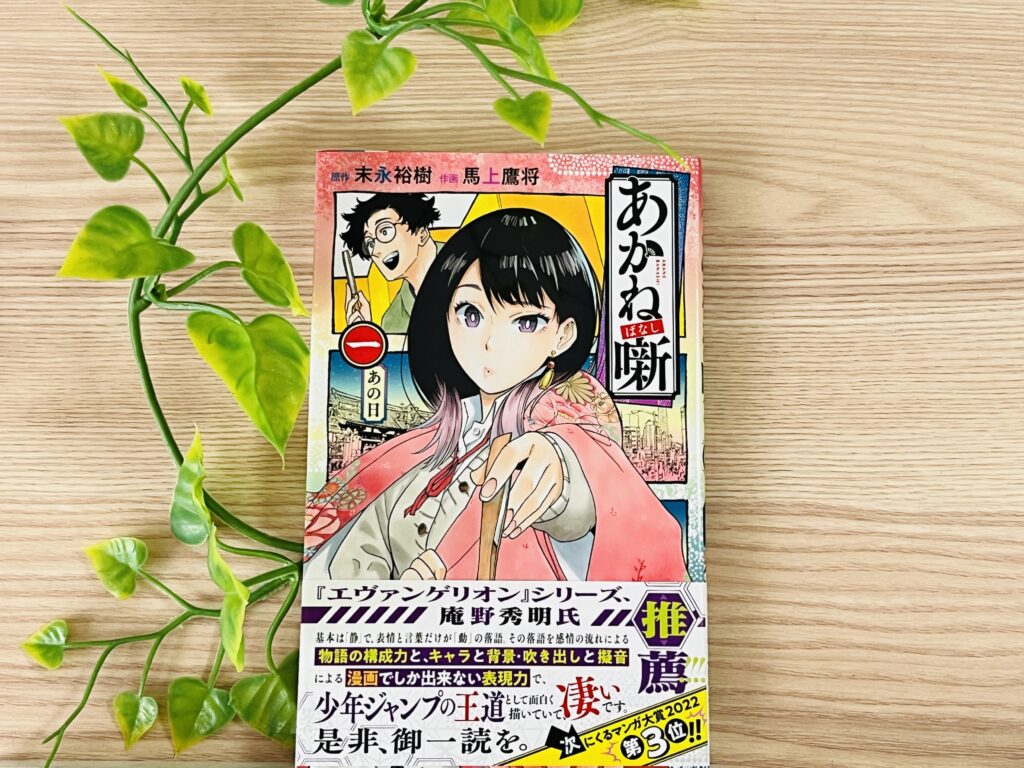
✅ Curious about this one? Check it out here! →Akane-banashi, Vol. 1
New to the series? Visit the Akane-banashi guide for more essays about rakugo, artistic inheritance, and Akane’s growth.