
Spoiler note: This essay discusses major developments in Akane-banashi, including the events surrounding Akane’s father and Arakawa Issho.
The man in front of you ended your father’s dream. Could you really listen to what he had to say?
I doubt I could. Anger would probably reach me before his words did. Yet Akane does something far more difficult: she listens to Arakawa Issho, the man she has every reason to see as her father’s enemy, and carries his words home with her.
That does not mean she loves her father any less. It means that her love for him is strong enough to grow beyond simple revenge. In Akane-banashi, Akane’s gift is not only the power to hold an audience with her voice. It is also the courage to hear something that may change her.
Akane Begins With Love—and Anger
For Akane, rakugo was never just a performing art. It was the glow she saw in her father when he stepped onto the stage, and the memory of watching that light disappear after his expulsion.
Her journey begins with questions she cannot let go. Was her father’s rakugo truly unworthy? Why was a man who had worked so hard denied the future he had devoted himself to? Akane enters the rakugo world because she wants to find the answer for herself.
That makes Issho more than a powerful master in her eyes. He is the man who shattered her father’s dream. Akane’s anger is real—but she refuses to let it become the end of her thinking.
Loving Her Father Without Idealizing Him
It is difficult for any child to look at a beloved parent objectively. When that parent has been hurt, even considering the other side can feel like betrayal.
But as Akane grows, she begins to separate two things: the father she loves and the rakugo performer he was. Her affection does not change. His rakugo remains the beginning of everything for her. Yet if she wants to become an artist in her own right, she cannot simply preserve an idealized version of him.
Akane is not trying to prove that her father was always right. She is trying to understand what happened—and to carry the love of rakugo he gave her into a future of her own.
Listening Is Not the Same as Agreeing
What moved me most is that Akane never confuses listening with surrender.
Hearing Issho out does not erase the pain of her father’s expulsion. It does not mean she approves of everything he did, or that she has suddenly forgiven him. She simply recognizes that his words may contain something she needs to understand—as a daughter and as a rakugoka.
To listen is not to lose. To understand another person’s reasoning is not to abandon your own feelings. Akane takes in what she hears, examines it, and decides for herself what it means. Her openness is not passivity. It is strength with a mind of its own.
She Refuses to Keep Issho a Simple Villain
The story would be easier if Akane could reduce Issho to one role: the cruel man who ruined her father’s life. But once she listens, she begins to see that he, too, believes he is protecting something within rakugo.
Understanding that does not require her to accept every judgment he made. It simply prevents her from deciding that one painful act is the whole of who he is.
This is one of Akane’s finest qualities. Even when a truth is uncomfortable, she does not close her ears if it might bring her closer to the heart of rakugo. She can try to understand another person without handing that person control over her convictions.
Her Desire to Understand Rakugo Is Stronger Than Her Anger
Akane’s composure is not merely a sign that she is mature for her age. I think it reveals just how completely rakugo fills her mind.
The question “Can I forgive this man?” is slowly overtaken by larger questions. What was missing from her father’s performance? What does it truly mean to become a shin’uchi? What kind of rakugoka does Akane herself want to be?
She could reject Issho in anger, but doing so would take her farther from the answers she wants. Akane is not calm because she feels nothing. She feels the hurt and still chooses to learn. That is why her single-mindedness feels powerful rather than naïve.
Akane Changes What Her Anger Is For
At first, anger is the force that pushes Akane onto the rakugo path. But anger alone cannot sustain an artist forever.
Through her senior disciples, rival performers, and the audiences she faces, her purpose begins to change. She no longer wants only to prove her father right. She wants to discover a rakugo that belongs to her.
The energy that once pointed backward gradually turns toward the future. Akane does not discard her anger. She gives it a new purpose: growth.
Understanding Is Not Forgiveness
I would hesitate to describe this moment by saying that Akane “forgives” Issho. What she does is more careful—and perhaps more difficult.
She listens, considers what his words mean, and takes them away with her. She can recognize what rings true while leaving room for what still hurts. Understanding does not make another person’s actions right, and forgiveness does not require pretending that the wound never existed.
Akane keeps her love for her father intact while allowing herself to see beyond it. That emotional flexibility is part of what makes her growth so compelling.
From Her Father’s Rakugo to Her Own
Akane’s story begins with her father’s unfinished dream. The deeper she travels into rakugo, however, the more that journey becomes her own.
She loves the rakugo her father showed her, but she does not simply imitate it. She listens with her own ears, thinks with her own mind, and chooses her own answer—even when the lesson comes from the person who hurt her family most.
Akane-banashi is fascinating not only because it shows us the power of a storyteller’s voice. Through Akane, it also shows us the strength required to listen.
She can carry anger without letting it close her ears. She can love her father without being trapped inside his story. And she can take even painful words and turn them into a step toward the artist she wants to become.
That, to me, is Akane’s quietest—and perhaps greatest—strength.
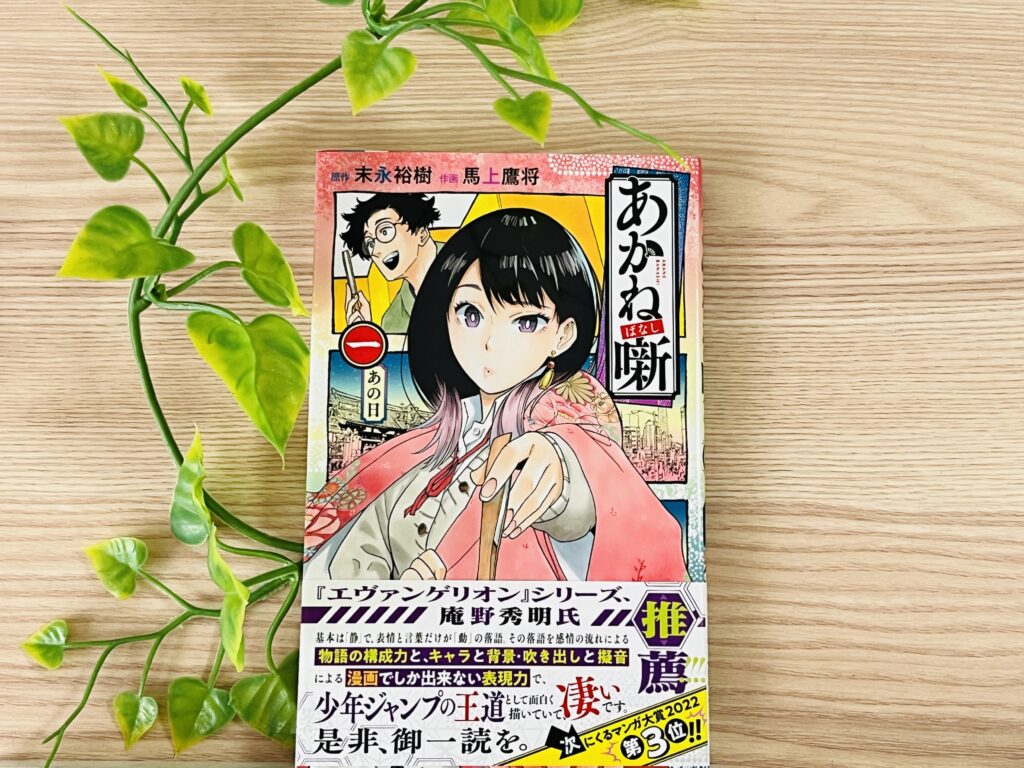
✅ Curious about this one? Check it out here! →Akane-banashi, Vol. 1
New to the series? Start with the Akane-banashi guide. You can also read why Akane’s father never chose another master to explore the bond between master and disciple.