If you watched Tsurune and found yourself wondering what hayake actually is — you are not alone.
For viewers unfamiliar with kyudo, the concept can feel difficult to grasp at first.
But understanding hayake is one of the most important keys to understanding Tsurune.
Because hayake is not simply a technical problem.
It is what happens when the mind and body stop working together — when fear quietly takes over the thing a person loves most.
If you are new to the series, you may want to start here first:
✅ Tsurune: More Than Archery — A Story About Facing Yourself Through Kyudo
What Hayake Actually Is
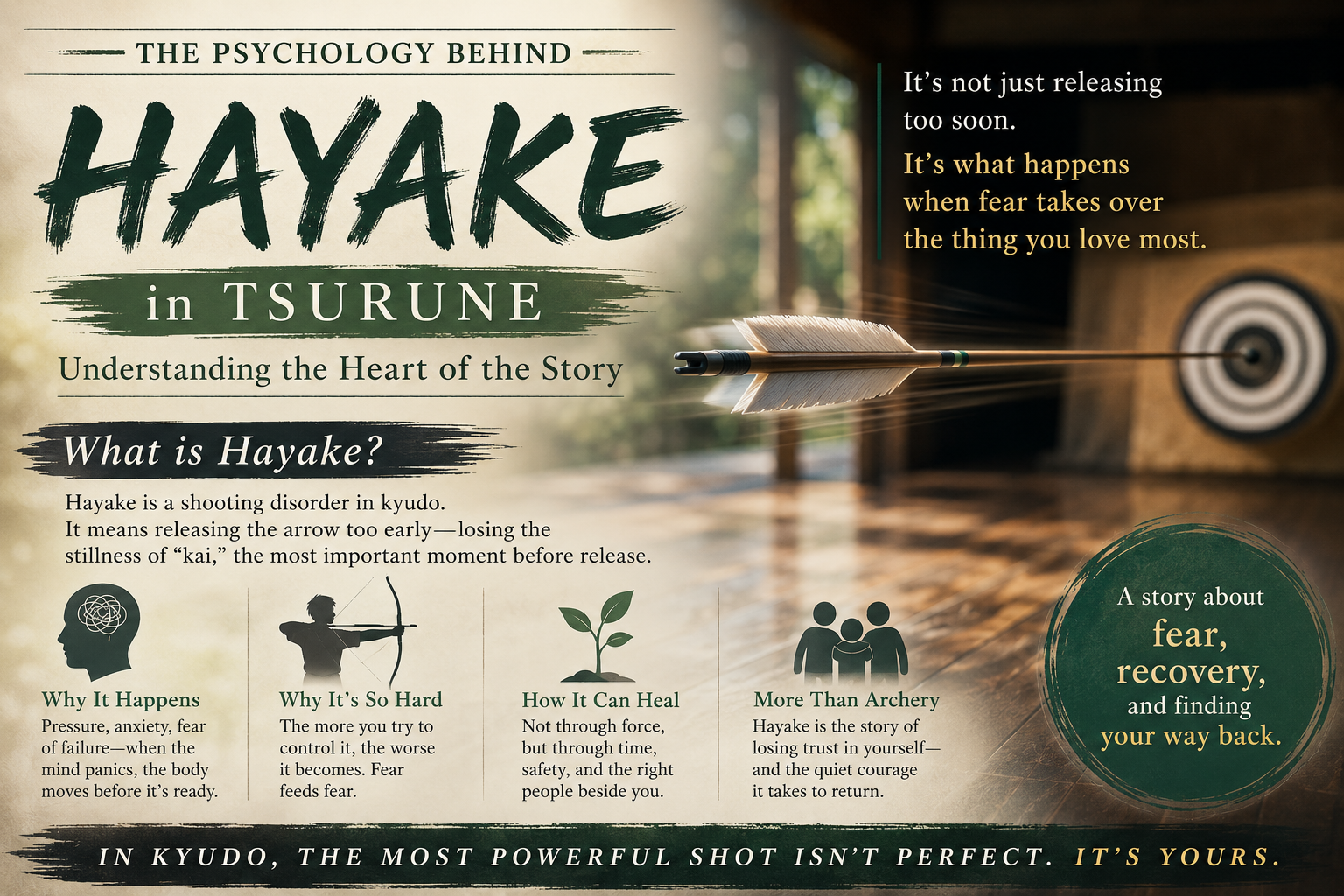
In kyudo — Japanese archery — hayake refers to a specific shooting disorder.
It describes the inability to hold the “kai” — the moment of full draw and stillness before release — and releasing the arrow too early as a result.
In kyudo, kai is everything.
It is the pause where the archer settles, breathes, and finds stillness before letting go.
Without it, accuracy becomes nearly impossible.
But hayake is not simply about releasing too soon.
It is about losing control over something that should feel natural.
The archer knows they should wait.
They want to wait.
And yet the body moves before they are ready.
That gap — between what the mind intends and what the body does — is what makes hayake so deeply unsettling.
Why It Happens
Hayake is rarely caused by technical failure alone.
In most cases, psychological pressure plays a significant role.
Important competitions.
The weight of other people watching.
The fear of making a mistake.
When that pressure accumulates, the body begins to look for an escape.
It wants to finish the moment before something goes wrong.
And so it releases — too early, before stillness has been found.
Overseas, a similar phenomenon is sometimes called the yips.
It appears in golf, baseball, and other precision sports — a psychological condition where anxiety disrupts physical movement that once felt automatic.
Hayake can be understood as the kyudo equivalent.
And what makes it particularly difficult is this:
the more a person tries to resist it, the worse it often becomes.
The thought — “I have to hold this time” — creates tension.
That tension makes stillness harder to find.
And the cycle continues.
That is what makes hayake so much more than a technical problem.
It is a loop that lives inside the mind.
Why It Was So Painful for Minato
Hayake affects many people who practice kyudo seriously.
But for Minato Narumiya, the circumstances made it especially devastating.
It did not happen quietly, in a practice session alone.
It happened during a competition.
At a moment that mattered.
In front of teammates who were counting on him.
That is the detail that changed everything.
Because a technical mistake can be corrected with practice.
But the guilt of feeling like your failure became someone else’s burden — that does not disappear so easily.
Minato carried that guilt long after the competition ended.
And it changed his relationship with kyudo entirely.
Not because he stopped loving it.
But because the place he loved had become associated with one of the most painful moments of his life.
For a deeper look at what that experience cost him:
✅ Minato Narumiya from Tsurune: When the Thing You Loved Becomes the Thing You Fear
Why Hayake Is So Difficult to Overcome
One of the reasons hayake is so hard to recover from is the nature of kyudo itself.
Kyudo is a discipline of stillness.
Of silence.
Of emptying the mind and existing fully in the present moment.
But when hayake takes hold, that stillness becomes frightening.
Because inside the quiet, there is now a voice.
“What if it happens again?”
That anxiety makes holding kai harder.
Which makes the fear stronger.
Which makes the next attempt even more difficult.
Fear feeds fear.
And the harder a person tries to think their way out of it, the deeper the loop becomes.
This is why hayake cannot simply be solved through effort alone.
It requires something more — time, safety, and the slow rebuilding of trust between the mind and body.
How Tsurune Chose to Tell This Story
Most sports anime treat obstacles as walls to be broken through.
Train harder.
Push further.
Overcome.
Win.
Tsurune takes a completely different approach.
Rather than presenting hayake as a challenge to be conquered, the series treats it as a wound — something that requires patience, care, and the right kind of support to heal.
Minato does not overcome hayake in a single dramatic moment.
It returns.
It reappears at difficult times.
Recovery is not a straight line.
And Tsurune never pretends otherwise.
That honesty is one of the series’ greatest strengths.
Because real psychological struggles rarely resolve neatly.
They take time.
They require an environment where it feels safe to try again.
And they often require someone nearby who understands — without pushing.
✅ Masaki Takigawa — The Person Who Guided Without Controlling
Hayake Is About More Than Archery
Once you understand what hayake is, Minato’s story becomes much clearer.
But something else becomes clear too.
The fear that hayake represents is not unique to kyudo.
Many people know what it feels like when something they once loved becomes difficult to approach.
A sport.
A creative pursuit.
A performance.
Something that once felt natural — until one painful moment changed everything.
The experience of wanting to return to something, but not knowing how to feel safe inside it again.
That is what hayake makes visible.
And perhaps that is why Tsurune resonates with so many people who have never touched a bow in their lives.
Because at its core, this story is not really about archery.
It is about what happens when fear quietly takes the place of something you love.
And what it takes — slowly, honestly, with the right people beside you — to find your way back.
Related Reading:
✅ Tsurune: More Than Archery — A Story About Facing Yourself Through Kyudo
✅ Minato Narumiya from Tsurune: When the Thing You Loved Becomes the Thing You Fear
✅ Masaki Takigawa — The Person Who Guided Without Controlling
I also share the small manga moments that stay with me long after reading—the pauses, glances, and choices that never fully leave.
You can follow those weekly reflections on Substack.
✅ My Substack Here!