A closer look at the character who anchors Kimi to Wonderland — and the one scene that explains everything about him.
Spoiler warning: this piece discusses key character development, though it stops short of the ending.
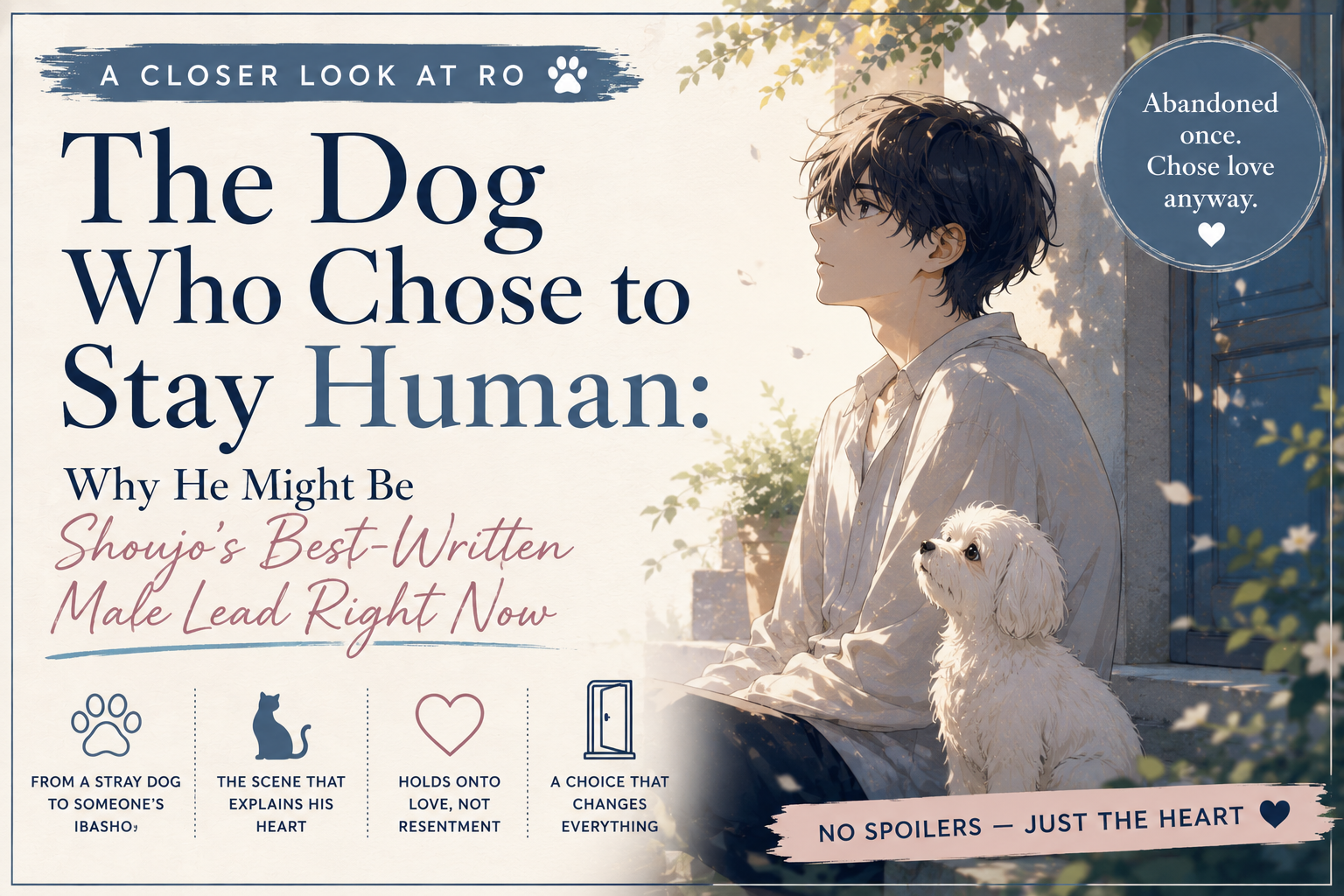
In my last piece on Kimi to Wonderland, I used one scene as the emotional center of the whole article: Ro, talking to an abandoned cat. If that scene is the reason you’re still thinking about this manga, this one’s for you. I want to spend some real time with Ro — not just that scene, but the character underneath it, and why I think he might be one of the best-written male leads in shoujo manga right now.
✅Haven’t read Kimi to Wonderland yet? Here’s the spoiler-free overview to get you up to speed first.
Who Ro Actually Is
Ro used to be a wild dog. At one point he was taken in and given a name — Kuro — before eventually being abandoned.
Later, when Nobara gets hit by a car, Ro is caught up in the same accident and somehow gains the ability to turn human. He spends the story moving between two forms: a small, fluffy dog, and a strikingly good-looking young man. On the surface, his arrangement with Nobara is purely transactional — she wants her hearing back, he wants to return to being a dog. That’s supposed to be the whole deal.
But underneath his stated goal of “going back to normal” is something he never says out loud: the pain of being abandoned, a long stretch of time spent completely alone, and the fact that he has never once, in his entire existence, felt like he was allowed to simply be somewhere.
The Cat Scene, Revisited
I touched on this scene in the last article, but it deserves a slower look.
Ro finds a stray cat grieving over being abandoned by its owner. He doesn’t try to fix the cat’s sadness or talk it out of feeling that way. Instead, he tells it something close to this: being abandoned hurt, and it was lonely — but sitting with why it hurt so much led him somewhere unexpected. He realized he was only that sad because he’d genuinely loved his owner. The love and the pain were sitting inside him in equal, matching amounts. So rather than let the pain win, he decided the love was the part worth keeping.
It plays like comfort offered to the cat. It’s really the moment Ro says out loud a conclusion he’d already reached about his own life. This isn’t just a touching aside — it’s the clearest possible statement of who Ro is as a character: someone who has every reason to close himself off, and chooses not to.
Why This Scene Is a Setup, Not Just a Moment
Later in the story, Ro is faced with a major decision — I won’t get into what it is here. But it’s worth saying plainly: that line to the cat, “I want to hold onto the part of me that loved,” isn’t just a beautiful standalone moment. It’s the emotional groundwork for whatever he chooses later.
In other words, this scene isn’t decoration. It’s the story quietly telling you, in advance, exactly how Ro thinks and what he values — so that whatever comes next makes complete emotional sense in hindsight.
A Rare Kind of Male Lead
Shoujo and shonen manga are full of characters who used to be animals, and full of characters carrying old wounds. Neither trope is new.
What makes Ro stand out is what he does with the wound. In a lot of stories, being abandoned or betrayed hardens a character — it becomes the reason they don’t trust anyone, the source of a grudge the plot spends volumes resolving. Ro goes the opposite direction. Because he knows what abandonment feels like, he’s able to sit with Nobara’s loneliness, and with a stray cat’s grief, in a way almost no one else in the story can.
He holds onto love anyway. Not because he’s strong enough that it doesn’t cost him anything — he’s clearly still hurting — but because he decided, deliberately, that the hurt wasn’t going to be allowed to cancel out the love. That’s a genuinely rare character arc for a male lead to be given.
Why That Final Tear Stays With You
Near the end of the story, there’s a moment where Ro’s eyes well up. I’m not going to spoil what leads there, but the meaning of that single tear is something I haven’t stopped thinking about since finishing the series.
Was it grief for the self he was letting go of? Relief at getting to stay near Nobara? Or something quieter — the first time Kuro, the dog who’d once been thrown away, got to exist as Ro and feel like that was allowed?
I think it’s probably all three at once.
Closing Thoughts
Ro isn’t just “the dog who can turn into a good-looking guy.” That description undersells him completely.
He knows exactly what it feels like to be discarded, and he chooses love over resentment anyway. He carries real vulnerability the entire story and never once uses it as an excuse to stop caring about people. And whatever he ultimately chooses, he chooses it — not because circumstances forced his hand, but because it was his decision to make.
Something that was once thrown away, deciding for itself who to love and where it belongs — that’s the core of who Ro is.
In the last piece, I wrote about ibasho — that quiet, hard-to-translate sense of having a place you’re allowed to exist. I think Ro doesn’t just search for that feeling over the course of the story. By the end, he’s become it, for someone else.
And Ro only gets to become someone’s ibasho because of Nobara — because of how far she has to travel from the person who shut everyone out to the person who lets him in. I’ve written about her journey in a separate piece, which is worth reading alongside this one.
Related Reading
✅ Ibasho: The Untranslatable Japanese Word for Belonging — And the Manga That Captures It
✅ She Chose Silence for Years — Then Asked If She Could Hug Him: Nobara’s Quiet Rebellion
If this idea stayed with you, I share weekly manga moments, emotional reflections, and the quiet scenes I can’t stop thinking about on Substack.