Spoiler note: This essay discusses ideas and scenes from the Akane-banashi anime.
Akane-banashi changed the way I saw rakugo. One performer sits on a cushion. There is no scenery, no costume change, and almost no props. Yet once the story begins, several characters appear. A house, a street, or a boat seems to form around them. Before the audience notices what has happened, they are already inside the tale.
But the stage is still nearly empty.
How does a rakugoka make an invisible world feel real? The answer lies not in one trick, but in the way voice, gaze, gesture, timing, and the audience’s own imagination work together.
Because the Stage Shows Almost Nothing, It Can Become Anything
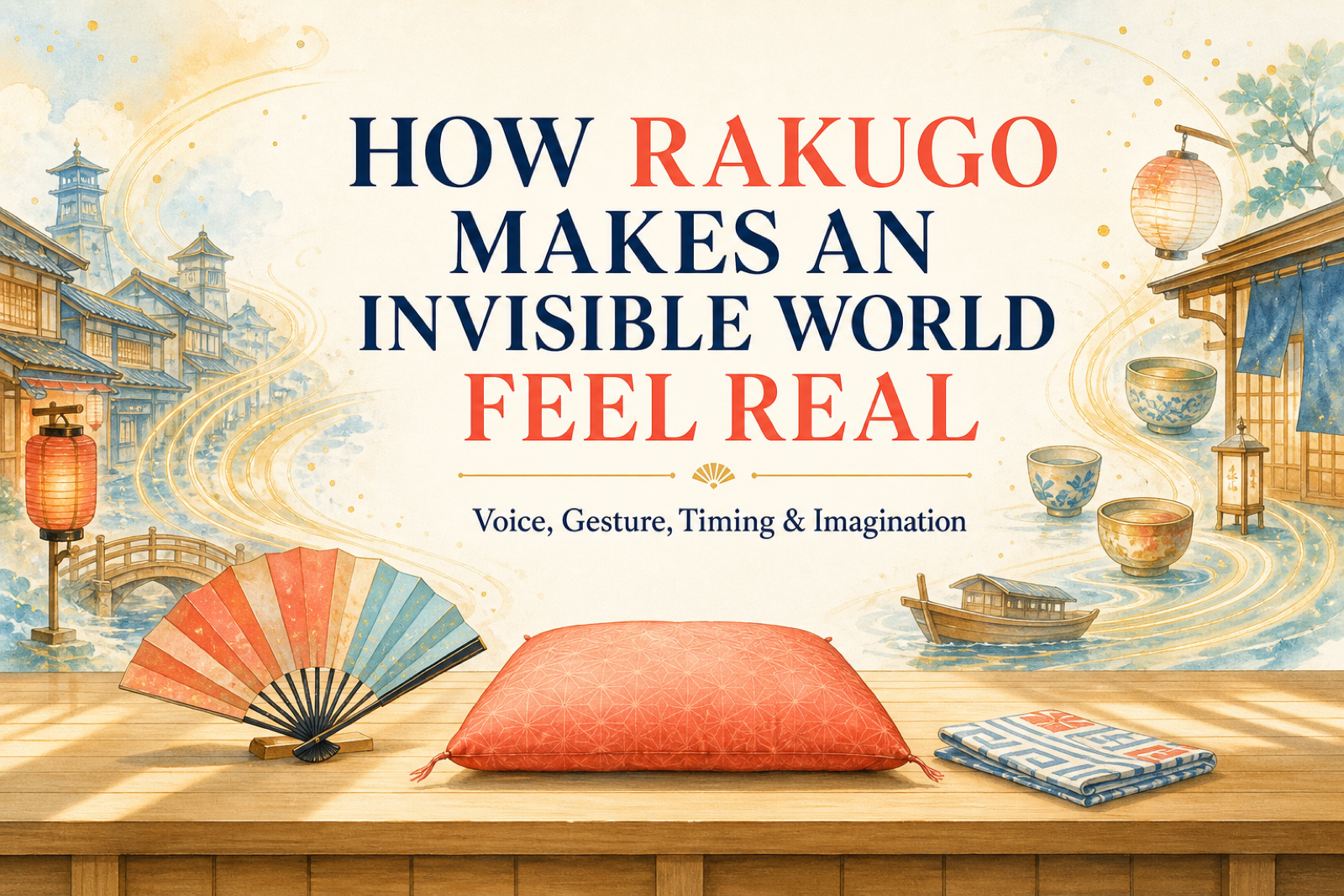
A rakugo stage offers very little to look at: a cushion, a folding fan, a tenugui hand towel, and the performer. Compared with film, anime, or theater, that sounds like a severe limitation.
Yet the absence of fixed scenery is also a kind of freedom. The same small stage can become a tenement, a restaurant, a riverboat, an Edo street, or the private space inside a character’s mind.
The performer does not present a completed picture. The audience receives words and gestures, then fills the open space with memory and experience. The Rakugo Arts Association explains that listeners expand their imagination and draw the scene inside their minds.
Emptiness is not something rakugo fails to overcome. It is the space in which the audience enters.
A Turn of the Head Creates Two People
A single rakugoka may play every character in a story. Clothing does not change when one person becomes another. Instead, voice, posture, expression, and especially the direction of the face tell us who is speaking.
The performer turns one way to speak, then the other way to answer. That small movement creates the impression of two people facing each other. Japan’s Cultural Digital Library identifies this use of stage-left and stage-right as a basic method of distinguishing characters.
Gaze gives the invisible partner a location. Looking upward can suggest someone taller or standing; looking down can place a child or seated person in the scene. When the performer treats an empty point in space as though someone truly occupies it, the audience begins to see that person too.
The Voice Lets Us See a Character’s Body
Voice does more than separate one role from another. Speed, breath, vocabulary, rhythm, and the shape of a sentence can reveal age, temperament, status, and emotion.
A rapid reply may feel nervous or impulsive. A carefully measured one can suggest caution or authority. When a boastful character’s voice wavers for an instant, we hear the fear beneath the words.
This is why the same story can feel completely different in another performer’s hands. The plot may remain unchanged, but the rakugoka’s understanding of each character alters the warmth, humor, and pain carried by every line.
Rakugo is not simply the accurate delivery of a script. It passes the performer’s interpretation of the story to the audience through the voice.
A Fan and a Towel Become an Entire Prop Room
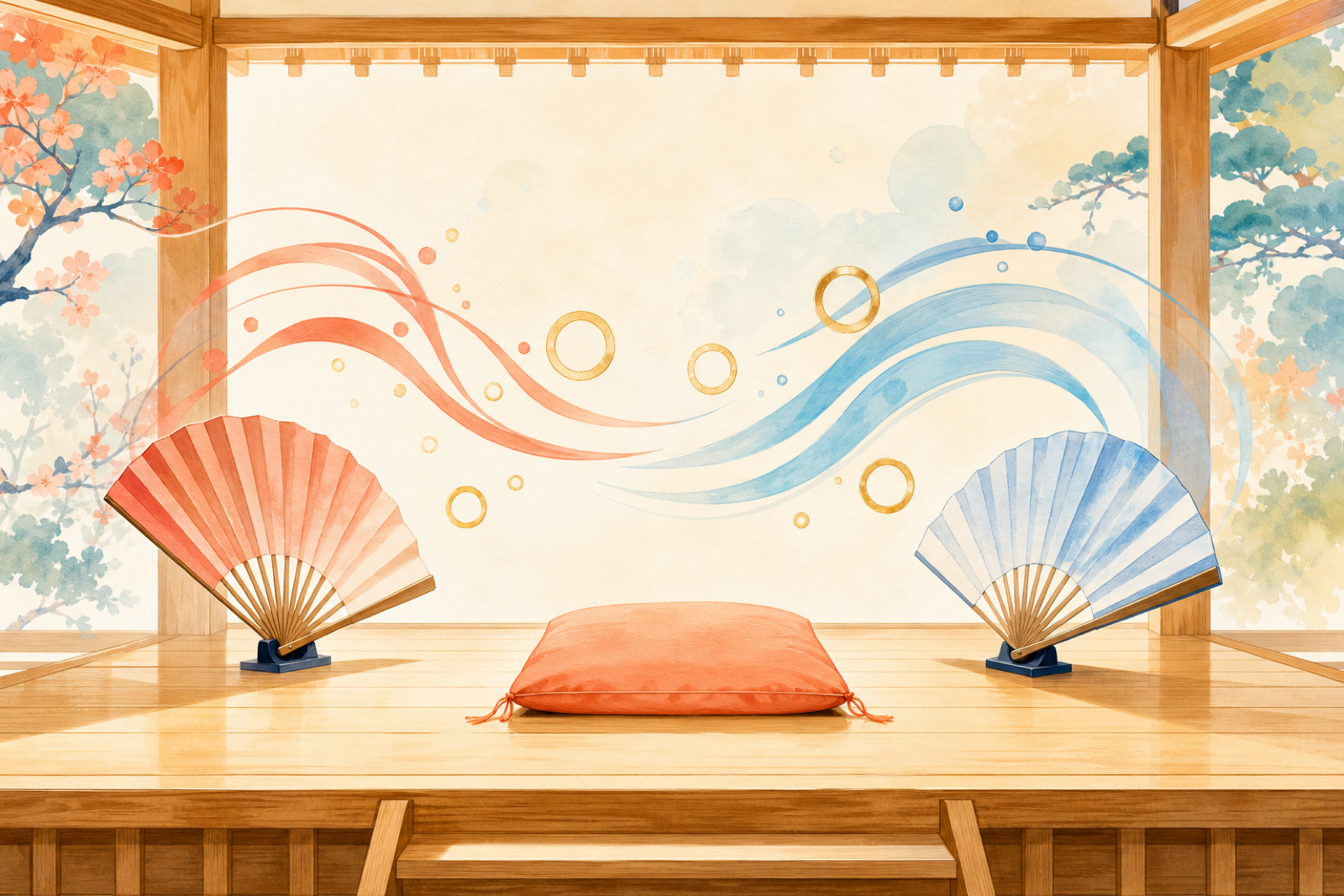
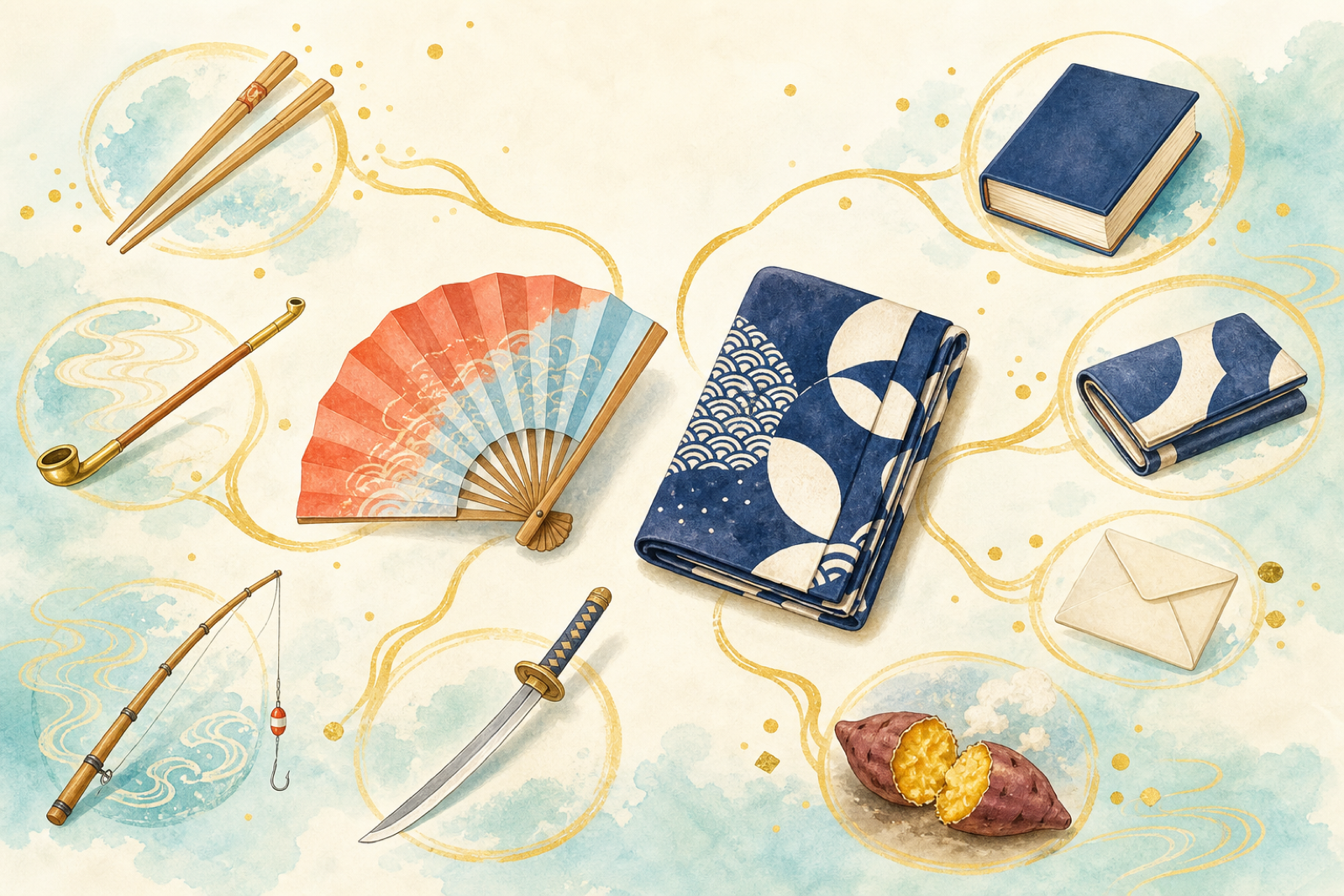
Rakugo’s best-known props are the folding fan and tenugui. A fan may become chopsticks, a kiseru pipe, a fishing rod, or a sword. A tenugui may become a book, letter, wallet, or even a roasted sweet potato.
The fan never literally turns into chopsticks. The transformation happens through the performer’s gaze and movement: how the invisible food is lifted, how its heat or weight affects the hand, and how the character reacts after tasting it.
The audience knows it is still a fan and sees the imagined chopsticks at the same time. That double vision is part of the pleasure. We are not fooled; we willingly complete the illusion.
Ma: The Silence That Moves the Story
A rakugoka guides the audience not only with words, but with ma—the meaningful interval between them.
When a character hears something surprising and does not answer immediately, the silence allows us to feel the shock. A pause before the punchline gives the audience time to understand the situation and become ready to laugh.
If the pause is too short, the meaning may not arrive. If it lasts too long, the tension can fade. And the ideal length is not fixed: it changes with the listeners in the room.
Silence is not empty time. It is where the audience imagines, responds, and catches up with the storyteller.
Is the Audience Being Controlled?
Watching rakugo can feel as though the performer has the audience under complete control. A glance makes someone appear. A change in voice replaces that person with another. A pause draws the whole room forward, and laughter breaks exactly where the storyteller has led it.
The rakugoka certainly guides attention and emotion with extraordinary precision. But the audience is not merely passive.
The performer offers fragments: a word, a gaze, a gesture, a fan. The listeners create faces, streets, food, and weather from those fragments. Even when everyone hears the same story, the world pictured inside each mind will be slightly different.
The storyteller builds the entrance and points out the path. The audience supplies the world around it. Rakugo is less an act of control than a collaboration disguised as a monologue.
Akane-banashi Shows Why a Storyteller Must Also Listen
Akane has a natural ability to attract attention, but passion alone does not guarantee that a performance will reach its audience. The rakugo she wants to give and the rakugo a particular room can receive are not always the same.
Who is listening today? Where does the room relax? Where do people laugh, hesitate, or fall behind? As Akane gains experience, she learns not only to express what is inside her, but to notice what comes back from the audience.
This connects rakugo to the strength explored in my essay on Akane’s ability to listen. A storyteller speaks, but she also listens—to laughter, silence, uncertainty, and the changing energy of the room.
A great rakugoka does not simply impose a private vision. She keeps her own artistic center while making space for the people in front of her to enter.
The True Stage Exists Inside the Listener
Rakugo presents remarkably little: voice, expression, gaze, movement, a fan, a towel, and the silence between words.
Yet inside the listener, people stand up, meals appear, streets unfold, and the sounds of another world begin to rise.
The performer does not complete that world alone. By refusing to show everything, the rakugoka trusts the audience with part of the creation.
Akane-banashi helped me understand that rakugo is not merely the art of telling an entertaining story. It is the art of reaching into another person’s imagination—and receiving an answer from it.
Only one performer sits onstage. But the story is never made by one person alone.
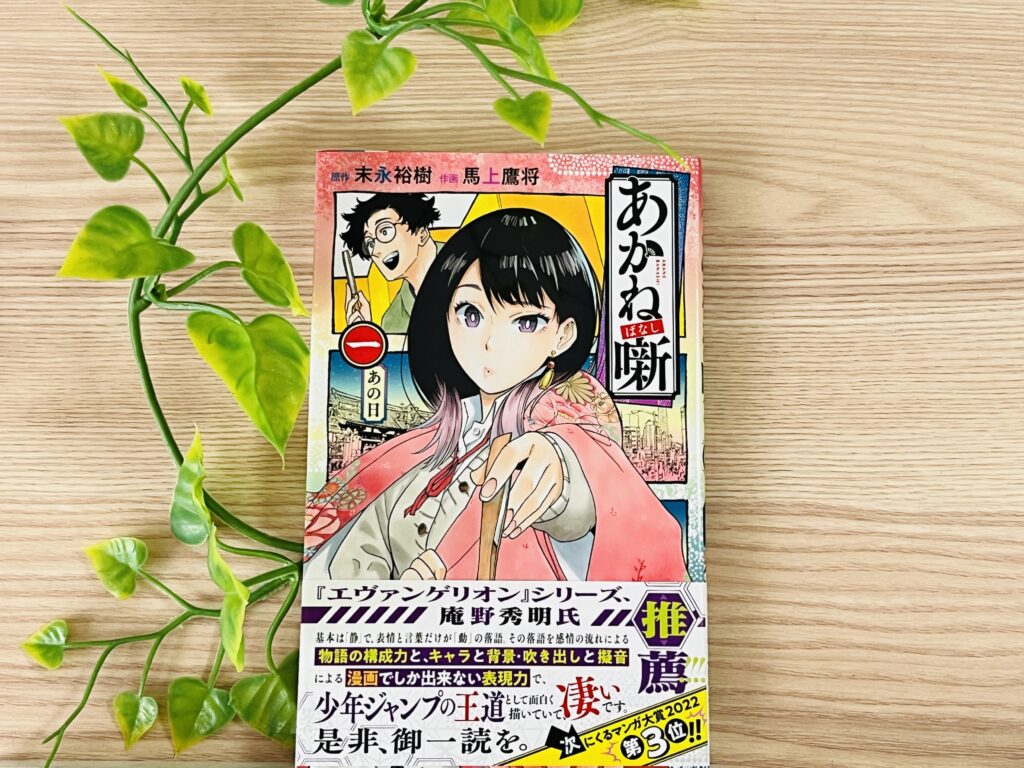
✅ Curious about this one? Check it out here! →Akane-banashi, Vol. 1
New to the series? Begin with the Akane-banashi guide. You can also read why Akane needs her senior disciples and how their guidance helps her learn to meet an audience.