This article contains spoilers through Given: To the Sea (2024).
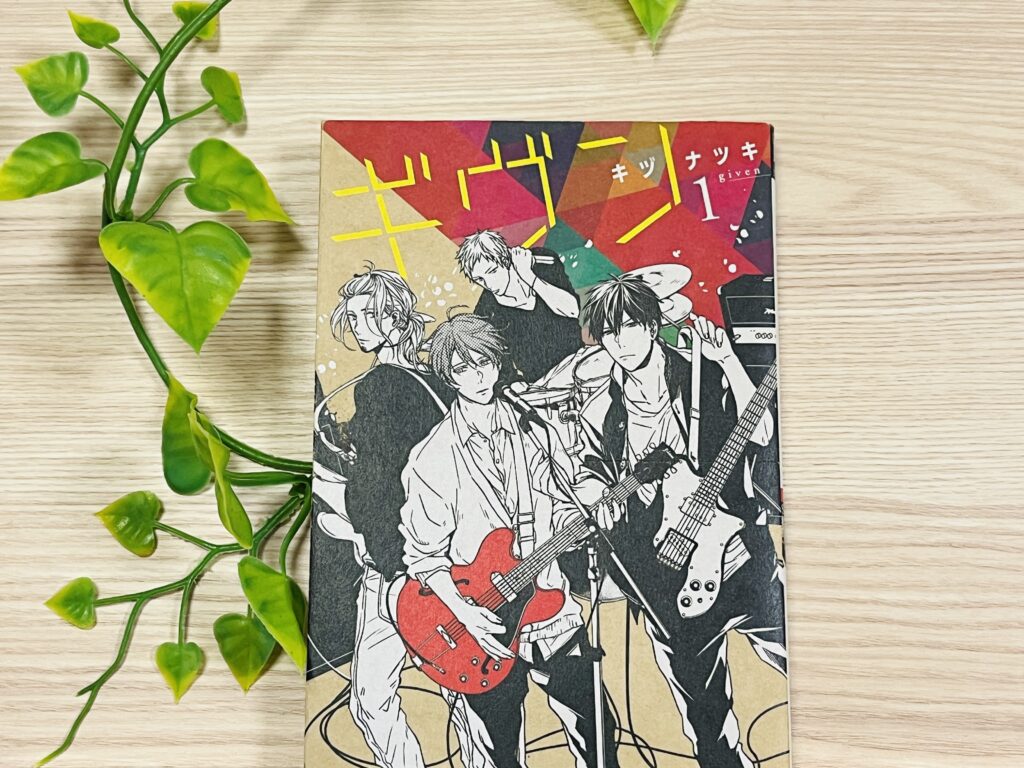
A band is four people making music together.
That is what it looks like from the outside.
But in Given, the band is something else too.
It is the place where four people — each carrying something they couldn’t put down — found somewhere they were allowed to simply be.
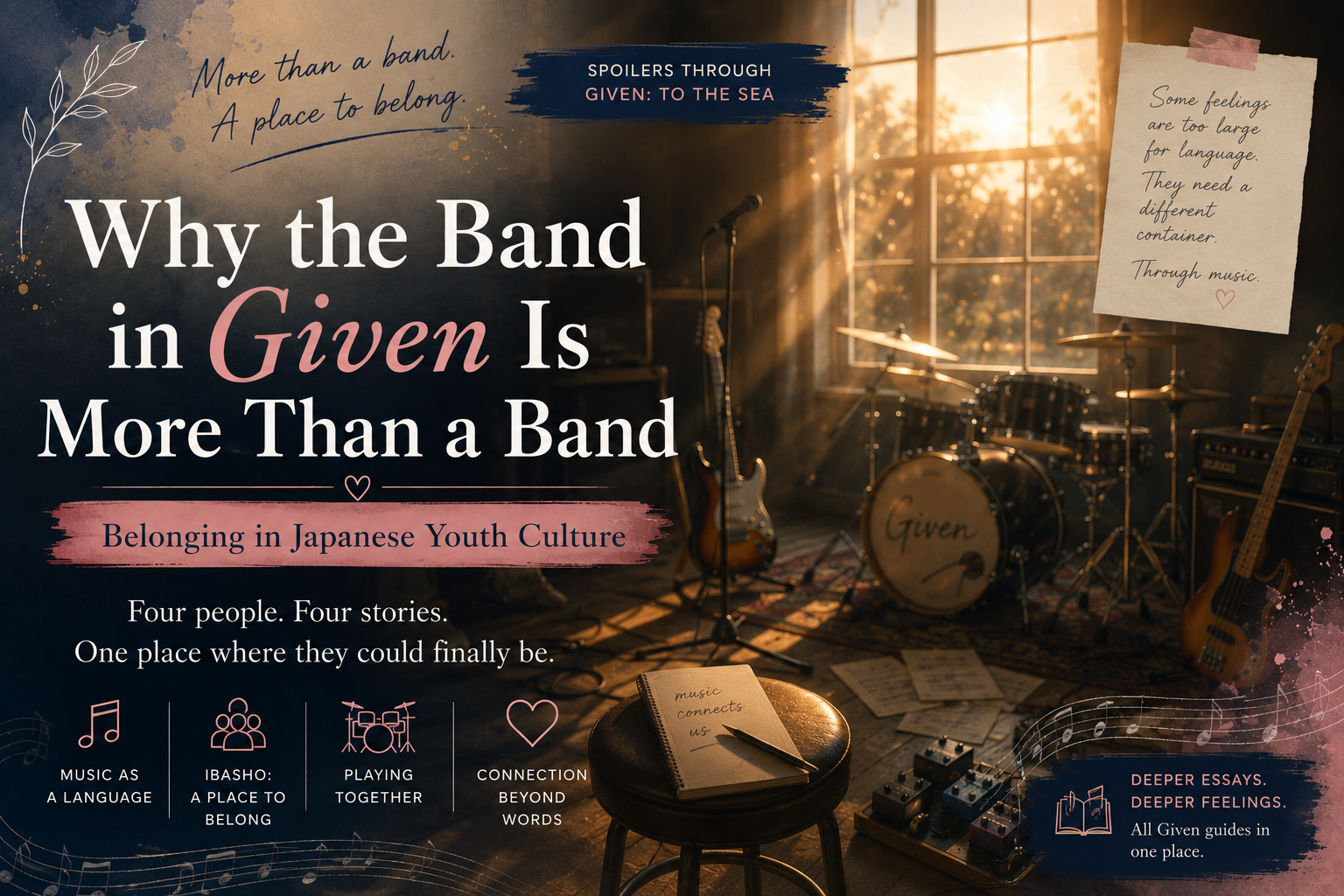
The Japanese Concept of Ibasho
There is a word in Japanese that doesn’t translate cleanly into English.
Ibasho (居場所).
Literally: the place where you are. But the meaning is deeper than that.
Ibasho is the place where your existence is accepted without condition. Where you don’t have to perform or explain or justify yourself. Where the simple fact of being there is enough.
For young people in Japan, the absence of ibasho — having nowhere that feels like yours, no group where you belong — is understood as something serious. Not just uncomfortable, but damaging.
And finding it, when you do, is a relief that goes deeper than it might look from the outside.
The band Given was ibasho for four people who needed it.
Each for different reasons. Each in different ways.
What the Band Gave Mafuyu
Mafuyu Sato had nowhere that felt like his.
His home had not been safe. The one relationship that had made the world feel navigable had ended before it was finished. He had been moving through his days as if time had stopped — present in body, absent everywhere else.
And then Ritsuka said something no one had ever said to him before.
I need your voice.
Not: I understand what you’ve been through. Not: I accept you despite everything. Just: you, right now, exactly as you are — you are needed here.
That is a specific kind of belonging. Not the belonging that comes from being known and forgiven. The belonging that comes from being wanted for what you already have.
The band didn’t ask Mafuyu to heal before he could join. It asked him to show up and sing.
And in showing up and singing, something that had been frozen inside him began, very slowly, to move.
For a deeper look at what the band unlocked in Mafuyu:
✅ Mafuyu Sato from Given: What His Silence Is Actually Made Of
What the Band Gave Ritsuka
Ritsuka Uenoyama had something Mafuyu didn’t — technical skill, passion, a history with music that had been real and sustaining.
But somewhere along the way, the passion had faded.
He could still play. He just couldn’t remember, quite, why it had ever mattered.
Then he heard Mafuyu sing.
And something woke up.
What the band gave Ritsuka was not belonging in the way it gave Mafuyu belonging. It gave him something adjacent: the return of meaning. The rediscovery of why music had ever felt like the most important thing.
You can love something alone. But sometimes it takes another person — the right person, at the right moment — to show you what you were actually reaching for.
Mafuyu’s voice gave Ritsuka that.
The band was the place where it happened.
For a deeper look at what Ritsuka found — and what he chose to do with it:
✅ Ritsuka Uenoyama from Given: The Boy Who Acts Before He Thinks
What the Band Gave Haruki and Akihiko
For Haruki and Akihiko, the band meant something different again.
Their relationship outside the band was complicated — tangled, unresolved, capable of causing real damage. There were moments when it seemed like the weight of everything between them might pull the whole thing apart.
But the band held.
Not because it fixed anything. But because it gave them a place where they had to keep showing up. Where the music required them to be in the same room, to listen to each other, to function together even when everything else was difficult.
When Haruki told Akihiko — after being pushed too far — if you weren’t a bandmate, I’d be done with you, that line revealed something important.
The band was the reason the relationship survived long enough to become something better.
It was the container that held two people together while they slowly, painfully figured out how to be toward each other.
For a deeper look at Haruki’s quiet endurance:
✅ Haruki Nakayama from Given: The Person Who Always Put Everyone Else First
For a deeper look at what Akihiko was working through:
✅ Akihiko Kaji from Given: Why the Most Put-Together Person in the Room Was Falling Apart
What Playing Together Actually Does
There is something that happens when people make music together that doesn’t happen in other kinds of shared activity.
You have to listen. Really listen — not just to yourself, but to the other people in the room. You have to adjust. You have to feel what they’re doing and respond to it in real time.
In that sense, playing music together is a form of paying attention to another person that goes deeper than conversation. You are not exchanging information. You are synchronising — finding the same rhythm, the same feeling, the same moment — together.
For four people who were each, in different ways, struggling to connect — struggling to say what they meant, or feel what they felt, or reach the people they cared about — the band offered a way of being together that bypassed all of that.
They didn’t have to find the words.
They just had to play.
The Name
Given.
Something received. Something that arrives without being earned or demanded.
The band gave each of them something they hadn’t known they needed.
Mafuyu received a place where he was wanted as he was. Ritsuka received the return of why music had ever mattered. Haruki received a reason to stay. Akihiko received a container for a relationship that might otherwise have broken entirely.
None of them asked for these things. None of them could have predicted that four people in a practice room would become, for each of them, the place where something important happened.
It was given.
That is, maybe, how the best kinds of belonging always arrive.
Not because you sought them out perfectly. But because you showed up — imperfectly, uncertainly, not quite knowing why — and found that something was already there, waiting to be received.
A Final Note
Given is a story about music. About love. About grief and guilt and the slow process of learning to move forward.
But underneath all of that, it is also a story about four people who needed somewhere to belong — and found it, unexpectedly, in each other.
The band is not just where the music happens.
It is where they happen.
And that, in the end, is what ibasho means.
Not a place on a map.
A place where you are allowed to exist.
If this resonated with you, these go deeper:
✅ Mafuyu Sato from Given: What His Silence Is Actually Made Of
✅ Ritsuka Uenoyama from Given: The Boy Who Acts Before He Thinks
✅ Haruki Nakayama from Given: The Person Who Always Put Everyone Else First
✅ Akihiko Kaji from Given: Why the Most Put-Together Person in the Room Was Falling Apart
✅ What Is Given? — Where to start if you’re new to the series
I also share the small manga moments that stay with me long after reading—the pauses, glances, and choices that never fully leave.
You can follow those weekly reflections on Substack.
✅ My Substack Here!

If this resonated with you — I wrote a short book about exactly this feeling.
Why Japanese Romance Feels Different explores what makes Japanese love stories hit differently, through the lens of Given: silence as love, sincerity over perfection, and carrying the past forward.
This essay is part of a wider comparison: Why Do Manga Characters Choose Silence Over Confession? (Given, Chihayafuru, and A Sign of Affection Compared)
This essay is part of a wider comparison: Why Manga Characters Find Ibasho in the People Who Chose Them: Given, Choking on Love, and Kimi to Wonderland Compared