There is a familiar shape to the shojo heroine.
She blushes easily. She loses her words at the wrong moment. She is pursued, protected, chosen — and through being chosen, she begins to understand her own worth.
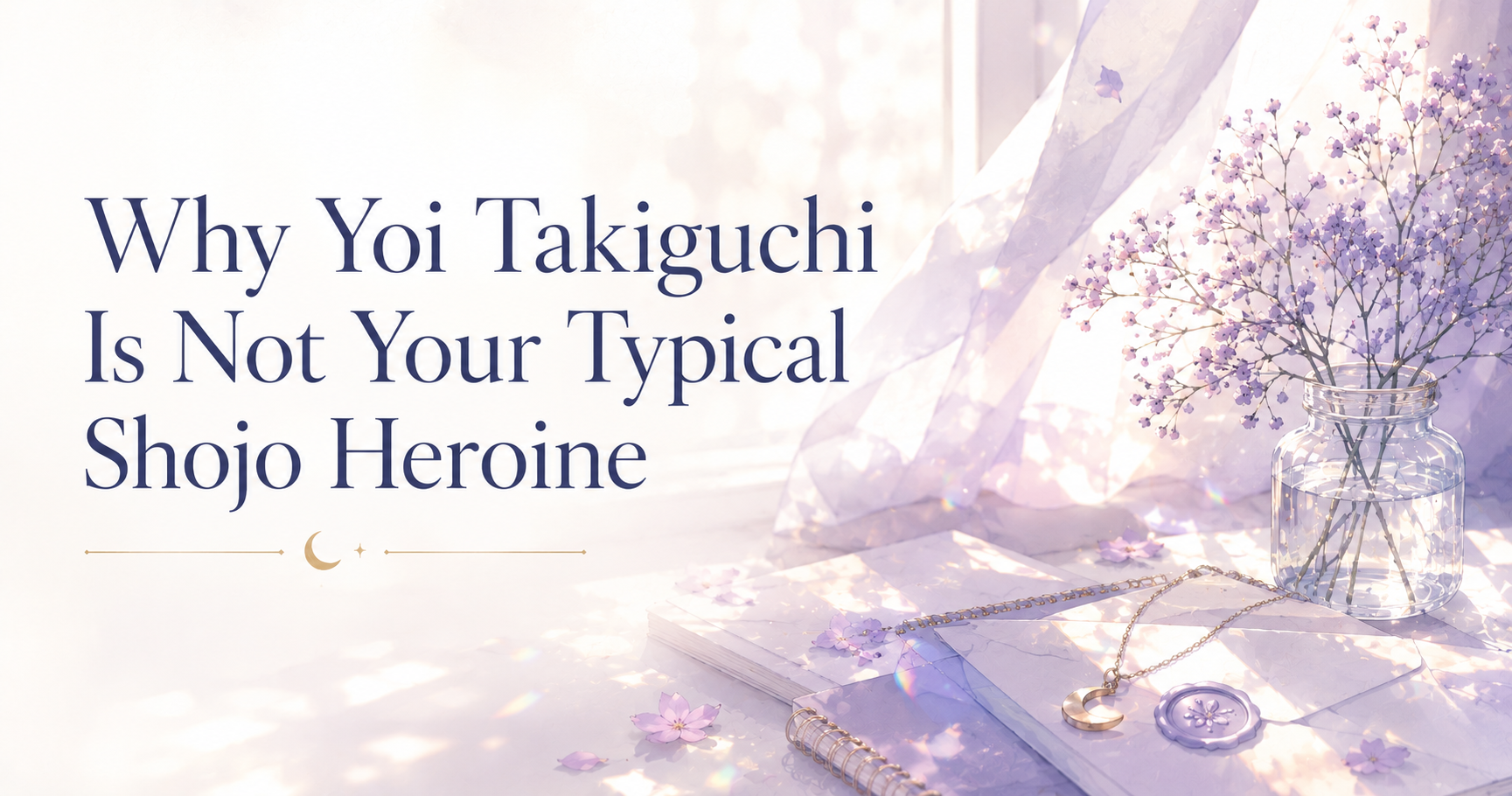
Yoi Takiguchi does not fit that shape.
She is tall, with a low voice and sharp features that people have always found striking. She moves through difficult situations without flinching. She helps others without being asked and without expecting anything in return.
Her classmates call her a prince.
And in the first chapter, quietly, to herself, she thinks:
“I know better than anyone that the heroine role doesn’t suit me.”
That sentence contains everything. The outside and the inside, and the distance between them.
✅Kohaku Ichimura Explained: The Prince Who Chose to See Her Differently
The Weight of a Label She Never Chose
Yoi did not decide to become a prince.
It happened the way these things usually happen — gradually, through accumulated perception, until one day the image was simply there, and arguing with it would have required more energy than accepting it.
Her height. Her voice. The way she carries herself. The way she steps in when something is wrong without stopping to calculate the cost.
Each of these things, individually, might mean nothing. Together, they became a verdict.
And so she adapted.
She learned not to show too much. Not to lose composure. Not to need things from people — or at least, not visibly.
This is sometimes described as strength. But it is more accurate to call it adaptation. A long, quiet adjustment to being seen in a particular way, until the adjustment became indistinguishable from the self.
✅The “Prince” Label in In the Clear Moonlit Dusk — What It Really Costs
Why She Has Never Been in a Relationship
Yoi’s lack of romantic experience is not simply shyness.
It is something more structural than that.
To be admired is not the same as to be liked. To be looked up to is not the same as to be seen.
Yoi has spent years as an object of admiration — someone others aspire toward, not someone they approach as an equal.
No one has treated her as a person who might want to be pursued. No one has assumed she might need softness, or reassurance, or the ordinary kindness of being considered ordinary.
And so she stopped assuming it for herself.
The idea that she could be someone’s heroine — not a prince, not an ideal, but an actual person someone chooses — had become genuinely difficult to hold.
What Kohaku’s Words Actually Did
Kohaku Ichimura’s first real words to her are not complicated.
“You are incredibly beautiful.”
Not cool. Not impressive. Not prince-like. Beautiful.
It would be easy to underestimate how much weight that word carries for someone like Yoi.
She has been admired for years. But admiration, in her experience, has always kept its distance. It looks up. It does not reach across.
Kohaku’s word reaches across.
And then he goes further. He tells her the men around her have no eye for what is in front of them. He treats her, without ceremony, as someone who deserves to be treated gently.
Something that Yoi had quietly closed — not in a single moment, but over years of being seen only one way — begins, almost against her will, to open.
Her Inside Was Always There
Mika Yamamori has spoken in interviews about a deliberate choice she made with Yoi’s character.
She wanted Yoi’s interior to remain genuinely feminine — warm, attentive, capable of being moved — even as her exterior remained composed.
The reason was practical as much as emotional: a character who is cool on both the outside and the inside tends to resist the kind of story where love becomes possible.
So Yoi thinks about Kohaku more than she would like to admit. She notices his absence. She registers his presence in a room before she has consciously decided to.
And when she learns that Kohaku visited her workplace alone with someone else, the response that surfaces — quiet, involuntary — is:
“I really don’t like that.”
For a person accustomed to managing her own feelings into silence, that admission is not small. It is the sound of something that can no longer be entirely contained.
The Question She Carries
Yoi is not simply a character with an unusual aesthetic.
She is a question in human form:
What happens when the image others have of you becomes the only version of yourself you know how to be?
This is not a question that belongs only to fictional princes.
It belongs to anyone who has been told, repeatedly and by enough people, that they are strong — and has learned to perform that strength until performing it became the same as living it.
It belongs to anyone who has been relied upon for so long that needing something for themselves began to feel like a failure of character.
Yoi’s gradual change through her relationship with Kohaku is not just a romance unfolding. It is someone carefully, haltingly, learning that it is safe to want something for herself.
What Actually Makes Her Different
To be clear about what sets Yoi apart from the more familiar shojo heroine:
She does not express emotion quickly or easily. She tends toward protecting others rather than being protected. She approaches her own feelings with caution, not urgency. She does not believe, at the start, that she is the kind of person someone would choose.
And yet — she feels everything.
She is not distant. She is not cold. She is someone who has learned to carry a great deal without letting it show — and who is, slowly, finding that she no longer has to carry it alone.
That gap — between the surface and what lives beneath it — is what makes her feel real.
Not a type. Not an archetype. A person.
Closing
Yoi is not weak. That is not what any of this means.
She is, by most measures, genuinely capable — of handling difficulty, of showing up for others, of holding herself together in situations that would unsettle someone less practiced.
But her strength has always been maintained through concealment. Through the careful, habitual act of not showing what she carries.
Kohaku’s arrival does not dismantle that. It does something quieter and more lasting:
it offers her, for the first time, a place where concealment is not required.
What she does with that offer is what this story is about.
For a full introduction to the manga — plot, characters, and anime details — see: ✅ [What Is In the Clear Moonlit Dusk? Plot, Characters & Why Fans Love It]
I also share the small manga moments that stay with me long after reading—the pauses, glances, and choices that never fully leave.
You can follow those weekly reflections on Substack.
✅ My Substack Here!