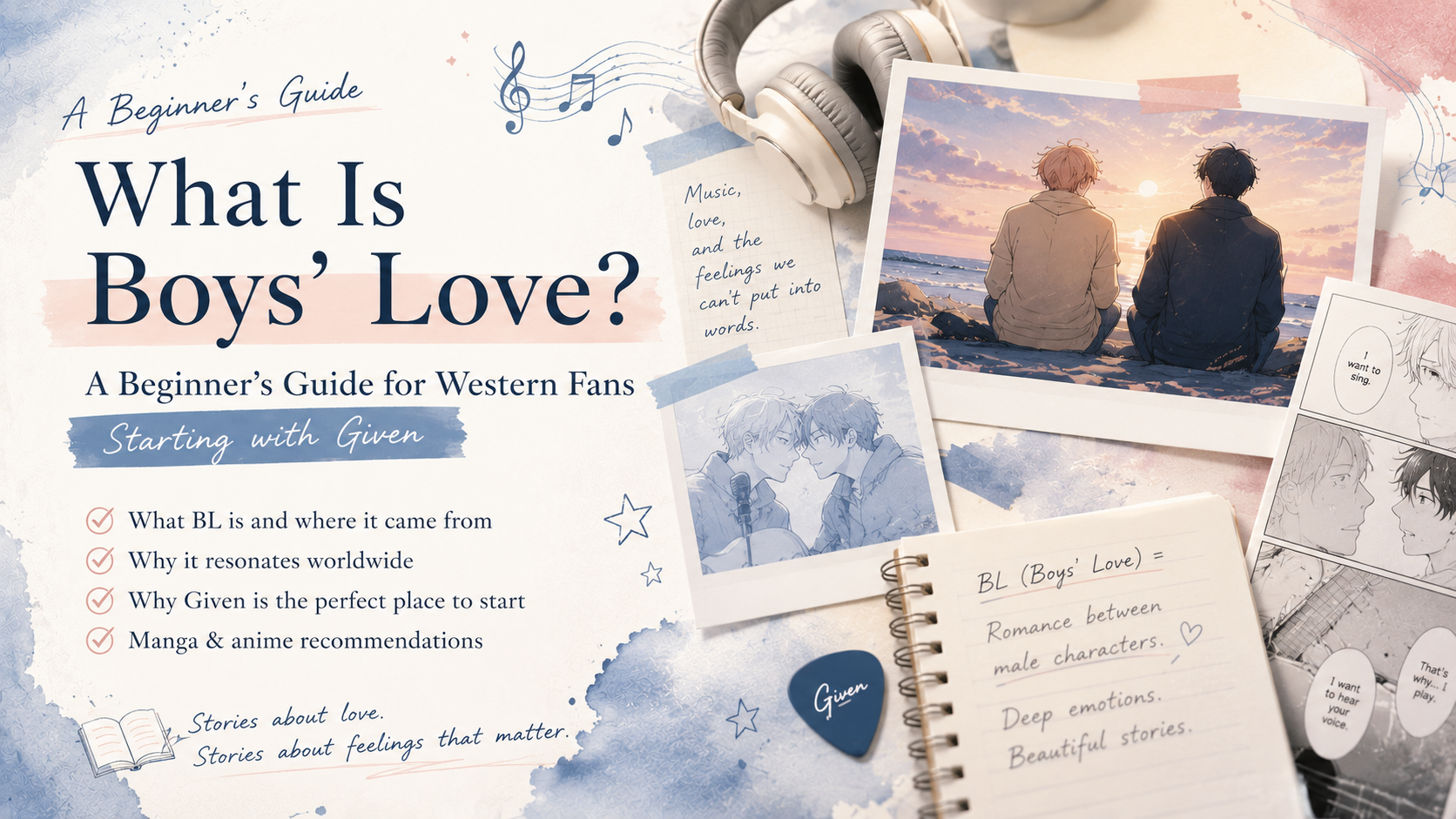
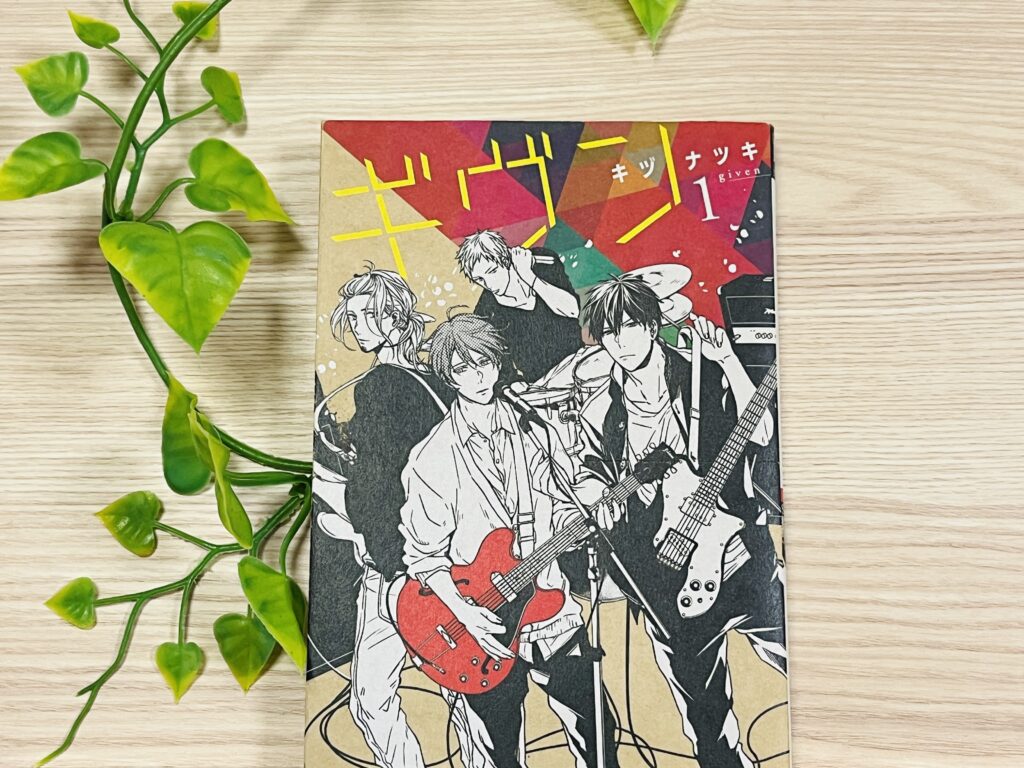
You may have come across the term Boys’ Love somewhere.
Or maybe you watched Given and thought: so this is what BL is.
Either way, you’re in the right place.
This is a gentle introduction to the Boys’ Love genre — what it is, where it came from, why it travelled so far from Japan, and why Given is one of the best places to start.
What Is Boys’ Love?
Boys’ Love — usually shortened to BL — is a genre of fiction that centres on romantic relationships between male characters.
It exists across manga, novels, anime, and film. It originated in Japan, was initially created largely for female readers, and has since grown into something much wider — beloved by readers and viewers of all genders, all over the world.
In English-speaking spaces, “BL” is widely understood as-is. You may also encounter the terms “Boys’ Love” or “yaoi,” though BL has become the most commonly used shorthand internationally.
Where Did BL Come From? — A Story That Starts in 1970s Manga
This might surprise you: BL’s origins trace back to Japanese shōjo manga — manga aimed at young women — in the 1970s.
At the time, a group of female manga artists began creating stories centred on deep emotional bonds and romantic feelings between male characters.
Why male characters?
One widely held interpretation is that writing male characters gave these creators a kind of freedom that writing female characters didn’t. Stories about women were weighted down by social expectations — how women should behave, what they should want, what roles they were allowed to occupy.
Male characters existed outside those constraints. Which meant the stories could be purely about feeling. About love and longing and loss, without the noise of gender roles getting in the way.
By the 1990s, the term “Boys’ Love” had entered common use. Dedicated magazines and publishing imprints emerged. The genre had become its own distinct world.
Why BL Travelled So Far
From the 2000s onward — accelerated by the internet, and later by streaming platforms — Japanese BL began reaching readers and viewers far outside Japan.
The reason it resonated so widely is something people talk about often in BL fan communities:
The emotional detail.
The hesitation at the beginning of a feeling. The weight of something you can’t say out loud. The particular pain of loving someone and not knowing how to show it.
BL stories tend to take these moments seriously. They slow down for the feeling. They don’t rush past the uncertainty or the longing to get to the resolution.
That quality — the care with which emotion is handled — translates across languages and cultures. Because the feelings themselves are universal.
Why Given Is One of the Best Places to Start
Given is frequently recommended as a first BL series. There are specific reasons for that.
The human drama comes before the romance.
Given is, before anything else, a story about music, grief, and the slow process of coming back to life. The emotional groundwork is laid carefully. By the time romantic feelings arrive, you are already deeply invested in the characters as people.
It doesn’t treat same-sex love as unusual.
The series doesn’t pause to make a point of the fact that its characters are male. It simply shows people falling for each other — getting jealous, getting scared, not knowing what to do with what they feel. The love is the focus. Not the gender.
The anime is exceptionally well-made.
The 2019 TV anime aired in the Noitamina programming block on Fuji TV — a slot known for ambitious, thoughtful animation. The music, the visuals, the pacing — all of it is worth your time.
There’s a lot to stay for.
TV anime, a film, an OAD, and two further films (Hiragi Mix and To the Sea) make up the full series. If you find yourself pulled in, there’s a lot more waiting for you.
New to Given entirely? Start here: ✅ What Is Given? — A Story About Music, Loss, and the Feelings We Can’t Put Into Words
Ready to watch? Here’s the order: ✅ Given Watch Order — Where to Start and How to Watch the Full Series — Coming soon
If You Loved Given — What to Read or Watch Next
Manga
Umibe no Étranger (The Stranger by the Shore) — A quiet, emotionally precise story about solitude and the slow arrival of love. If what you loved about Given was the restraint and the feeling underneath it, this one will reach you.
Twittering Birds Never Fly — For readers who want something darker and more complex. The emotional entanglement between the two leads is unlike anything else in the genre.
Super Lovers — A warm story where family bonds and romantic feelings gradually intertwine. A gentler entry point into the genre for readers who prefer something lighter.
Anime
Dakaichi: I’m Being Harassed by the Sexiest Man of the Year — A fun, comedy-driven BL anime. If you want something lighter after the emotional weight of Given, this is an easy watch.
Banana Fish — Technically not BL, but contains one of the most emotionally devastating relationships in anime. If Givenleft you wanting something with more dramatic weight, this is worth your time.
Given itself, continued — if you’ve only seen the TV anime, the films are waiting. Each one deepens the story in ways the anime couldn’t.
A Final Note
BL is a genre about men falling in love with men.
But that’s not the reason it stays with people.
It stays because of the feelings it takes seriously. The ones that are hard to say. The ones that don’t have a clean shape. The ones that arrive before you’re ready for them.
Given is a perfect example of that.
If you’re new to the genre — welcome. You’ve started somewhere good.
Want to go deeper into Given before exploring further?
✅ Mafuyu Sato from Given: What His Silence Is Actually Made Of
✅ Ritsuka Uenoyama from Given: The Boy Who Acts Before He Thinks
✅ When Your Partner Finishes Their Ex’s Love Song — What Given: To the Sea Understands About Love
✅ What Is Given? — Where to start if you’re new to the series
I also share the small manga moments that stay with me long after reading—the pauses, glances, and choices that never fully leave.
You can follow those weekly reflections on Substack.
✅ My Substack Here!
If this resonated with you — I wrote a short book about exactly this feeling.
Why Japanese Romance Feels Different explores what makes Japanese love stories hit differently, through the lens of Given: silence as love, sincerity over perfection, and carrying the past forward.