
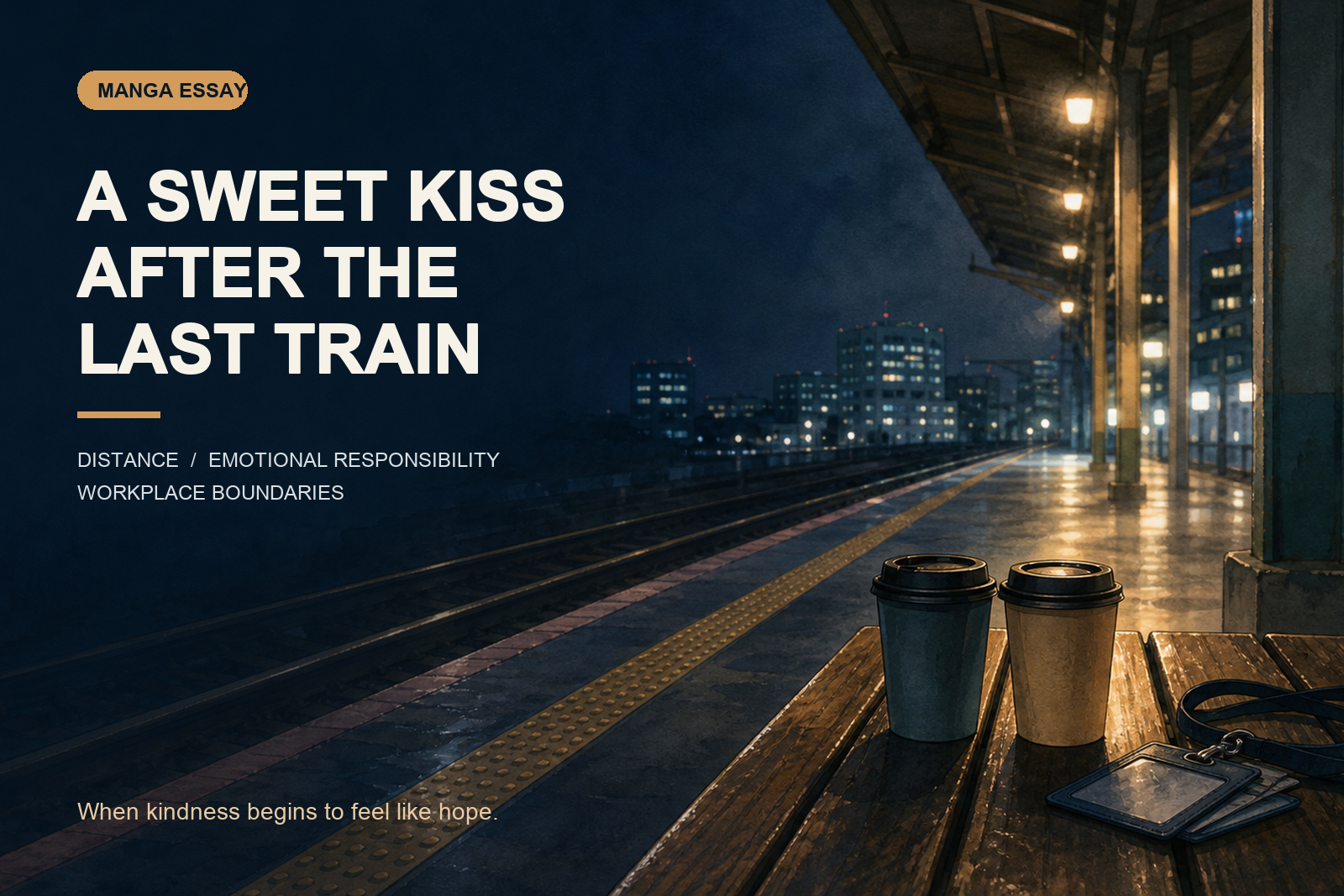

Why does kindness sometimes hurt more than an actual confession?
A Sweet Kiss After the Last Train is not simply an office romance.
It is a story about the fragile line between comfort and expectation—the moment when emotional safety slowly begins to feel like love.
A former boss who knows too much. A woman who has learned not to ask for too much. A workplace where every small act of kindness carries more meaning than it should.
What makes this manga so compelling is the way it turns ordinary moments—walking home after work, a gentle word, a glance that lingers—into emotional turning points.
If you love romance built on tension, restraint, and feelings that grow in silence, this story is impossible to forget.
What Is A Sweet Kiss After the Last Train About?
Saeka is the kind of woman everyone relies on.
At work, she appears capable and composed. But emotionally, she has a habit of putting her own needs last, convincing herself that staying strong is easier than asking for comfort.
Then Chisuwa returns.
A former boss from Kansai, he knows the version of Saeka that existed before she became the dependable adult everyone sees now. He notices when she pushes herself too hard. He understands the weaknesses she tries to hide. And most dangerously, he steps into those vulnerable spaces with effortless warmth.
The problem is not that he is kind.
The problem is that his kindness feels too personal to remain safely professional.
That uncertainty—is this care, or is it love?—is what makes every chapter emotionally addictive.
For a deeper portrait of Saeka—and the specific history that makes her so vulnerable to this kind of closeness: ✅ Saeka Natori — The Woman Who Was Too Strong to Be Loved
Current Manga Status: Volume 2 and the Ending
The original Japanese manga, Shūden-go wa Amai Kiss Shite (終電後は甘いキスして), is written by Azu Ishida and published by Kodansha. Two collected Japanese volumes are available as of August 2026.
Volume 2 was released in Japan on March 13, 2026. Kodansha currently lists two volumes, and no official completion announcement has been confirmed. The manga should therefore be treated as ongoing.
If you arrived looking for the ending, the series is not finished yet. There is no final ending to summarize at this time, and no unconfirmed Volume 3 information should be assumed.
For a closer discussion of the latest published volume, read Volume 2: What Changes When Feelings Finally Have a Name.
The Core Themes of This Manga
At its heart, this manga is not about confession. It is about the choices people make through distance.
Three ideas define the story.
Distance
The emotional closeness between Saeka and Chisuwa shifts long before either of them names it.
Chisuwa moves closer without deciding to. Saeka feels the distance dissolving without understanding why. And the silence between them slowly fills with everything neither of them has said.
For why this kind of unspoken closeness is one of the most emotionally powerful dynamics in Japanese romance: ✅ Why Japanese Romance Rarely Confesses — The Cultural Reason Feelings Stay Unspoken
Emotional Responsibility
How much responsibility do we carry for the feelings our kindness creates in someone else?
Chisuwa never intended to mislead Saeka. His warmth was genuine—rooted in the way he has always cared for the people around him. But genuine warmth, given without awareness of its weight, can still leave someone alone inside a feeling they built around you.
For the full psychology behind why unconscious kindness is so difficult to protect yourself from: ✅ Why His Kindness Felt Like Love — The Psychology Behind Emotional Misreading
Workplace Boundaries
When trust already exists inside a professional relationship, even small moments can feel intimate.
The workplace enforces proximity. It creates involuntary familiarity. And it makes the smallest gesture—a quiet check-in, a moment of quiet support—land with far more weight than it would anywhere else.
For why the office setting makes every emotion heavier than it should be: ✅ Why Office Romance Feels Different — When the Workplace Makes Every Small Gesture Feel Heavier
Key Character Dynamics
The chemistry between Saeka and Chisuwa is built on one of the strongest dynamics in romance manga.
Former boss and subordinate. Shared professional history. Emotional familiarity that predates the current dynamic. Mutual trust. Unspoken tension.
Chisuwa never forces the relationship forward. Instead, he creates emotional safety first.
That is what makes him so dangerous—and so unforgettable.
He knows when Saeka is tired. He knows what she is trying not to say. And he moves closer in ways that still leave room for denial.
This delicate balance between reassurance and emotional risk gives the story its irresistible pull.
For the full portrait of Chisuwa—and why his particular kind of closeness is so impossible to dismiss: ✅ Osuke Chisuwa — The Man Who Got Too Close Without Meaning To
For why the former boss dynamic adds a specific emotional weight that other romantic setups cannot replicate: ✅ The Former Boss Romance — Why Shared History Makes Everything More Dangerous
Why This Story Feels Different
Many office romances rely on obvious attraction.
This one relies on timing, silence, and emotional atmosphere.
A late train. A quiet walk home. The moment after work when professional roles begin to blur.
Japanese romance manga often uses situations as emotional language, and A Sweet Kiss After the Last Train does this beautifully.
Instead of asking readers to believe in instant passion, it lets intimacy grow through repeated acts of quiet support.
That slower emotional pacing makes every scene feel heavier, softer, and far more intimate.
For how Chisuwa’s Kansai dialect creates a specific kind of intimacy that standard Japanese cannot: ✅ What Kansai Dialect Does to a Romance — Why Chisuwa’s Language Breaks Down Saeka’s Walls
Where to Read A Sweet Kiss After the Last Train Legally
Official English Release
Kodansha officially publishes A Sweet Kiss After the Last Train in English on K MANGA. The official English chapters are free to read, and the series is updated on an irregular schedule.
K MANGA is the confirmed official English release. No English print edition or separate paid English collected edition has been confirmed for this article, so readers should not assume that one exists.
Official Japanese Version
Japanese readers can follow 終電後は甘いキスして through Kodansha’s official Palcy and Magazine Pocket services. Kodansha also provides the official collected-volume listings, including Volume 2.
Availability, free-reading periods, and accessible chapters can change. Check each official platform for its current terms and regional availability.
For more options across publishers, see Where to Read Japanese Manga Legally Online: A Guide for Global Fans.
Who Should Read This Manga?
This manga is perfect for readers who love:
- office romance
- older, emotionally composed male leads
- quiet support instead of loud declarations
- emotional tension over fast confession
- workplace relationships with blurred boundaries
- romance that feels mature and psychologically layered
- kindness that slowly becomes impossible to ignore
If your favorite romances are built on restraint rather than impulse, this series will absolutely pull you in.
Final Reflection
A Sweet Kiss After the Last Train stays with you because it understands something deeply human:
sometimes the most painful feelings are born not from rejection, but from kindness that feels too meaningful to dismiss.
Every moment between Saeka and Chisuwa asks the same dangerous question:
how close can two people become before kindness turns into hope?
That emotional uncertainty gives the story its ache.
It is sweet. It is quiet. And somehow, it feels far more intimate than a direct confession.
For Saeka’s character—and what it costs her to finally let someone past the wall: ✅ Saeka’s Armour — What Happens When a Strong Woman Finally Lets Someone In
For the full story of Volume 2—and what changes when feelings finally have a name: ✅ Volume 2 — What Changes When Feelings Finally Have a Name
I also share the small manga moments that stay with me long after reading—the pauses, glances, and choices that never fully leave.
You can follow those weekly reflections on Substack. ✅ My Substack Here!
This essay is part of a wider comparison: Why Distance Feels More Intimate Than Closeness in Shoujo Manga