Why Some People Stay Close—But Never Choose — The Hidden Structure of Emotional Avoidance in Romance —
There is a kind of relationship that feels harder than rejection.
Not distant. Not cold. Close.
They stay with you. They notice you. They help when you need it.
And yet—nothing moves forward.
You are not chosen. But you are not let go either.
This kind of relationship does not break cleanly.
It lingers.
And that is exactly what makes it painful.
What This Concept Means
This is not simple indecision.
It is a specific structure.
The distance is gone. The emotional connection is there. But the relationship remains undefined.
They will:
- spend time with you
- support you
- say things that feel intimate
But they will not:
- define what you are
- take responsibility for the relationship
- move things forward
The connection exists.
The commitment does not.
Why It Feels So Difficult
This kind of relationship creates a unique kind of tension.
You cannot move forward. But you cannot step away either.
Because something is there. You feel it. But you cannot prove it.
You are left asking:
- Do they like me?
- Am I imagining this?
- Should I wait?
- Should I leave?
There is no clear answer.
And without clarity, you stay.
Not because it works—but because it might.
The Structure of Emotional Avoidance
At the center of this pattern is emotional avoidance.
Not the obvious kind. A quieter version.
Instead of leaving, they stay. Instead of rejecting, they soften things. Instead of choosing, they delay.
Because choosing comes with risk.
- The relationship might change
- Someone might get hurt
- Something might be lost
So they maintain what feels safe.
Closeness without commitment. Connection without definition.
It protects the present—at the cost of the future.
A Note on What This Is Not
It would be easy to read this pattern into any story where someone stays close without confessing.
But it’s worth being precise about what separates real emotional avoidance from something that only looks like it from the outside.
Take Osuke Chisuwa, from A Sweet Kiss After the Last Train. On the surface, his relationship with Saeka Natori can look like exactly this structure—closeness without a defined relationship, warmth without a confession.
But Chisuwa isn’t avoiding a choice.
He never noticed there was one to make. He wasn’t withholding commitment to protect himself from risk. He genuinely believed he and Saeka were simply close colleagues—because Saeka, guarded as she is, never gave him a reason to think otherwise. His warmth wasn’t strategic ambiguity. It was instinct, offered without any awareness of what it was doing to her.
That’s a completely different mechanism from the one this article is describing.
The pattern here—someone who stays close because leaving feels riskier than staying, who keeps things undefined on purpose because a definition would force a decision—describes someone who knows, at some level, that a choice is being avoided.
Chisuwa never got that far. He wasn’t avoiding the choice. He didn’t know it existed.
For the specific psychology of Chisuwa’s situation—unconscious kindness misread as something more:
✅ Why His Kindness Felt Like Love — The Psychology Behind Emotional Misreading
For the full portrait of the man at the center of that story:
✅ Osuke Chisuwa — The Man Who Got Too Close Without Meaning To
The Hidden Cost
This kind of relationship—the genuine version, where someone does know and is choosing not to choose—is not neutral.
It has a cost.
For the person waiting:
- emotional exhaustion
- time that cannot be reclaimed
- growing uncertainty about their own judgment
For the person avoiding:
- no real relationship
- no real decision
- no growth
Nothing fully begins. Nothing fully ends.
Final Reflection
Kindness is not the problem.
But kindness alone is not enough.
At some point, a relationship requires something else. A decision.
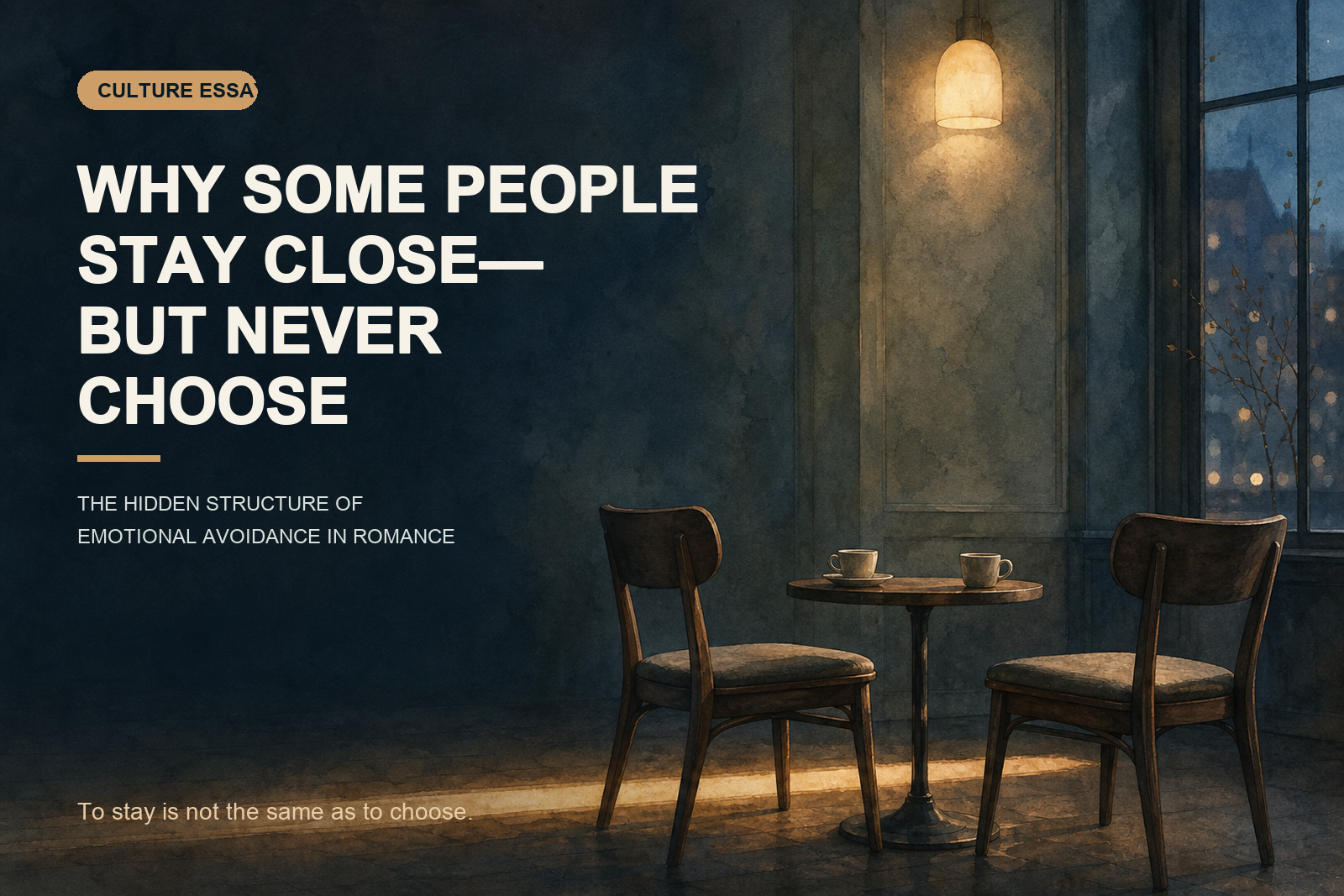
To stay is not the same as to choose.
And that difference matters more than it seems—whether the person staying knows they’re avoiding a choice, or, like Chisuwa, never realized there was one to make at all.