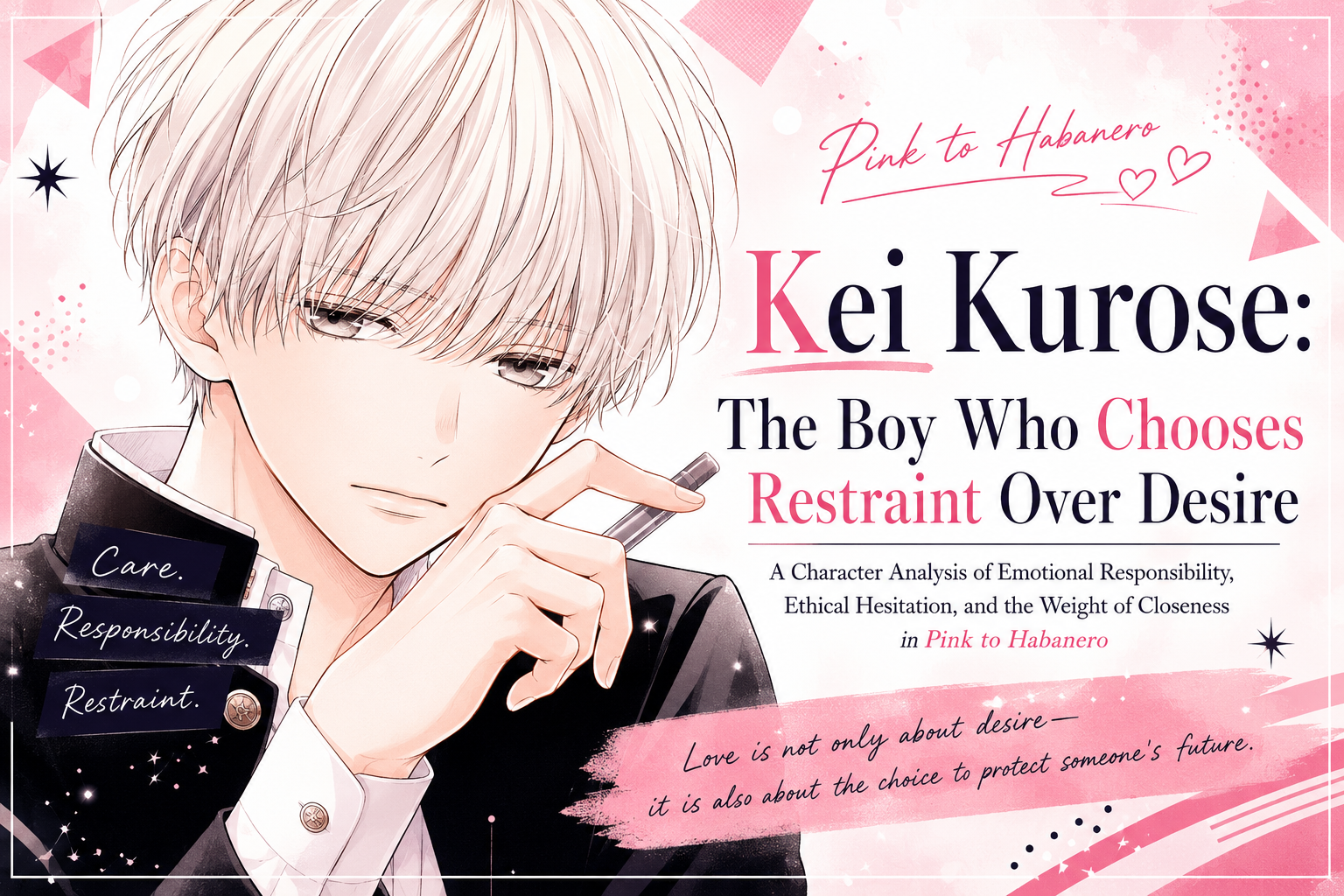
A Character Analysis of Emotional Responsibility, Ethical Hesitation, and the Weight of Closeness in Pink to Habanero
In romance manga, certain types of male leads appear again and again.
The cold boy who turns out to be kind.
The blunt boy who secretly cares deeply.
The distant boy who only reveals his softer side to the heroine.
At first glance, Kei Kurose seems to belong to that familiar category.
He is handsome.
Reserved.
Emotionally difficult to read.
And almost completely indifferent to casual attention from girls.
But that description is not enough.
What remains after reading Pink to Habanero is not simply the feeling that Kurose was kind.
What defines him is something far more specific:
He refuses to treat emotions casually.
And because of that,
his love is shaped not by emotional intensity alone—
but by restraint.
Before looking at Kurose himself, it helps to understand the world that shaped the way he handles closeness and emotion.
→ Pink to Habanero:A Story About Kindness, Hesitation, and Choosing Responsibility
The Position He Stands In
At school, Kurose keeps his distance from others.
He does not flirt.
He does not encourage unnecessary attention.
He does not hand out emotional intimacy lightly.
And yet, outside school, he works in an environment that demands the exact opposite.
He works in a setting where he is expected to:
- smile naturally
- charm people
- create emotional closeness
- make others feel special
At first, this contrast seems contradictory.
But Kurose is not someone hiding his “real self.”
Instead, he carefully controls when emotional access is allowed.
This difference matters.
Because Kurose understands something most people ignore:
Once feelings are expressed, they begin affecting another person’s world.
They create expectation.
Attachment.
Hope.
Emotional responsibility.
And because he understands this,
he refuses to approach closeness carelessly.
The Boy Who Becomes More Careful as Feelings Deepen
When Kurose begins developing feelings for Mugi, he does not immediately move closer.
He does not act impulsively.
He does not cling to her emotionally.
He does not pursue her simply because he wants her.
Instead—
he becomes more cautious.
This is what makes him unusual.
In many romance stories:
feelings create pursuit
desire creates action
love creates emotional urgency
But for Kurose, the opposite happens.
The deeper his feelings become,
the more carefully he steps back.
Not because he lacks emotion.
But because he begins taking the relationship more seriously.
Kurose does not see love as something to possess.
He sees it as something that carries consequences.
That is why he asks questions many characters avoid:
- What will this relationship ask her to carry?
- Am I giving her happiness—or emotional burden?
- If I move closer because I want her, am I also limiting her future?
- Am I acting out of care, or out of my own emotional need?
These questions define his restraint.
Ethical Hesitation Instead of Emotional Impulse
Kurose’s hesitation is important because it is not indecision.
It is ethical awareness.
He is not emotionally passive.
He is emotionally responsible.
This distinction matters.
Many characters avoid closeness because they fear rejection.
Kurose fears something different:
becoming emotionally selfish
using another person to stabilize himself
allowing desire to outweigh responsibility
That is why his restraint feels heavy.
He understands that emotional closeness changes people.
And once another person begins carrying your feelings,
responsibility begins too.
Because of this, Kurose never treats affection lightly.
His restraint is not the absence of passion.
It is the result of understanding how much passion can affect another person’s life.
The Strength of Stepping Back
Kurose’s greatest strength is not protectiveness alone.
It is his ability to step back when desire would make moving forward easier.
Most people, when they fall in love, instinctively move closer.
Kurose does something harder.
He stops himself.
He creates distance.
He slows emotional momentum.
He regulates his own feelings instead of letting them control the relationship.
And this matters because his restraint is not coldness.
It is care.
A very specific kind of care:
refusing to turn another person into a solution for your own uncertainty
This is why his actions can sometimes feel frustrating.
There are moments when both the reader and Mugi want him to simply give in—
to choose comfort,
certainty,
or immediate closeness.
But if he did,
he would no longer be Kurose.
His restraint is meaningful precisely because desire exists.
Mugi Did Not Change Him
It would be easy to say that Mugi transformed Kurose.
But that is not really what happened.
Kurose already possessed the ability to:
- observe carefully
- take responsibility seriously
- regulate his emotions
- protect others through distance
What Mugi changed was something else.
She created emotional permission.
She did not force him to open up.
She did not demand emotional performance.
She did not pressure him into becoming softer.
Instead, she stayed.
She noticed him carefully.
She remained emotionally present.
And she continued approaching him without trying to control him.
Because of that,
the parts of Kurose that had always existed could no longer remain hidden.
He begins watching her.
Protecting her.
Helping her.
Eventually needing her.
Not because he became someone new—
but because he finally encountered a relationship where emotional closeness felt safe enough to allow.
What This Reveals About Japanese Romance
Kurose reflects a recurring idea found in many Japanese romance stories:
love is not only about emotional expression
it is also about emotional restraint
In this kind of storytelling:
distance can be care
hesitation can be responsibility
silence can be emotional awareness
Kurose embodies this structure very clearly.
He does not prove his love through emotional intensity alone.
He proves it through caution.
Through pacing.
Through refusing to approach closeness irresponsibly.
And that changes the emotional feeling of the romance entirely.
Final Reflection
Kei Kurose is not simply a “cool male lead.”
He is someone who understands the weight of emotion—
and refuses to treat it casually.
That is why his restraint matters.
He understands that once another person begins carrying your feelings,
responsibility begins too.
And because of that,
he refuses to let desire alone decide the shape of the relationship.
So when he finally chooses closeness,
when he finally allows himself to stay beside someone openly,
those moments feel earned.
Not impulsive.
Meaningful.
And that is what makes him unforgettable.
Related Reading
If you want to explore a romance built on distance, hesitation, and emotional restraint:
→ Pink to Habanero — A Manga About Distance, Hesitation, and Emotional Restraint
If you want to explore a character who chose responsibility over emotional impulse:
→ Seta — The Man Who Chose Restraint
If you want to explore why restraint changes the emotional meaning of romance:
→ Quiet Men in Manga — Why Restraint Makes Japanese Romance So Powerful
I also share the small manga moments that stay with me long after reading—the pauses, glances, and choices that never fully leave.
You can follow those weekly reflections on Substack.
✅ My Substack Here!