In many romance stories, love is proven through action.
A character confesses their feelings. They move closer. They fight to be chosen.
Because of this, readers are often taught to associate love with movement and certainty.
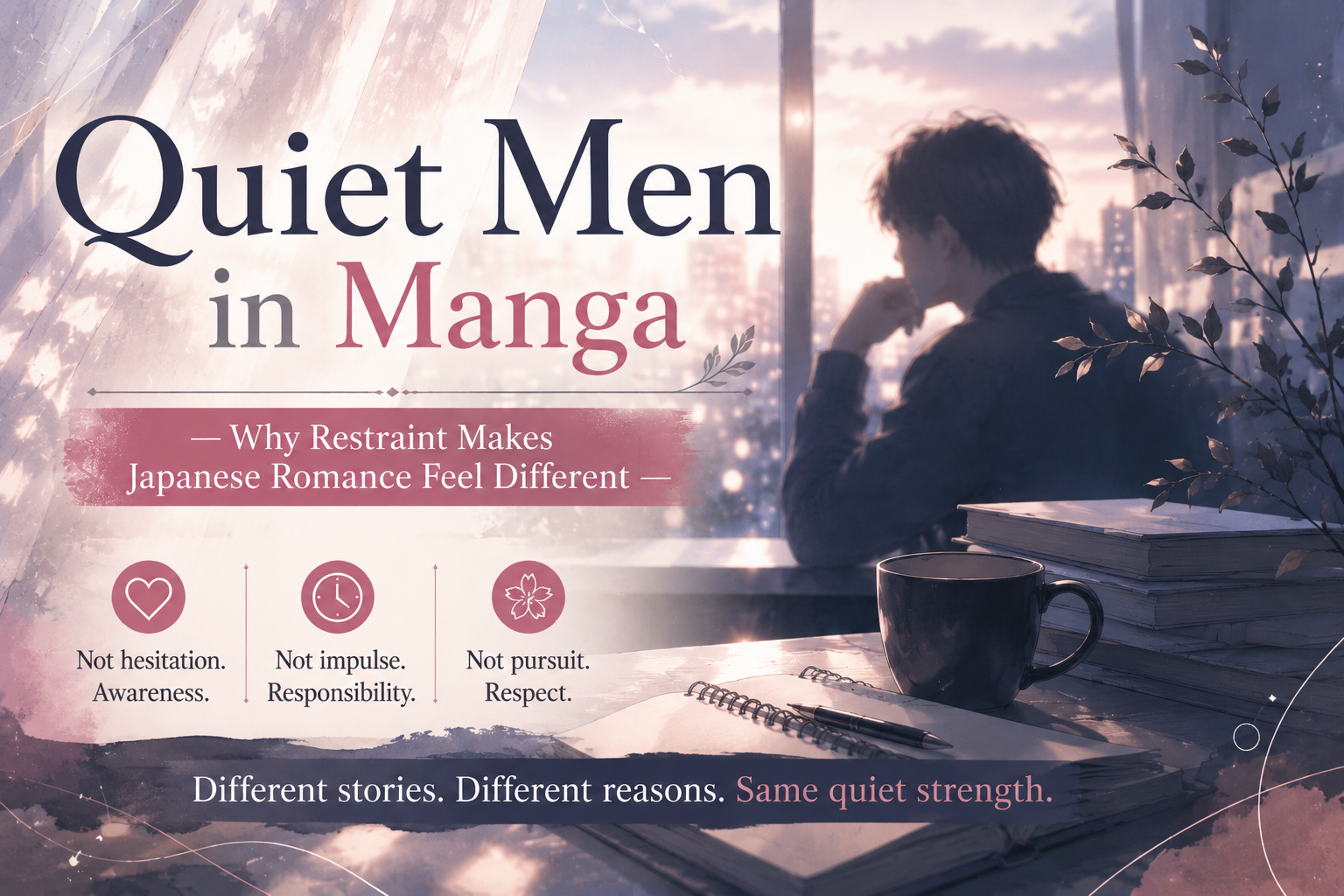
But Japanese romance manga frequently presents a different kind of character:
men who hold back instead of pushing forward.
At first, these characters can feel frustrating. Readers may wonder why they do not simply act on their feelings.
But over time, that restraint becomes exactly what gives these stories their emotional depth.
What Makes “Quiet Men” Different
Quiet men are not passive characters.
In fact, what defines them is often the opposite:
they are fully aware of what they could do.
They know they could confess. They know they could step closer. And sometimes, they know they might even succeed.
But instead of acting immediately, they stop and consider what their actions would change.
This is what separates restraint from hesitation.
Hesitation comes from uncertainty. Restraint comes from awareness.
Why Restraint Feels Powerful in Japanese Romance
Many Japanese romance stories place strong emphasis on emotional responsibility.
Love is not treated as something that automatically justifies action. Characters are expected to think about timing, boundaries, and the emotional position of the other person.
As a result, romance becomes less about “winning” someone and more about how a person handles their feelings.
This creates a very different emotional atmosphere from stories where love is measured primarily through direct pursuit.
Different Types of Quiet Men
What makes these characters interesting is that they do not all hold back for the same reason.
Their restraint reflects different ideas about love, responsibility, and emotional awareness.
ピンクとハバネロ — Kurose Kei and the Weight of Love
Kurose does not approach relationships casually.
Before moving forward, he thinks about whether the relationship can truly last and whether the timing is right. His restraint comes from taking love seriously rather than treating emotions as something immediate.
ゆびさきと恋々 — Shin Iryu and Knowing One’s Place
Iryu understands exactly where he stands emotionally.
Because of that awareness, he avoids forcing his feelings into someone else’s relationship. His restraint is shaped by timing and position rather than fear.
ゆびさきと恋々 — Itsuomi Nagi and Learning Before Acting
Itsuomi does not close the distance in Yuki’s world by assuming he already understands it.
He learns her pace, her language, her rhythm — before he ever asks her to meet his. His restraint is shaped by curiosity paired with respect, not fear.
ゆびさきと恋々 — Oushi Ashioki and the Restraint of Letting Go
Oushi’s restraint looks different from the others on this list, because his story doesn’t end in being chosen.
He has protected Yuki since childhood, certain that closeness would always be enough. When it isn’t, his restraint becomes something harder than waiting for the right moment to act — it becomes recognizing when the right choice is to stop holding on.
ハニーレモンソーダ — Miura Kai and the Decision to Wait
Miura chooses not to rush another person’s growth.
Instead of leading aggressively, he creates space. His restraint reflects trust in another person’s pace rather than a need to control the relationship.
隣のステラ — Takahashi Yudai and Choosing Beyond Himself
Takahashi often acts with awareness of what others need rather than what benefits him emotionally.
Even when it costs him personally, he prioritizes the emotional reality of the situation over immediate reward.
Why These Characters Stay With Readers
Quiet men often remain memorable because their feelings are visible through choices rather than declarations.
Readers are asked to notice:
what a character chooses not to say
when they decide not to interfere
how they carry feelings they cannot resolve immediately
Because these emotions are restrained instead of fully released, they continue to create tension inside the story.
That tension lingers with readers long after the scene ends.
What This Reveals About Japanese Romance
These stories suggest a different definition of romantic strength.
Strength is not always measured by how forcefully someone pursues love.
Sometimes, it is measured by:
how carefully they handle another person’s feelings
how much responsibility they take for their own emotions
whether they can hold desire without immediately turning it into action
This is one of the reasons Japanese romance often feels emotionally layered even in quiet scenes.
Final Reflection
At first glance, quiet men may appear inactive.
But over time, it becomes clear that they are constantly making decisions.
They choose when to step forward. When to wait. When to remain silent. And when not to cross a line.
Their restraint creates emotional tension not because nothing happens, but because so much is being deliberately held back.
And that quiet restraint is one of the defining strengths of Japanese romance manga.
Continue Reading
If this idea of “quiet men” stood out to you, each character reveals a different form of restraint, timing, and emotional responsibility.
Some wait. Some step back. Some stay silent. Some let go.
And those differences completely change the meaning of their relationships.
→ Hak — The Man Who Chose to Stay
If you want to see where Shin, Itsuomi, and Oushi’s stories all begin: → A Sign of Affection — A Manga About Quiet Distance, Care, and Responsibility
Or, if you want to explore how restraint shapes romance itself:
→ Why Responsibility Is Often Misread as Distance
✅ Quiet Heroines in Manga— Why Restraint Isn’t Passivity —
If this idea stayed with you, I share weekly manga moments, emotional reflections, and the quiet scenes I can’t stop thinking about on Substack.
This essay is part of a wider comparison: Why Do Manga Characters Choose Silence Over Confession?