Spoiler Warning: This character analysis contains major spoilers for all 14 volumes of Rainy Day Serenade, including its ending.
If you have not read the manga yet, begin with our spoiler-free guide to Rainy Day Serenade—its story, characters, time-slip mystery, English release, and 2027 anime.
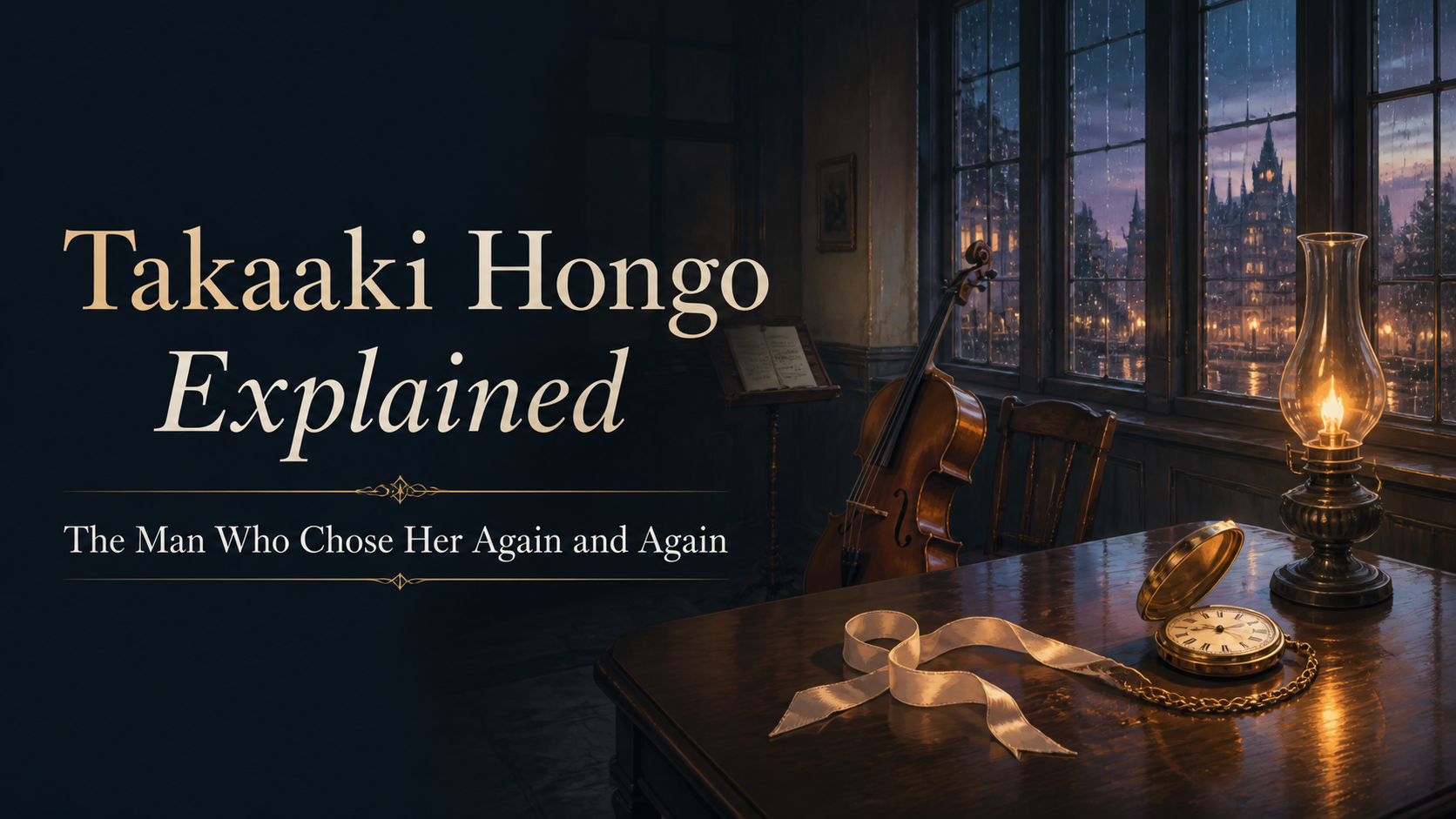
At first glance, Takaaki Hongo appears to be a familiar kind of historical-romance hero.
He is the heir to a wealthy family, possesses the social power Hina lacks, and repeatedly helps a girl stranded far from her own time. His connection with Hina also seems to have been written into their lives long before either of them fully understands it.
Yet describing their love as “fated” does not explain what makes Takaaki’s story so affecting.
The first time he sees Hina, he does not see her for who she is. He mistakes her for his fiancée, Hinako Kitamine.
From that mistaken beginning, Takaaki must learn to recognize Hina as an individual—not a familiar face, not a substitute for another woman, and not someone who exists only to be rescued. As time, memory, and social circumstances repeatedly reshape their relationship, he continues to choose the person standing before him.
Takaaki’s love matters not because destiny makes his choice inevitable, but because he must make that choice again each time certainty disappears.
He Does Not See Hina at First
Takaaki and Hina’s relationship begins with a mistake.
After traveling from the present into a past resembling Japan’s Meiji era, Hina encounters a man who believes she is Hinako, the woman he is expected to marry. Hina and Hinako look remarkably alike, so his confusion is understandable.
But this mistaken identity is more than a convenient plot device. It establishes one of the manga’s central questions: What does it mean to truly recognize another person?
At first, Takaaki places a name and a social role he already knows onto Hina’s face. As long as he understands her as “Hinako Kitamine,” he cannot see the actual woman in front of him.
Hina and Hinako may share the same appearance, but they are not interchangeable. They grew up in different eras, carry different burdens, and want different lives. Each has her own will.
Takaaki’s love therefore cannot fully begin until he moves beyond their resemblance. A face brings them together. The person behind that face makes him stay.
Learning the Difference Means Learning to See Hina
As Takaaki spends more time with Hina, he gradually understands that she is not Hinako.
What matters is that he does not simply replace one label with another after learning the truth. His perception changes through their time together.
He notices how Hina speaks and acts. He sees her disregard rules that his world treats as natural. He learns that she cannot ignore someone in trouble, even when helping puts her at risk. He also sees her determination to stand on her own in a time where she has no secure identity or place to belong.

Through these differences, the woman he once understood as “someone who looks like Hinako” becomes Hina.
This does not mean the story presents Hina as better than Hinako. Instead, Takaaki learns to stop comparing them and to recognize both as separate women.
He does not fall in love with the family name or marital role suggested by Hina’s face. He falls in love with someone whose decisions surprise him, whose values challenge his own, and whose future he cannot control.
Love, in Rainy Day Serenade, is not the act of fitting another person into a familiar role. It begins when Takaaki remains interested in Hina precisely because she exceeds what he expected her to be.
Takaaki Has Power, but He Is Not Entirely Free
Compared with Hina and Hinako, Takaaki holds considerable privilege.
He belongs to a wealthy family, enjoys a respected social position, and has resources that the women around him do not. When Hina is vulnerable, he has the practical ability to protect her.
Power, however, is not the same as freedom.
As an heir, Takaaki is responsible for more than his private happiness. His engagement to Hinako is not merely a romantic understanding between two individuals. It is connected to their families, reputations, and futures.
In the historical society reflected by the manga, marriage—especially between prominent families—could function as an arrangement between households. Personal affection was only one part of a decision shaped by duty, inheritance, and social standing.
From a contemporary perspective, Takaaki’s inability to reject an unwanted engagement immediately may feel frustrating. But ending it would not be a private breakup. It would disturb the expectations of both families and affect Hinako’s position as well as his own.
Historical context does not excuse every painful decision. Nor does understanding Takaaki’s position mean ignoring the greater restrictions placed on women. It does, however, help us understand what his choices cost.
Takaaki is not a rescuer standing safely outside the system that confines Hina and Hinako. He is also caught within it—though his privilege gives him more room to act than either woman has.
Ending the Engagement Is More Than a Romantic Declaration
When Takaaki and Hinako announce their wish to end their engagement before their families, the scene is not simply about choosing “true love” over the wrong partner.
Both are asserting the right to take part in deciding their own lives.
Hinako has a future she wants, just as Takaaki has someone he wishes to choose. Reconsidering their arranged relationship does not require them to treat one another as enemies. On the contrary, it allows them to stop reducing each other to the roles their families assigned them.
For Takaaki to choose Hina honestly, he must also recognize Hinako as more than the woman he rejected. Hinako’s desire to claim her own future forces him to confront the same question: Will he continue down the path selected for him, or will he accept responsibility for a choice of his own?
His family does not simply approve and remove every obstacle. Social obligations do not disappear because he has identified his true feelings.
Takaaki’s growth does not consist of abandoning responsibility in the name of romance. He learns that silent obedience is not the only form responsibility can take. He must state what he wants—and be prepared to live with the consequences.
His Relationship with Hina Is Not a Simple Rescue Fantasy
Takaaki frequently tries to protect Hina. On the surface, this can resemble a familiar romantic pattern: a powerful man rescues a vulnerable young woman.
But Hina never remains a passive heroine waiting for him to determine her future.
She thinks and acts for herself. She takes risks to help others and tries to protect the people she loves, including Takaaki. At times, she even attempts to bury her own feelings because she believes that loving him will make his situation more difficult.
Hina may need Takaaki’s help, but she never becomes his possession. The deeper lesson for Takaaki is therefore not simply how to keep her safe. He must learn how to trust her judgment.
The desire to protect someone can easily become a desire to choose on that person’s behalf. To love Hina as an individual, Takaaki cannot merely create the future he believes is best for her. He must listen to what she wants, even when her decision frightens or hurts him.
Their relationship is not permanently divided into protector and protected. Takaaki gives Hina support in a world where she has no established place. Hina, in turn, shows him that a life beyond inherited expectations may be possible. They save each other, though rarely in the same way.
Time and Memory Cannot Guarantee Their Love
Rain, music, memory, and time travel repeatedly alter Hina and Takaaki’s relationship.
Recognizing their feelings does not guarantee that they can remain in the same era. Even meeting again is uncertain. When memory and recognition shift, the emotional history they have built cannot always be received in the same way.

This is where the idea of destiny becomes insufficient.
Destiny may bring Hina and Takaaki together, but it cannot maintain their relationship for them. It cannot erase their social obligations, keep time from separating them, or ensure that everything they once shared will always be remembered.
When the proof of their previous bond becomes unstable, Takaaki does not have the right to treat Hina’s past love as a permanent promise. He has to reach out to the Hina who exists now.
His music becomes both an appeal to memory and an invitation. He hopes something will reach her, but he cannot force her to return his feelings simply because another version of their relationship once existed.
All he can do is offer himself again.
That makes the ending more moving than a straightforward restoration of what was lost. Takaaki is not merely trying to reclaim the past. He is asking whether they can create another future together.
He Is Not Choosing an Unchanging Woman
To say that Takaaki chooses Hina repeatedly does not mean his love remains untouched from beginning to end. He must choose again because both of them change.
The Hina he first encounters is a mysterious girl he mistakes for Hinako. She later becomes someone precious to him, a woman determined to act on her own convictions, and—through the disruptions of time and memory—someone who may once again feel distant.
Takaaki changes as well. He begins as a young man who understands duty largely through obedience to his family. He gradually becomes someone who can acknowledge his own desires, respect another person’s freedom, and accept the consequences of acting on both.
Once they have changed, the fact that they loved each other before is not enough.
Takaaki must look beyond the Hina preserved in his memories and recognize the person who stands before him now. He cannot demand that she remain the same woman or give him the same answer.
The woman he chooses is not an eternal romantic ideal. She is a person capable of having experiences he does not share, making decisions he cannot predict, and even choosing a life apart from him.
Loving her means accepting that freedom—and reaching for her anyway.
Choice, Not Destiny, Reconnects Them
Hina and Takaaki clearly share a bond that ordinary coincidence cannot explain.
Rain carries people across time. Childhood memories return in fragments. Music continues to connect lives separated by years. Their paths seem intertwined before either of them understands why.
Still, Rainy Day Serenade does not suggest that soulmates will inevitably find happiness without effort.
Destiny cannot prevent mistakes or separation. It cannot remove the expectations of Takaaki’s family. It cannot even guarantee that Hina and Takaaki will remain within reach of one another.
What reconnects them is not destiny alone. It is the effort to see the other person clearly. It is the refusal to take away that person’s freedom. And it is the decision to choose someone again—not because they belonged to you in the past, but because you still want to know the person they are now.
Takaaki does not ultimately choose a face resembling Hinako’s. He does not choose the fiancée’s role his family placed before him. Nor does he wait passively for a “destined woman” whose love is guaranteed.
Whenever their circumstances change, he looks at Hina again and decides that he still wants a life with her.
Those repeated decisions make his love more meaningful than fate.
Why Takaaki Hongo Is Such a Memorable Romantic Lead
Takaaki is not a perfect man who immediately sees beyond every social restriction.
He mistakes Hina for someone else. He struggles against the responsibilities attached to his family and position. His wish to protect Hina can come dangerously close to overlooking her own will.
What matters is that he does not try to complete their love while preserving those misunderstandings.
He learns to distinguish Hina from Hinako and recognize the wishes of both women. He reconsiders the meaning of responsibility instead of using duty as an excuse to avoid choosing. Even after time and memory undermine the assumptions beneath his relationship with Hina, he does not treat her former love as something he owns.
He reaches out again.
Takaaki’s love is not about choosing one person once and claiming her forever. It is about watching another person change, changing alongside her, and trying to build a new relationship each time the old certainty disappears.
Destiny may bring Hina and Takaaki together. But destiny alone is not what keeps their love alive.
What connects them is Takaaki’s willingness to look at the person in front of him—not a familiar face, not a prescribed role, and not merely a woman preserved in his memories—and choose her again.