This spoiler-light guide covers the premise, main characters, historical setting, anime adaptation, and English manga release. It does not reveal the ending or the final romantic outcomes.
On rainy days, high school student Hina Katagiri dreams of an old Western-style house and a mysterious boy she seems to have known as a child.
Then one day, the dream becomes real.
Hina suddenly finds herself in Tokyo in 1907, where a young man named Takaaki Hongo mistakes her for his fiancée. The confusion deepens when Hina meets the real fiancée, Hinako Kitamine—a young woman who looks almost exactly like her.
Written by Haruka Kawachi, Rainy Day Serenade is a time-slip romance set between modern Japan and the rapidly changing society of the early twentieth century. Its official English title is Rainy Day Serenade, while the Japanese title is Namidaame to Serenade.
The series has all the elements of a sweeping romance: recurring dreams, mistaken identity, lost memories, and two people separated by time. Yet it is also a story about something more difficult than destiny.
What happens when love asks you to choose between different lives? Can a woman claim her future when family, marriage, and social status have already decided it for her? And if time changes what two people remember, can they still choose each other again?
Rainy Day Serenade at a Glance
- Japanese title: Namidaame to Serenade
- Official English title: Rainy Day Serenade
- Creator: Haruka Kawachi
- Japanese publisher: Kodansha
- Magazine: Kiss
- Japanese edition: Complete in 14 volumes
- Genres: Time-slip romance, historical drama, mystery
- TV anime: Officially announced for 2027
- English manga: Scheduled as a 2-in-1 omnibus edition
What Is Rainy Day Serenade About?
Hina Katagiri is an active modern high school student and a member of her school’s kendo club. For years, rainy days have brought her strange dreams of playing with a boy in the garden of an old house.
During music class, Hina is suddenly transported to the place from those dreams.
There she meets Takaaki Hongo, a young man who believes she is Hinako Kitamine, the noblewoman he is expected to marry. Hina initially assumes that she must still be dreaming, so she goes along with his mistake.
That explanation becomes impossible when she meets Hinako herself.
Hina and Hinako have nearly identical faces, but they are not interchangeable. They were raised in different eras, carry different memories, and want different things from life.
Hina eventually learns that she has traveled to 1907—Meiji 40 in the Japanese calendar. While searching for a way home, she becomes entangled in the lives of Takaaki, Hinako, and the people around them.
The series gradually expands from a case of mistaken identity into a romance and mystery about time, memory, family obligations, and lives that appear to echo one another.
Why the 1907 Setting Matters
The past in Rainy Day Serenade is not a generic fantasy kingdom. It is Japan during a period of intense social and cultural change.
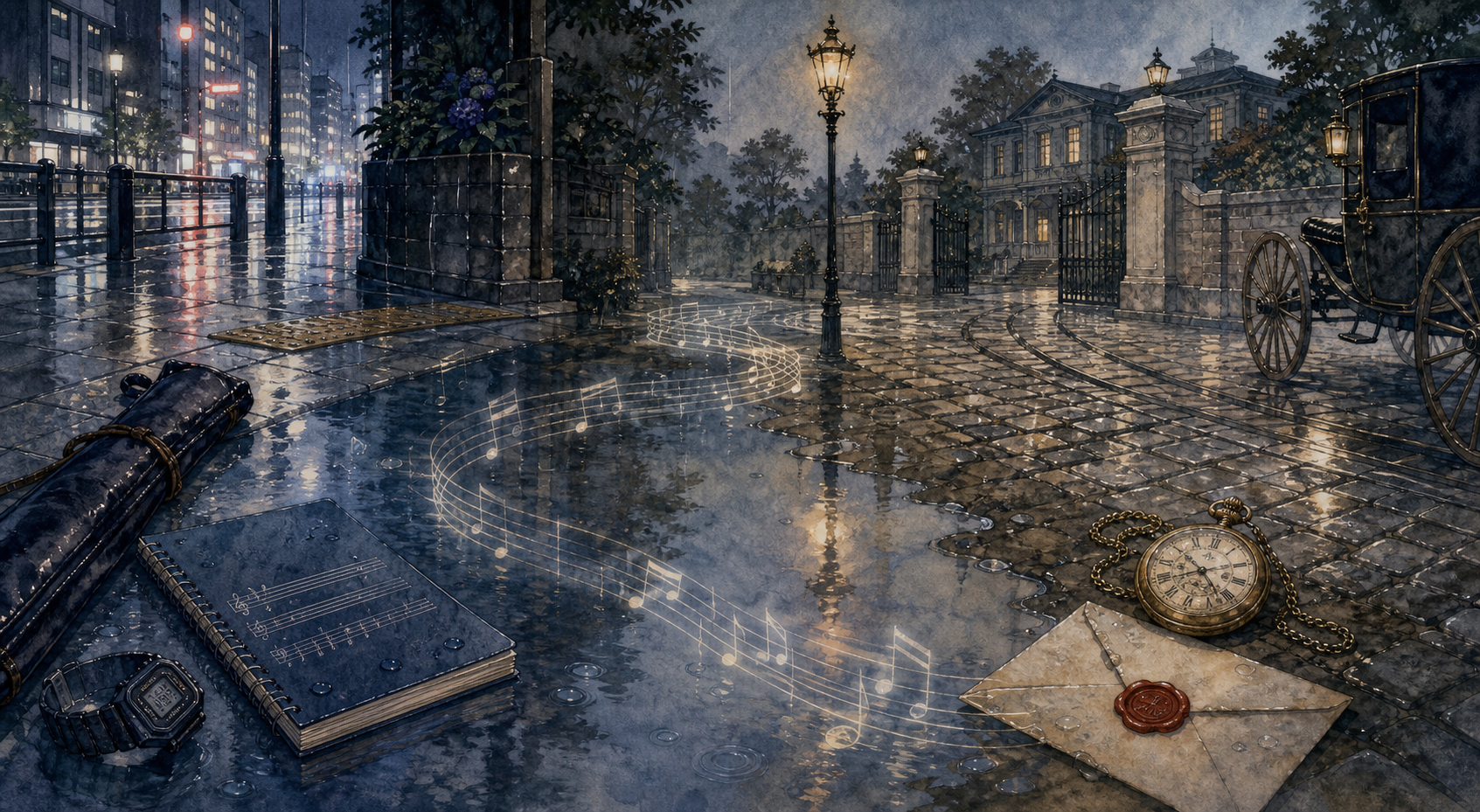
In 1907, Western-style houses, horse-drawn carriages, modern businesses, kimono, and Western clothing could all exist within the same city. New technology and new ways of thinking were spreading, but family status and gender still placed severe limits on personal freedom.
For Hina, the era can appear beautiful and romantic. It is also a society in which a young woman may have little control over whom she marries, where she goes, or what kind of future she is allowed to imagine.
The manga explores arranged engagements, obligations to one’s family, differences in class, the limited movement of upper-class women, and the pressure to preserve a family’s reputation.
Hina’s direct speech and willingness to act are startling to people from this period. However, the story does not reduce the conflict to a modern girl arriving to correct everyone in the past.
Hina also has to learn that personal courage cannot instantly dissolve social structures. The people she meets are not simply waiting for her to give them modern answers. They have responsibilities, fears, and relationships that she must understand before she can truly help them.
The Main Characters
Hina Katagiri
Hina is the modern high school student at the center of the story. She is physically capable, impulsive, and often willing to act before she has considered every risk. Her kendo experience gives her a confidence that contrasts sharply with the behavior expected of a young lady in 1907.
But Hina’s appeal does not come from being a fearless visitor from the future. She is frightened, confused, and sometimes reckless. Her desire to protect someone can make a situation more dangerous. As her connection to the past deepens, she must confront the possibility that returning home and staying beside the people she loves may not be compatible choices.
What makes Hina compelling is her refusal to treat the people of 1907 as characters in someone else’s history. She recognizes them as individuals whose feelings and futures matter.
Takaaki Hongo
Takaaki Hongo is a young heir from a wealthy family and Hinako’s official fiancé. When he first meets Hina, he mistakes her for Hinako. Her unfamiliar behavior confuses him, but he is gradually drawn to her honesty, energy, and willingness to challenge what others accept without question.
Takaaki could easily have been written as a commanding historical-romance hero who solves every problem through wealth or status. Instead, he is a man constrained by the same position that gives him power.
He carries family obligations, grief, and responsibilities that he cannot simply abandon. He is sincere but emotionally guarded, and he does not always have the freedom to separate what he wants from what his family expects.
Hina and Takaaki’s relationship can be described as a love written by fate. Dreams, memory, resemblance, and time all seem to pull them together. Yet the romance becomes meaningful because fate is never enough.
Takaaki must learn to see Hina as herself—not as Hinako, not as a familiar face, and not as someone filling a place prepared for another woman. Hina must also decide whether loving him means surrendering her own life or making an active choice about the future she wants.
For a spoiler-filled look at how duty, memory, and changing circumstances shape his love, read why Takaaki Hongo chooses Hina again and again.
Hinako Kitamine
Hinako is an upper-class young woman living in 1907 and Takaaki’s official fiancée. Although she and Hina share almost the same face, Hinako has her own memories, desires, and understanding of the world. Treating the two women as substitutes for each other would erase the very thing the story asks readers to notice: they are separate people.
Hinako lives in comfort, but her life is tightly controlled. Her family influences where she may go, whom she may meet, and whom she is expected to marry. The freedom Hina takes for granted is almost unimaginable to her.
At first, Hina’s independence can seem dazzling. But Hinako’s development is not about copying the modern girl. She has to find her own language for resistance. Her choices may begin within a narrow space, but they gradually become expressions of a will that belongs to her alone.
Taketora
Taketora is a young man whose life becomes closely connected with Hinako’s. Their relationship faces obstacles that affection alone cannot remove. In a society governed by family rank and social expectations, wanting to be together does not automatically create a future in which that relationship is possible.
Hinako must acknowledge her feelings and decide whether she can act on them. Taketora must also determine whether he will remain within the role assigned to him or choose a different life.
Their story does not claim that love makes inequality disappear. Instead, it asks what people must risk in order to live by their own decisions.
Hina and Hinako Are Not Interchangeable
The resemblance between Hina and Hinako is one of the manga’s central mysteries. Readers naturally wonder why two women from different eras look so alike and whether their connection explains Hina’s recurring dreams. The complete answer belongs to the deeper story and is best discovered in the manga.
What matters from the beginning is that resemblance does not make them the same person.
Hina’s identity was shaped by modern Japan. Hinako’s identity was shaped by the restrictions and expectations of 1907. Each woman has relationships, memories, and desires that the other cannot inherit merely by taking her place.
Hina cannot become Hinako because other people mistake her for Hinako. Hinako cannot gain freedom simply by borrowing Hina’s identity. The two women instead help each other imagine choices that previously seemed impossible.

A Romance About Choosing Again
Many time-travel romances present love as an unchangeable force. Two people belong together because fate has already decided it.
Rainy Day Serenade is more interested in what happens after fate creates the first meeting.
Hina and Takaaki’s relationship begins with a mistake. Takaaki believes she is someone else, while Hina believes the entire situation may be a dream. Their romance therefore cannot become honest until they learn to see each other clearly.
For Takaaki, this means distinguishing Hina from the woman whose position and appearance she seems to share. For Hina, it means confronting what choosing him could cost. She has a life in the present, and love does not automatically make that life disposable.
Time may separate them. Memory may become uncertain. Familiar faces may create mistaken expectations. The emotional question remains the same: when everything that once connected two people has changed, can they still look at each other and choose again?
More Than a Love Story
Romance is central to Rainy Day Serenade, but it is only one part of its appeal.
The manga asks whether a relationship still exists when a memory is lost; whether changing the past can protect one person without taking something from another; whether responsibility to family can coexist with happiness; and whether resembling someone means being able to take that person’s place.
The mechanics of the time slip are not explained all at once. Dreams, objects, music, and seemingly minor encounters gradually gain new meanings as the mystery develops.
That makes the series rewarding as both a historical romance and a carefully constructed time-travel mystery. Early scenes often contain emotional or narrative clues whose importance becomes visible much later.
Women Choosing Their Own Lives
Hina and Hinako seek freedom from very different positions.
Hina comes from a time in which women have far more legal and social choices than they did in 1907. Even so, traveling through time places her in a situation where every possible future may require a painful loss.
Hinako’s restrictions are more immediate. She cannot easily reject an engagement, leave home alone, or publicly choose the person she loves. Her desire for freedom is not selfish rebellion. It begins with recognizing that beneath her obligations to family and status, she possesses a life that should belong to her.
The manga does not judge the past only from a comfortable modern distance. Instead, it shows how much courage even a small act of choice could require from a woman living within that society.
The two women do not replace each other. They remind each other that another future may be possible.
Who Should Read Rainy Day Serenade?
This series is especially worth reading if you enjoy emotionally rich time-travel romance, historical fiction set in early twentieth-century Japan, mysteries that reveal their connections gradually, romance based on choice rather than destiny alone, and heroines confronting marriage and family expectations.
The manga will appeal most to readers who want to follow how characters change, not only learn which couples end up together.
What We Know About the 2027 Anime
A TV anime adaptation of Rainy Day Serenade has officially been announced for 2027.
The official anime website currently confirms the 2027 television adaptation. A more specific premiere date, streaming platforms, cast, and main production staff have not yet been announced there.
The manga’s world seems especially suited to animation. Rain, music, Western-style houses, horse-drawn carriages, kimono, and early modern Tokyo can gain new emotional weight through movement and sound.
One of the most interesting challenges will be differentiating Hina and Hinako. They are supposed to resemble each other, but their voices, posture, expressions, and ways of moving should make it clear that they are two different women.
How to Read Rainy Day Serenade in English
The official English title is Rainy Day Serenade.
Kodansha Comics plans to release the manga in a 2-in-1 omnibus format. The first book, Rainy Day Serenade Omnibus 1 (Vol. 1–2), is currently scheduled for January 19, 2027.
The announced edition contains Japanese volumes 1 and 2 in a 336-page paperback with ISBN 9798888779255. This gives English-language readers a substantial introduction to the mystery and its principal relationships in a single book.
Release dates and specifications can change, so check the official Penguin Random House listing before ordering.
Frequently Asked Questions
Is Rainy Day Serenade complete?
Yes. The Japanese manga is complete in 14 volumes. The official English omnibus release is scheduled to begin in 2027.
Is the historical setting the Taisho era?
Hina first arrives in 1907, which is Meiji 40 in the Japanese calendar. The story takes place in a rapidly modernizing Japan where Western and Japanese architecture, clothing, technology, and customs exist side by side.
Are Hina and Hinako the same person?
They have nearly identical faces, but they possess different personalities, memories, and wishes. The full reason for their resemblance is part of the manga’s larger mystery.
When will the anime premiere?
The television anime is officially planned for 2027. A precise premiere date has not yet been confirmed on the official website.
Is this mainly a romance?
Romance is central, but the series also explores time travel, memory, family obligations, arranged marriage, identity, class, and women’s freedom.
Final Thoughts
Rainy Day Serenade is not simply the story of a modern girl who travels into the past and meets her destined love.
It is about two women with the same face insisting on the right to live different lives. It is about men who must decide whether family duty will define the limits of their future. And it is about love that matters not because fate guarantees its success, but because the people involved keep choosing it for themselves.
Hina, Takaaki, Hinako, and Taketora live within boundaries created by time, memory, class, and marriage. None of them can cross those boundaries without losing something.
Even after separation, confusion, or forgetting, can you recognize the person before you—and choose them again?
With both a TV anime and the first English omnibus planned for 2027, this is an ideal time for international readers to discover Haruka Kawachi’s moving historical time-slip romance.
Related Reading
Explore the wider lineup, including the distinction between shoujo and josei, in Upcoming Shoujo and Josei Anime in 2027.