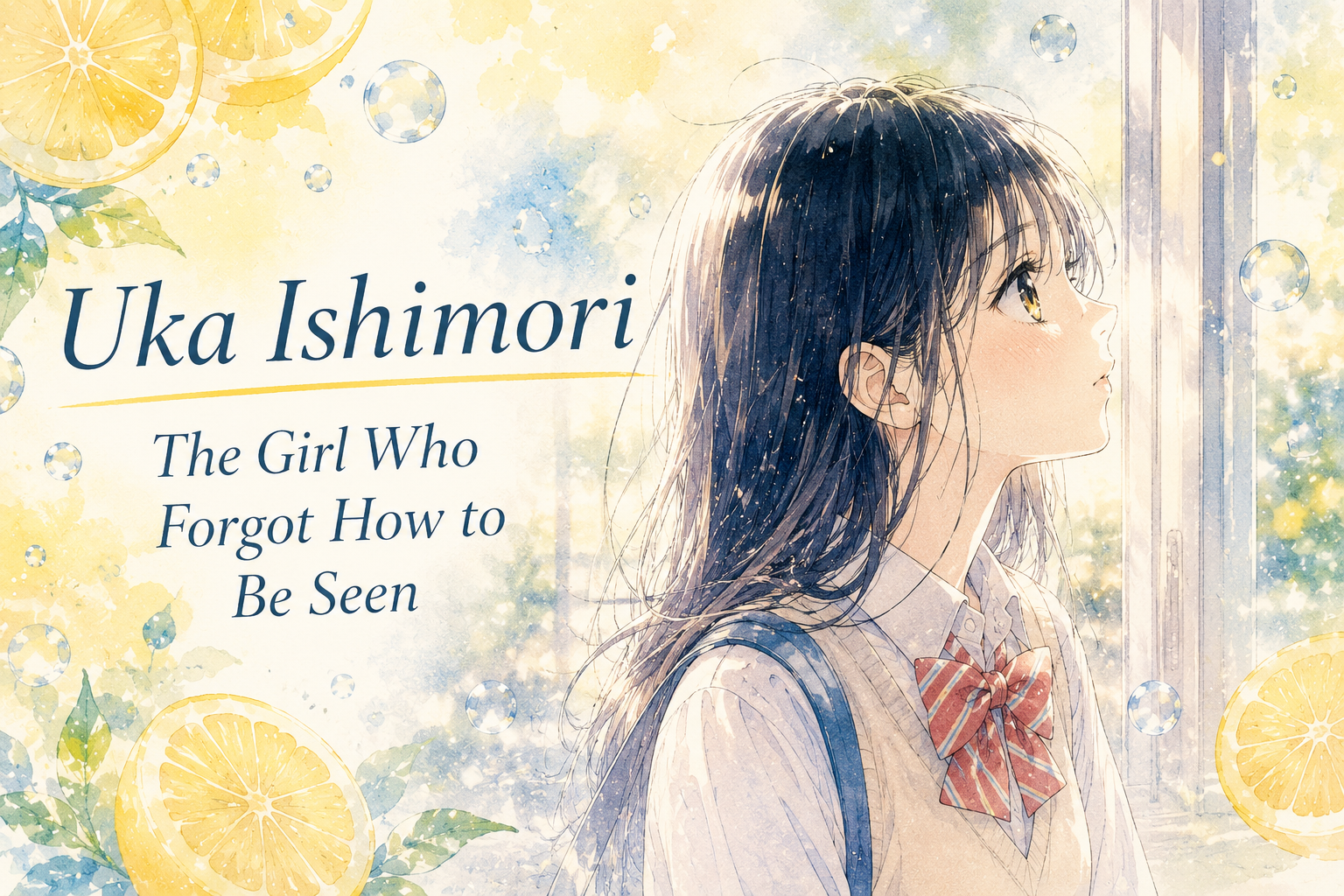
Have you ever been afraid of hearing your own name?
Uka Ishimori was.
Every time someone called out to her, something tightened in her chest — because it never seemed to end well. A joke at her expense. A comment she couldn’t respond to fast enough. Another moment of freezing in front of everyone while the seconds stretched out in silence. So she learned to make herself smaller. To take up less space. To exist as quietly as possible and hope that no one would look her way.
That was her survival strategy in middle school. And for a while, it worked — in the sense that survival strategies work. Not well. Just enough.
The Nickname That Became a Cage
Her surname, Ishimori, contains the word ishi — stone.
It didn’t take long for her classmates to notice.
She didn’t react when they teased her. She didn’t cry when they were cruel. She didn’t fight back when they crossed lines that should never have been crossed. From the outside, she looked unmoved. Untouchable. Cold.
So they called her Stone, and they said it like it was a fact rather than a wound.
The cruelest thing about a nickname like that is how it compounds over time. Each repetition makes it feel a little more permanent, a little more true. And somewhere along the way, Uka began to wonder if they were right — if the girl who couldn’t speak, couldn’t react, couldn’t seem to feel anything in front of other people was simply what she was.
But that was never the truth.
The truth was that she felt everything. She just couldn’t get any of it out.
The Gap Between Feeling and Expressing
This is the part of Uka’s story that I think gets overlooked.
She wasn’t emotionally absent. She was emotionally trapped.
The feelings were there — the hurt, the longing, the desperate wish to just have a normal conversation with someone without her body betraying her. But between feeling something and showing it, there was a wall she didn’t know how to get through. She’d freeze. Her face would go blank. Her voice would disappear. And people would read that blankness as indifference, which made them pull away, which made her feel more alone, which made the wall thicker.
It was a cycle she couldn’t break from the inside. And the longer it went on, the more she started to believe that this was simply who she was — someone who existed just outside the reach of ordinary human connection.
By the time she graduated middle school, she had nearly forgotten what it felt like to laugh freely, to cry without shame, to say hello to someone without rehearsing it first.
One Small, Stubborn Dream
And yet — she didn’t give up entirely.
When she entered high school, Uka carried exactly one dream with her. Not popularity. Not romance. Not any grand transformation. Just this: I want to enjoy being here. Simple words that contained years of longing inside them. She wrote her goals in a notebook. She told herself things would be different. She chose Hachimitsu High School partly because of a single sentence a stranger had said to her once — a boy with lemon-colored hair who had found her crying on the street and had spoken to her like she was worth speaking to.
She assumed he had forgotten her completely.
He hadn’t. But that comes later.
Change That Doesn’t Announce Itself
What makes Uka’s growth so quietly powerful is that it never arrives dramatically.
There’s no single moment where she transforms. No scene where she stands up, delivers a perfect speech, and suddenly becomes someone new. Instead, her development happens the way most real growth happens — incrementally, unevenly, with setbacks folded into the progress. One day she manages to ask a classmate for help. The next week she freezes again in a situation she thought she’d moved past. She takes two steps forward and one step back, and then somehow, over time, she realizes she’s standing somewhere she couldn’t reach before.
This is what makes her arc feel true rather than convenient. Healing from the kind of damage Uka carried doesn’t follow a clean narrative arc. It circles back. It surprises you with what’s still tender. And it asks you, again and again, to choose courage even when the last time you chose it, it didn’t go the way you hoped.
From Surviving to Noticing
The real turning point in Uka’s story isn’t romantic — or at least, it isn’t only romantic.
It’s the moment she starts to have enough space inside herself to notice other people.
In the early chapters, her inner world is almost entirely consumed by the effort of getting through each day. That’s not a criticism; it’s simply what it looks like when someone is still in the process of stabilizing. But gradually, something shifts. She begins to notice when Kai seems quieter than usual. She picks up on the fact that Ayumi is having a hard day before Ayumi says a word. She wants to do something for the people around her — not because she feels obligated, but because she genuinely cares.
That shift — from how do I survive this to how can I be there for someone else — is the most important transformation in the entire story. It’s the difference between someone who has learned to cope and someone who has genuinely healed. And it happened not because Uka was pushed or pulled in the right direction, but because she was given enough consistent safety and belief that something in her could finally relax and open outward.
What the Ending Confirms
The final chapter of Honey Lemon Soda is titled Last Sparkle.
And while that might sound like an ending, I think it’s actually a confirmation — of everything Uka had been building toward since the very first page. The girl who once couldn’t make eye contact became someone capable of standing beside the people she loves with steadiness and warmth. Not because someone fixed her. Not because love solved her problems. But because she kept choosing, one small moment at a time, to believe that she was worth the effort of becoming.
Kai saw that in her before she could see it in herself. But the seeing was always hers to do.
What Uka Leaves With You
Uka Ishimori’s story resonates not because she is exceptional, but because she isn’t.
She was hurt in ordinary ways by ordinary cruelty, and she struggled in ways that felt shameful precisely because they seemed so small from the outside. She wasn’t navigating a grand tragedy. She was just trying to get through a school day without falling apart — and failing at it, repeatedly, in ways she couldn’t explain to anyone.
If her story stays with you after you finish reading, I think it’s because of this:
Not being able to change yet is not the same as being unable to change. Sometimes the bravest thing a person can do is hold onto a small, stubborn dream in the middle of a season that keeps telling them to let it go.
Uka held on.
And that made all the difference.
Keep Reading
→ Honey Lemon Soda — A Manga About Growth, Quiet Support, and the Courage to Change The full story, themes, and why this manga is worth your time.
→ Kai Miura — The Boy Who Waited for Her to Find Her Own Courage The character who believed in Uka before she believed in herself.
→ Honey Lemon Soda Ending — The Boy Who Never Stopped Believing in Her Where Uka’s journey finally arrived — and what it meant.
I also share the small manga moments that stay with me long after reading—the pauses, glances, and choices that never fully leave.
You can follow those weekly reflections on Substack.
✅ My Substack Here!