Spoiler warning: This essay discusses the central relationship and emotional development of the three-volume manga Kake kara Hajimaru Sayonara no Koi. It does not use material from the novel, live-action drama, or sequel.
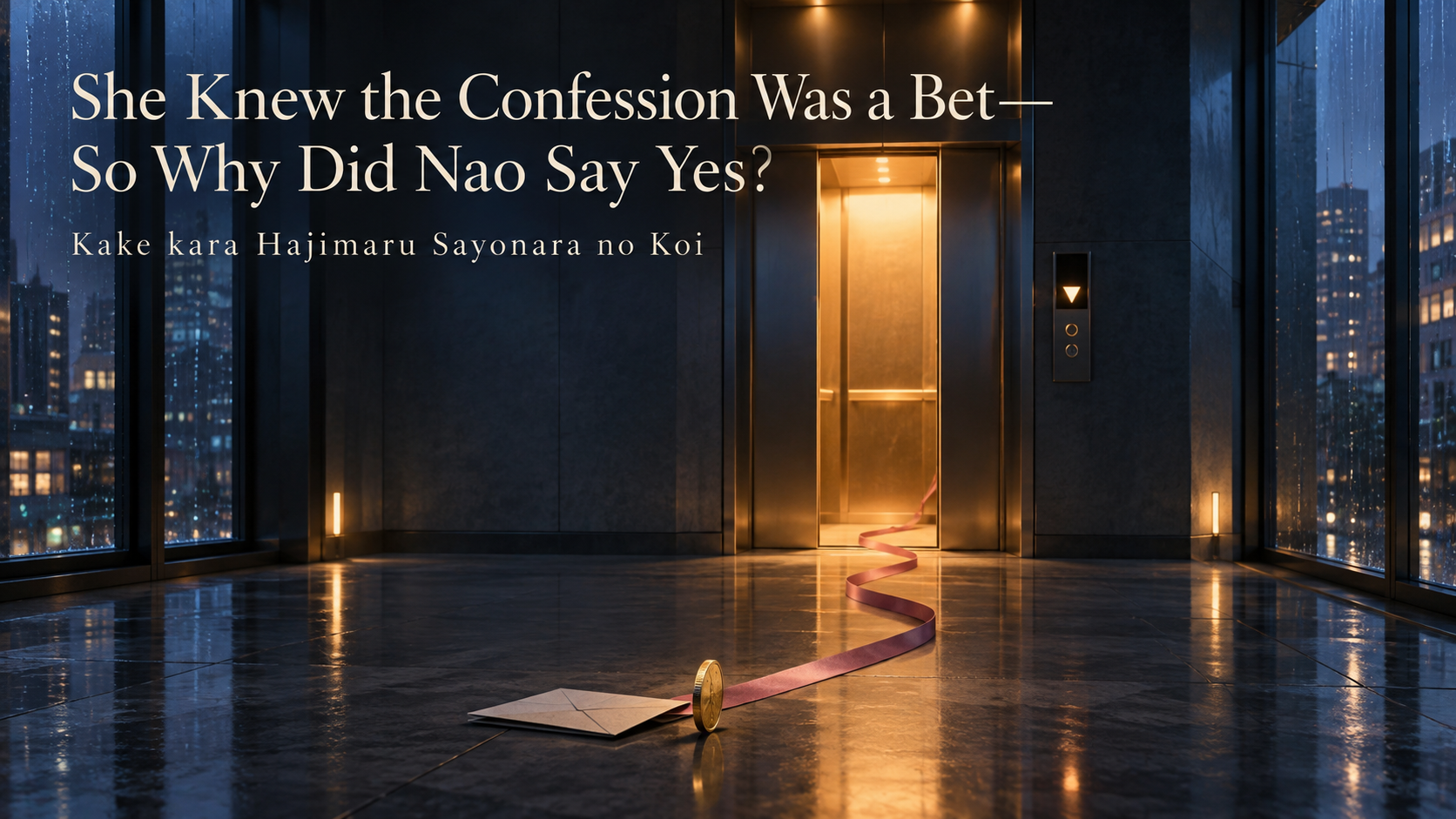
If you knew a confession was not sincere, would saying yes mean that you had been deceived?
Or could it still be a choice of your own?
That uncomfortable question sits at the beginning of Kake kara Hajimaru Sayonara no Koi, a manga written by Porun and illustrated by Watanuki Men.
According to the official Comic Elmo introduction, Nao Yoshinaga is known at work as the “Ice Iron Lady.” One day, she sees senior employees betting on whether Koichi Satomura can make her fall for him. Koichi is not a stranger to her. He is the colleague she has quietly loved for years.
Nao knows how the confession began.
And she accepts it anyway.
The bet is cruel and dishonest. Her decision does not make it harmless. But what stayed with me was that the story does not leave Nao in the simple position of a woman who believes a lie. She sees the danger and still decides that a brief chance to be close to the person she loves may be worth taking.
At first, I understood her immediately.
By the end, I was no longer sure I could make the same choice.
She Was Not Simply Tricked Into Dating Him
The official premise makes an important distinction clear: Nao witnesses the bet before the relationship begins.
That does not remove the imbalance between them. Koichi is still approaching her because of pressure from other men at work, and Nao is still being treated as the object of their game. The story’s later tenderness cannot rewrite that beginning.
But Nao’s awareness changes the emotional question.
She is not asking whether the confession is pure. She already knows it is not. She is deciding what she wants to do with a situation she did not choose.
For years, her feelings have remained private. The person she loves is close enough to see at work, but emotionally out of reach. When the bet creates an opening—even a dishonest one—Nao recognizes that it may be the only opening she will receive.
I do not read her answer as approval of the men who made the bet. I read it as an attempt to reclaim one decision from something humiliating.
They may have created the situation.
But they do not get to decide what the moment means to her.
A Last Memory Can Feel Better Than No Beginning
What made Nao’s choice understandable to me was the sense that her ordinary time beside Koichi would not continue forever.
She is not choosing between a safe, permanent relationship and a risky temporary one. In my reading, she believes separation is already approaching. If she refuses, she may lose him without ever knowing what it feels like to spend time together as more than colleagues.
Before reading the manga, I thought the answer was obvious.
If I were going to stop seeing someone I had loved for years, I would rather have a little happiness with them first. Even if it ended, at least the relationship would leave behind something real: a conversation, a meal, a familiar place, the memory of being chosen for a moment.
Nothing happening at all can feel like its own kind of loss.
Nao’s decision gave shape to that feeling. She does not appear to expect the arrangement to become a secure future. She seems to want one memory that belongs to her before goodbye takes the possibility away.
There is something painfully human in that choice.
Choosing the Beginning Does Not Mean Choosing the Pain
Yet choosing a risk does not mean choosing every consequence that follows.
Nao can decide to enter the relationship. She cannot decide in advance how deeply it will change her.
That distinction matters because people are often judged harshly when they knowingly step into an uncertain situation. We tell them that they understood the risk, as though understanding possible pain makes the pain smaller when it arrives.
It does not.
Nao may know the relationship was born from a bet. She may know that her time with Koichi could be limited. But knowledge cannot keep shared happiness at a safe emotional distance.
Once they spend time together, the relationship is no longer only an idea she can control. Small experiences begin to accumulate. Comfort becomes familiar. The person she expected to remember from afar becomes someone connected to ordinary parts of her life.
She chose to begin.
She did not choose for the eventual goodbye to be easy.
Happiness Makes a Planned Goodbye Harder
This was where my response to Nao began to change.
At first, I believed that beautiful memories would always be better than no memories. But the happier a memory is, the more places it creates for us to return to.
A season can bring someone back.
So can a familiar meal, a song, a scent, a street, or the particular quiet of an evening that resembles one you once shared.
Memories can be treasures. They can also arrive when we did not ask for them.
The more meaningful Nao’s time with Koichi becomes, the harder it is to treat their relationship as a temporary gift she can neatly store away. Happiness increases the value of what she has—and, at the same time, increases what she may have to lose.
By the time I finished the manga, I could no longer say as easily that I would make the same choice.
Perhaps those memories would become beautiful one day. But “one day” may come only after a long period in which every reminder hurts.
Choosing happiness for a limited time can still be brave.
It can also make goodbye much heavier than we imagined.
His Later Feelings Do Not Erase the Beginning
Koichi’s position also becomes more painful as the relationship changes.
The feelings that develop later may be sincere. His guilt and his fear of being hated can be understandable. I could feel sympathy for the way affection makes the truth harder for him to reveal.
But sympathy is not the same as justification.
The original bet remains wrong, and delaying the truth creates another wound. Loving someone later does not give a person permission to decide that the beginning no longer matters.
This is one reason the story affected me. It allows two emotional truths to exist together.
Koichi can be frightened because his feelings have become real.
Nao can still be hurt by what he and the others allowed to happen.
His sincerity does not cancel her pain. Her awareness of the bet does not cancel his responsibility.
Their relationship becomes moving not because the deception was secretly romantic, but because both people eventually have to face what their choices have created.
An Understandable Choice Is Not Always an Easy One to Repeat
I still understand why Nao said yes.
She had loved Koichi for a long time. The chance in front of her was flawed, but it was also real enough to touch. When goodbye already seemed close, accepting a short happiness may have felt less painful than allowing the relationship to end before it had ever begun.
What changed for me was not my sympathy for her.
It was my confidence that happy memories are always the kinder choice.
Nao’s decision reminds me that choosing to begin something and being protected from heartbreak are not the same. We can make a decision with open eyes and still discover feelings we could not measure beforehand.
That does not make the choice foolish.
It makes it human.
If you knew that happiness might make the goodbye harder, would you still choose to begin—or would you protect yourself by leaving the relationship untouched?
For verified Japanese publication information, see the official Comic Elmo page. If you are looking for legal Japanese editions or want to check whether an official English release has become available in your region, use our guide to reading manga legally online. As of October 16, 2026, this article does not present any English edition or translated title as officially confirmed.