
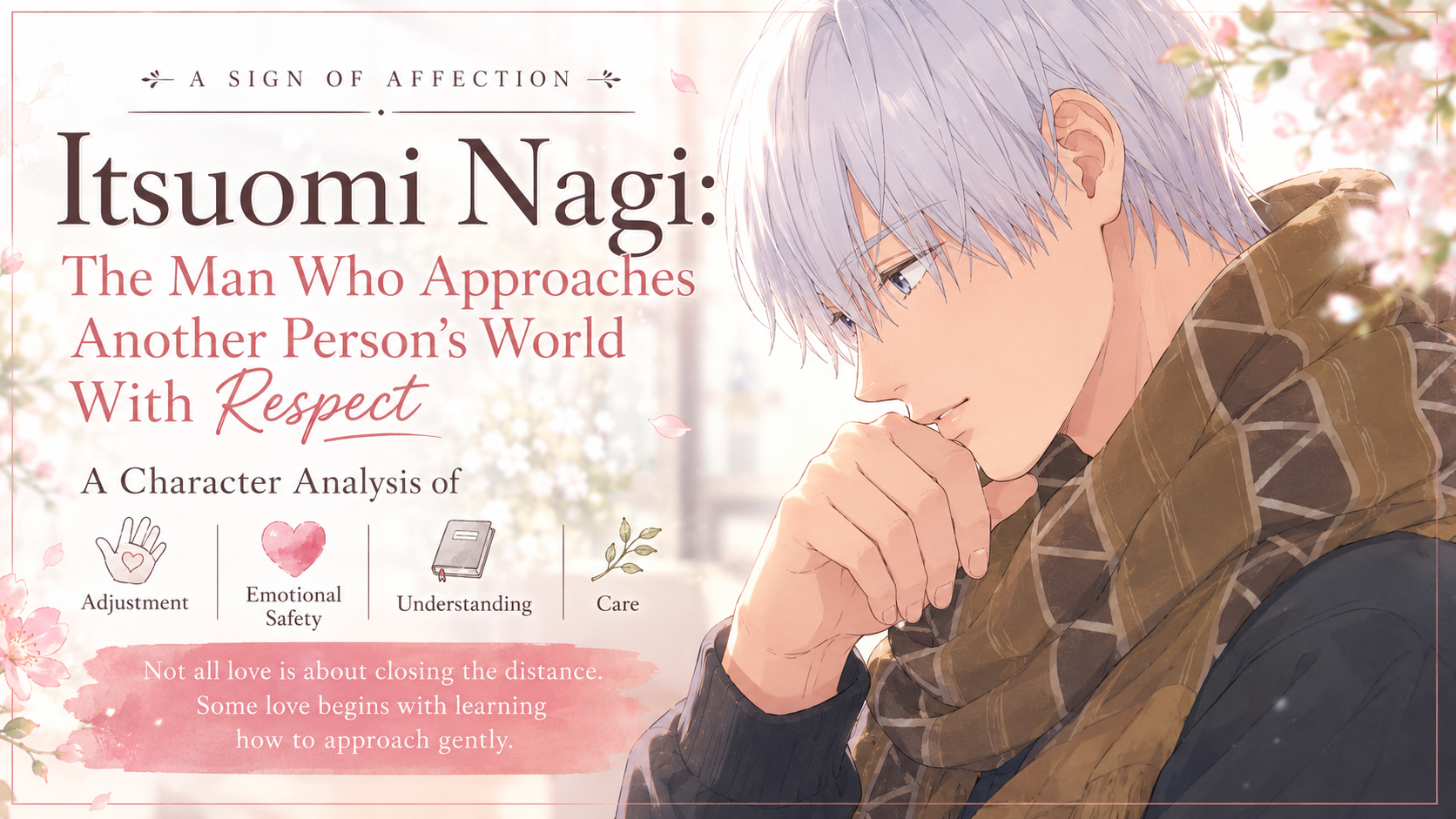

A Character Analysis of Adjustment, Emotional Safety, and Care Through Understanding in A Sign of Affection
Some characters stand out because they are charming.
Others because they are kind. Others because they pursue love intensely and without hesitation.
Itsuomi Nagi is different.
What makes him memorable is not charm alone, or even kindness by itself.
It is the way he approaches another person’s world—
carefully, deliberately, and without assuming he already understands it.
(In A Sign of Affection, the manga this character comes from, love is never built through urgency.)
It is shaped through attention, adjustment, distance, and the willingness to understand someone before moving closer to them.
The Situation He Was In
Itsuomi meets Yuki Itose in a moment of disconnection.
Yuki lives in a world where communication is not centered around sound.
Her world is built through:
sign language
text
expression
visual awareness
subtle shifts in attention
Itsuomi, meanwhile, moves freely through entirely different environments.
He travels constantly. He moves between languages and countries naturally. His life is fluid, social, and always expanding.
The two of them do not begin from familiarity.
They begin from difference.
And importantly—
the story never treats that difference as something to erase quickly.
Instead, it becomes something Itsuomi chooses to understand carefully.
The Man Who Adjusts Himself First
Many romance stories frame closeness as pursuit.
Itsuomi approaches closeness differently.
He does not immediately force his way into Yuki’s world. He does not try to define her experiences for her. He does not romanticize her differences. And he never treats her as fragile.
Instead, he adjusts himself first.
This is what makes him unusual.
Itsuomi changes:
his communication style
his pacing
his attention
the way he enters shared spaces
the way he expresses presence
before expecting emotional closeness in return.
Most importantly—
he never asks Yuki to enter his world first.
He moves toward hers.
Quietly. Carefully. Without making that adjustment feel performative.
Learning Before Acting
One of Itsuomi’s defining traits is that he chooses learning before certainty.
He watches carefully. He listens in ways that do not rely on sound. He pays attention to timing. He learns sign language. He learns how Yuki experiences space and interaction.
And this matters because his actions are never driven only by attraction.
They are driven by awareness.
Itsuomi understands something fundamental:
To care for someone is not to enter their world freely.
It is to understand how to enter it without taking it over.
That distinction changes the emotional structure of the entire romance.
Because his goal is never simply:
“How do I get closer?”
Instead, he asks:
“How do I exist in this person’s space without disrupting who they already are?”
Care Through Adjustment
Itsuomi’s love is not loud.
It is adaptive.
This is one of the most important things about his character.
Many people express affection by increasing intensity.
Itsuomi expresses affection by increasing understanding.
He adjusts naturally to the other person’s pace. Not because he lacks confidence— but because he prioritizes emotional safety over emotional urgency.
This creates a very different kind of romantic atmosphere.
Yuki is not overwhelmed. She is not emotionally cornered. She is given room to move at her own speed.
And because of that, the relationship feels safe.
Not passive.
Safe.
Movement Without Abandonment
At the same time, Itsuomi’s character is not entirely emotionally simple.
He is someone constantly moving.
through countries
through languages
through experiences
through social spaces
His adaptability comes from motion.
And this creates a quiet emotional tension underneath the romance.
Because someone who moves so freely can also feel difficult to hold onto.
Itsuomi is not the type of character who stops moving completely for love.
Instead, he creates closeness while continuing to move forward.
This matters because Yuki’s fear is not simply distance.
It is the possibility of being left behind emotionally.
And what makes Itsuomi compelling is that he never dismisses that fear.
Instead, he continuously adjusts so that closeness can exist without abandonment.
What This Reveals About Japanese Romance
Itsuomi reflects a recurring idea often found in Japanese romance storytelling:
understanding comes before expression
adjustment comes before intimacy
presence matters more than dramatic declaration
In this structure, love is not proven through intensity alone.
It is shown through:
awareness
pacing
consistency
attentiveness
restraint
Itsuomi embodies a form of care that is quiet, but deeply intentional.
He does not try to overwhelm Yuki with emotion.
He tries to understand how to stand beside her properly.
And that difference changes the feeling of the romance completely.
What Yuki Receives From This
Itsuomi changes himself before asking Yuki to change. That much doesn’t shift.
But what this means for Yuki is easy to overlook: she is never asked to perform understanding on someone else’s terms. She isn’t required to explain herself more clearly, adapt faster, or meet him halfway before he’s willing to meet her at all.
That is why his affection reaches her without feeling invasive — not because he suppresses his own presence, but because he never makes his presence her responsibility to manage.
Final Reflection
Itsuomi Nagi is not memorable because he changes Yuki’s life.
He is memorable because he does not try to control it.
He approaches her world with curiosity. He stays with patience. And he moves closer only after learning how to do so carefully.
In a genre often built on emotional intensity, Itsuomi represents something quieter:
the idea that understanding someone requires more than emotion.
It requires restraint. Attention. Adjustment.
And the willingness to move carefully inside another person’s world.
Related Reading
✅ A Sign of Affection — A Manga About Quiet Distance, Care, and Responsibility
✅ Yuki Itose Explained — Beyond the Trope
✅ Shin Iryu Explained — Restraint as Care
✅ Oushi Ashioki Explained — Letting Go
✅ Emma Nakazono Explained — Loving Anyway
✅ Kyouya and Rin Explained — No Rush
If this idea stayed with you, I share weekly manga moments, emotional reflections, and the quiet scenes I can’t stop thinking about on Substack.