If you could recover something you had lost, what would you be willing to give in return? I began The Tunnel to Summer, the Exit of Goodbyes thinking about that question. By the end, I found myself asking something different: what must we not lose from this point on?
The quiet connection between Kaoru and Anzu stayed with me long after the film ended. After a brief, spoiler-free introduction, I explore how their choices changed the way I thought about loss, time, and the future still ahead of us.
About The Tunnel to Summer, the Exit of Goodbyes — Spoiler-Free
The Tunnel to Summer, the Exit of Goodbyes is a Japanese animated science-fiction romance directed and written by Tomohisa Taguchi.
Kaoru is a high school student living with a painful past. Anzu is a transfer student trying to make room for her own dream. Together, they investigate the Urashima Tunnel, a mysterious place said to grant a person’s deepest wish in exchange for time.
The premise sounds like a story about obtaining what you want. The film gradually turns it into a question about loss, the cost of longing, and what two people may discover while pursuing separate wishes.
This article is a personal reflection based on watching the anime film.
The Official English Light Novel and Manga
As an Amazon Associate I earn from qualifying purchases.
The film is based on Mei Hachimoku’s light novel, illustrated by Kukka. The official English edition is published by Airship, an imprint of Seven Seas Entertainment.
The manga adaptation, The Tunnel to Summer, the Exit of Goodbyes: Ultramarine, is illustrated by Koudon and published in English by Seven Seas in four volumes. If the film has made you curious about the books, you can explore the original novel or begin with the first manga volume.
- View the light novel on Amazon.com — English paperback
- View Ultramarine Vol. 1 on Amazon.com — English paperback
Below, I return to what stayed with me after watching the film.
Spoiler warning: The reflection below discusses the ending of The Tunnel to Summer, the Exit of Goodbyes.
The Urashima Tunnel is introduced as a place where you can recover what you have lost, in exchange for time.
Before I watched The Tunnel to Summer, the Exit of Goodbyes, I understood that idea literally. If something precious had disappeared from your life, perhaps the tunnel could give it back.
By the time the film ended, however, the tunnel meant something different to me.
Perhaps it is not a place that simply returns what was lost.
Perhaps it is a place that makes you understand what you must not lose.
That change in meaning shaped the way I saw both Kaoru and Anzu. Kaoru is the one who enters the tunnel carrying a past he cannot repair. Anzu enters the investigation with her own desire and uncertainty, but I did not feel that the tunnel itself transformed her in the same way. What moved her most, I think, was Kaoru.
A Tunnel That Does Not Choose for You
Kaoru is surrounded by losses and family pain that he did not have the power to prevent.
His younger sister is dead. His family has broken apart. He lives with grief, blame, and circumstances that cannot be undone simply because he wishes hard enough.
There are problems in life that cannot be solved by finding the right explanation. We may carry them quietly because there is no action that can restore everything to the way it was.
Watching Kaoru, I began to feel that the Urashima Tunnel was not really offering him an answer. It was forcing him to remain with his desire long enough to understand it.
The tunnel does not gently tell him what matters. It does not remove his grief or decide his future for him. Instead, it separates him from ordinary time and leaves him facing the question he has been unable to settle:
What does he truly need now?
This is only my interpretation of the film, not an explanation of the tunnel’s official rules. But the years that pass outside felt meaningful to me for this reason. They seemed to represent the time Kaoru needed in order to make a choice for himself.
To me, the tunnel seems less like a place that gives Kaoru a new life than a place that leaves the decision with him. It gives him time to recognize what he cannot change—and what he does not want to lose now.
What Kaoru Gives Anzu Is Not Talent
Anzu also approaches the tunnel because she wants something. She doubts her ability to become a manga artist and fears that she may not possess enough talent.
Yet I did not come away believing that the tunnel gave Anzu her future.
Kaoru’s words and his belief in her seem to reach her more deeply than the tunnel’s promise does. Through him, she begins to see that her work may already have value—and that she can move forward without waiting for a supernatural place to make her worthy.
That does not mean Kaoru creates her success for her.
Anzu is the one who makes the decision. She is the one who continues drawing, works through uncertainty, and builds a life during the years he is gone. Her progress belongs to her.
Still, I felt that much of what carries her forward remains connected to Kaoru. She wants to keep moving. She wants him, if he returns, to see the person she has worked to become.
Investigating the tunnel gives Kaoru and Anzu the chance to know each other, but it is Kaoru’s presence that changes what Anzu believes is possible.
And it is Anzu’s own effort that turns that possibility into a life.
The Hands Beneath the Fireworks
One of the scenes that stayed with me most takes place during the summer festival.
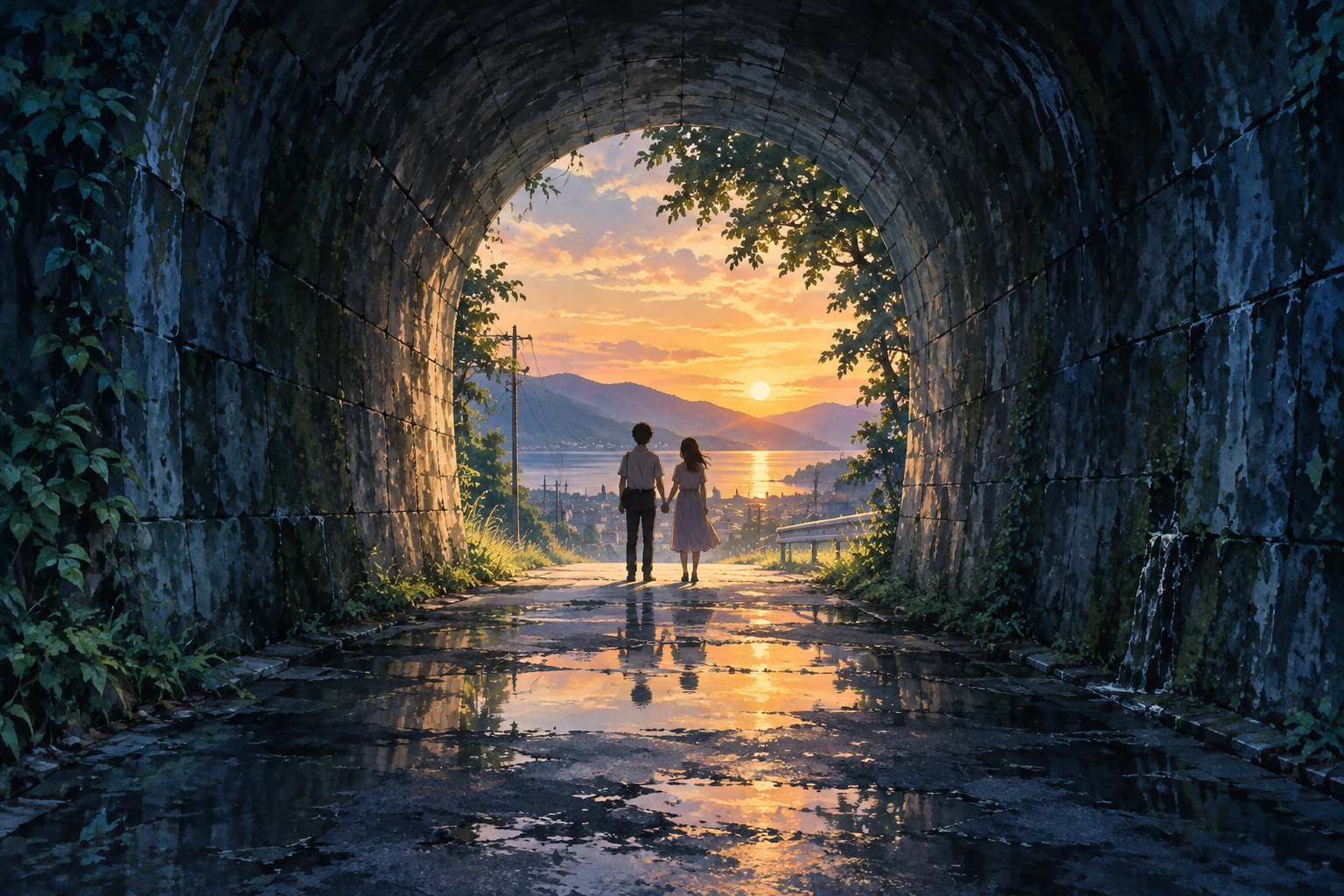
Kaoru and Anzu watch the fireworks together. Without exchanging words, they gently take each other’s hand.
That small gesture feels like a sign of their resolve, as though both have already begun to make a choice.
They are no longer only two people investigating a strange tunnel for separate reasons. Something outside the tunnel has become precious to them.
That is what makes the scene beautiful to me—and what makes everything that follows hurt more.
The tunnel promises access to what they believe they lack. The joined hands suggest that, without fully recognizing it yet, they have already found something they could lose.

Room to Think About What Comes Next
The ending asks us to accept an enormous difference between time inside the tunnel and time outside it.
In ordinary life, I often feel chased by time. It is easy to worry that I am late, that I have missed my chance, or that too much time has passed to begin something important.
But from Anzu’s words near the end, I received a different feeling: they could think about what comes next from here.
That moment allowed me, briefly, to step away from the urgency I usually attach to time. When we are trying to understand what truly matters, perhaps the amount of time that has passed does not have to decide everything for us. A future does not become meaningless simply because it did not begin when we expected.
Anzu’s years still contain effort, waiting, uncertainty, and life without Kaoru. She does not stand still; she keeps drawing and becomes the person who meets him again through her own choices. Remembering that weight makes her willingness to look ahead feel even more moving to me.
Her words seemed to create room after all that time: room to stop counting what had already passed, and to begin thinking about what they could do now.
Final Thoughts: What Must Not Be Lost
At first, I thought the Urashima Tunnel was about receiving something that had disappeared.
After watching the ending, I wondered whether it returns something less literal.
Kaoru cannot rewrite every part of his past. Anzu does not receive artistic ability without effort. The years outside do not come back.
But Kaoru comes to understand what he still has the power to choose. Anzu finds the resolve to trust her work and keep going. And both of them come to recognize that being together again belongs to the future they want.
So perhaps the tunnel’s real effect is not to grant a wish.
Perhaps it brings a person to the point where they must decide what they are no longer willing to lose.
What I felt was quiet and personal: when something truly important becomes clear, the fact that time has passed does not always have to be the end of the story.
The tunnel did not simply return what Kaoru and Anzu thought they had lost. In my eyes, it helped make visible what they must not lose from that point on.
Explore the Story in Print
If this film has stayed with you too, the original light novel and the manga adaptation offer two ways to explore the story on the page.