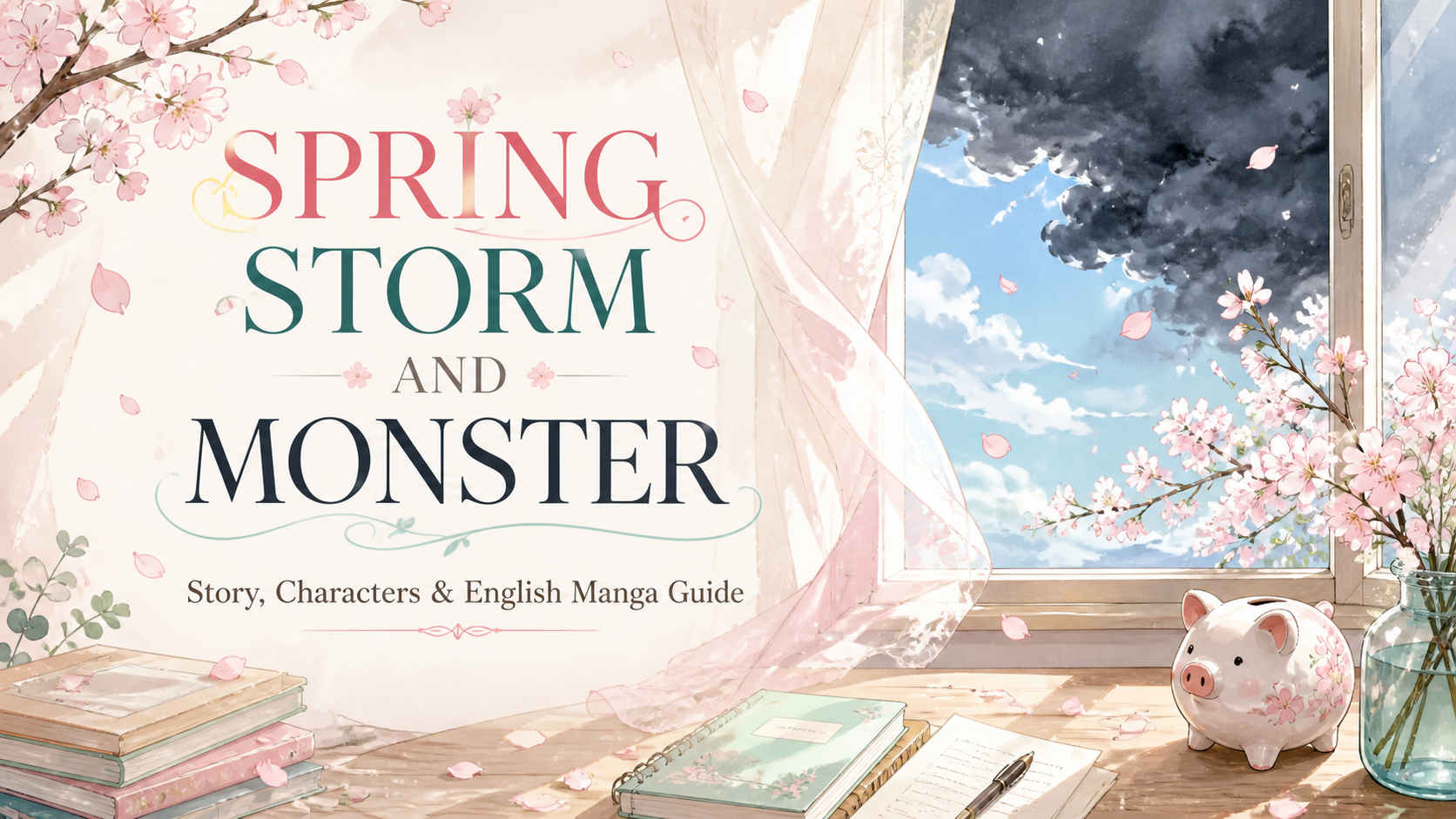
Ranko wants a quiet life in which she can avoid other people as much as possible. Kaya responds to fear and anger with violence, and crosses personal boundaries before anyone can prepare for him.
Spring Storm and Monster begins when these two opposites become stepsiblings after their parents marry. At first glance, it may look like another shoujo manga about a quiet girl drawn into the orbit of a dangerous boy. But its most difficult questions concern family, attachment, control, and whether understanding someone’s pain means accepting everything they do.
This spoiler-light guide introduces the story, its central characters, the official English release, and the boundaries readers may want to consider before starting.
What Is Spring Storm and Monster?
Spring Storm and Monster is an ongoing Japanese shoujo manga by Mitsubachi Miyuki. Its Japanese title is Haru no Arashi to Monster (春の嵐とモンスター), and it is serialized in Hakusensha’s Hana to Yume.
Miyuki is also the creator of Cheeky Brat and Stray Cat & Wolf, both of which are available in English.
- English title: Spring Storm and Monster
- Japanese title: Haru no Arashi to Monster (春の嵐とモンスター)
- Creator: Mitsubachi Miyuki
- Japanese publisher: Hakusensha
- Magazine: Hana to Yume
- Genres: shoujo manga, school life, family drama, romance
- Japanese release: ongoing, with 11 volumes available as of August 11, 2026
- English publisher: Yen Press
- English release: Volumes 1–5 available; Volume 6 scheduled for October 27, 2026
Japanese Volume 11 was released on July 17, 2026. The Japanese and English editions follow different publication schedules, so the number of volumes available in Japan should not be confused with the number currently translated into English.
A Spoiler-Free Story Introduction
Ranko Haruno is a first-year high school student who wants to move through life almost like air: unnoticed and undisturbed. She does not seek a large circle of friends or dramatic experiences. Her mother and her pet pig are the only companions she believes she truly needs.
That carefully protected life changes when her mother remarries.
Her new stepbrother is Kaya Amamine, a middle school student capable of throwing someone to the ground in public. He is volatile, distrustful of adults, and difficult to predict—the kind of person Ranko has spent her life trying to avoid.
Kaya’s behavior is connected to the environment in which he grew up. Yet having reasons for his behavior is not the same as having permission to frighten, restrain, or control another person.
Ranko does not simply reject him. She wants to protect her mother’s new happiness, and she tries to understand Kaya as a member of her family. Kaya, unused to someone who continues to face him instead of abandoning him, begins directing an increasingly powerful attachment toward her.
The story therefore begins with two young people who have very different survival strategies: Ranko avoids conflict by making herself smaller, while Kaya tries to prevent rejection by overwhelming the people around him.
The Main Characters
Ranko Haruno
Ranko is not emotionless or naturally uninterested in other people. Her withdrawal is a way of protecting herself from the exhaustion and uncertainty of relationships.
Once Kaya enters her home, she can no longer avoid every difficult interaction. Her kindness becomes central to the story, but kindness does not always produce a safe result. Trying to understand Kaya can slide into tolerating behavior that frightens her or limits her choices.
One of the aspects that stood out to me while reading the Japanese manga was Ranko’s gradual movement away from pure self-sacrifice and toward expressing her own will. She is not compelling simply because she tries to save a troubled boy. Her growth also concerns learning what she fears, what she can accept, and what she has the right to refuse.
Kaya Amamine
Kaya is the middle school student who becomes Ranko’s stepbrother. He expresses fear and anger through aggression and closes emotional distance before the other person has agreed to that closeness.
Yen Press has described Kaya as a boy from a broken home who was repeatedly placed with different relatives and rejected by people who should have provided safety. That history helps readers understand why he does not trust adults and why abandonment feels like an immediate threat.
It should not, however, be treated as a blanket excuse. Kaya is more complicated than the familiar “forceful boy who is secretly gentle.” His need for Ranko contains affection and vulnerability, but it can also become dependence, possession, and an attempt to keep her world small enough that she cannot leave him.
Understanding him requires holding two facts at once: he is a hurt child who has not learned how safe relationships work, and his actions can still frighten and harm other people.
Nasu
Nasu is connected to Ranko’s school life and to the possibility that her world could grow beyond the home she shares with Kaya. Yen Press uses the spelling “Nasu” in the official English edition.
It is easy to introduce him only as part of a love triangle, but his role also raises a larger question: can Ranko form friendships and relationships outside the closed emotional space Kaya wants to preserve?
This guide will not reveal how those relationships develop. Nasu’s choices, and Kaya’s response to them, are better discussed in a separate spoiler-marked character essay.
Why This Is More Than a Romance with a “Dangerous Boy”
Shoujo manga sometimes uses a male character’s exclusive attention as an intense romantic fantasy: he may be cold to everyone else, but the heroine alone can reach him.
Spring Storm and Monster contains that kind of emotional contrast. Kaya’s rare moments of honesty or gentleness can be striking precisely because they appear inside such unpredictable behavior.
In my Japanese article, I wrote about how much I enjoy Mitsubachi Miyuki’s timing: the moment when a guarded character unexpectedly becomes honest, or when kindness appears from someone who seemed incapable of it. Those shifts remain part of this manga’s appeal.
But the story becomes more interesting when Kaya’s intensity is not automatically translated into proof of healthy love. A feeling can be sincere without giving someone the right to control another person. Needing Ranko does not make her his possession.
If we focus only on Kaya’s dangerous actions, we may reduce him to someone who was simply born bad and miss the story’s concern with a child who never learned what safety looks like. If we focus only on his wounds, we risk erasing the fear and burden his actions create for Ranko.
The manga keeps readers between those interpretations. We can be moved by Kaya’s vulnerability while still asking whether Ranko’s boundaries are being respected.
Protecting Family—and the Problem of Boundaries
Ranko’s willingness to remain beside Kaya is shaped not only by sympathy. She also does not want to destroy her mother’s new happiness.
Japanese stories often depict someone suppressing discomfort in order to preserve harmony inside a family or group. The reasoning is familiar: if I endure this quietly, everyone else can remain happy.
That form of self-restraint is present in Ranko’s kindness. Yet becoming family is not an agreement to accept everything another person does. Being Kaya’s stepsister does not make her solely responsible for saving him, and learning about his past does not require her to place her own safety last.
Setting a boundary is also not the same as abandonment. “You matter to me” and “I will not accept this behavior” can both be true.
In fact, Kaya cannot build a lasting relationship until he understands that difference. Preventing someone from leaving is not the same as creating a reason for them to stay.
Ranko’s development therefore involves more than choosing a romantic partner. Can she trust her own discomfort? Can she express a refusal instead of remaining silent to protect someone else? Can she care for another person without disappearing inside that person’s needs?
The stepsibling premise does create romantic tension, but it also creates a setting in which love, family responsibility, dependence, and personal boundaries can become dangerously difficult to separate.
Where Can You Read Spring Storm and Monster in English?
Yen Press publishes the official English edition of Spring Storm and Monster. As of August 11, 2026, Volumes 1–5 are available, and Volume 6 is scheduled for October 27, 2026, in both paperback and digital formats.
The official Yen Press series page links to authorized retailers for each volume. Paperback sellers include Amazon, Barnes & Noble, Books-A-Million, Indigo, Kinokuniya, and the Crunchyroll Store. Digital options include Kindle, Apple Books, BookWalker, Kobo, and Google Play. Availability varies by country.
The Japanese edition is published by Hakusensha and has reached Volume 11. The official Japanese Volume 11 page lists authorized print and digital retailers.
This site does not link to unauthorized scans, raw-manga sites, or services whose licensing status is unclear. For more options, see our guide to where to read Japanese manga legally online.
Does Spring Storm and Monster Have an Anime?
No. As of August 11, 2026, no TV anime adaptation of Spring Storm and Monster has been officially announced.
The manga has received promotional videos with voice acting, but a voiced manga PV is not the same as an anime adaptation. Popularity and promotional videos are not enough to predict if or when an anime will be produced.
This section should only be updated after an announcement from Hakusensha, Hana to Yume, or another official production source.
Who Might Enjoy This Manga?
Spring Storm and Monster may appeal to readers who enjoy:
- Mitsubachi Miyuki’s other manga, including Cheeky Brat
- A quiet heroine paired with an unpredictable boy
- Shoujo manga built around remarriage, cohabitation, and stepsiblings
- Stories that examine obsession as both emotional intensity and a boundary problem
- Family reconstruction and young people trying to understand what family should mean
- A heroine gradually learning to express her own will
Readers should be aware that the series includes violence, possessive behavior, disregard for consent and personal space, and romantic tension between stepsiblings.
A manga can depict a dangerous relationship without requiring every reader to idealize it. It is possible to be drawn to Kaya’s vulnerability while remaining uncomfortable with his actions.
If you are just beginning to explore shoujo and josei manga, the amigurumiche Start Here page offers other stories with very different approaches to romance, distance, and personal choice.
Final Thoughts
Spring Storm and Monster begins with Ranko, who wants to live quietly, and Kaya, who has never learned how to approach another person safely, becoming stepsiblings without warning.
Kaya’s volatility and attachment give the manga much of its tension. His history helps explain why he expects abandonment, but understanding that history should not erase Ranko’s fear or her right to set boundaries.
The story is not only about whether Ranko can save Kaya. It is also about whether she can care for someone without sacrificing herself, and whether Kaya can learn that keeping someone close is different from preventing them from leaving.
The official English edition is available in print and digitally from Yen Press. Readers who are comfortable with its difficult themes can begin with the official Volume 1 page and decide how they want to read this deliberately unsettled relationship.