

I knew almost nothing about rakugo before watching Akane-banashi. I pictured a performer in a kimono, seated alone on a cushion, telling an old-fashioned story to an audience that already understood the rules.
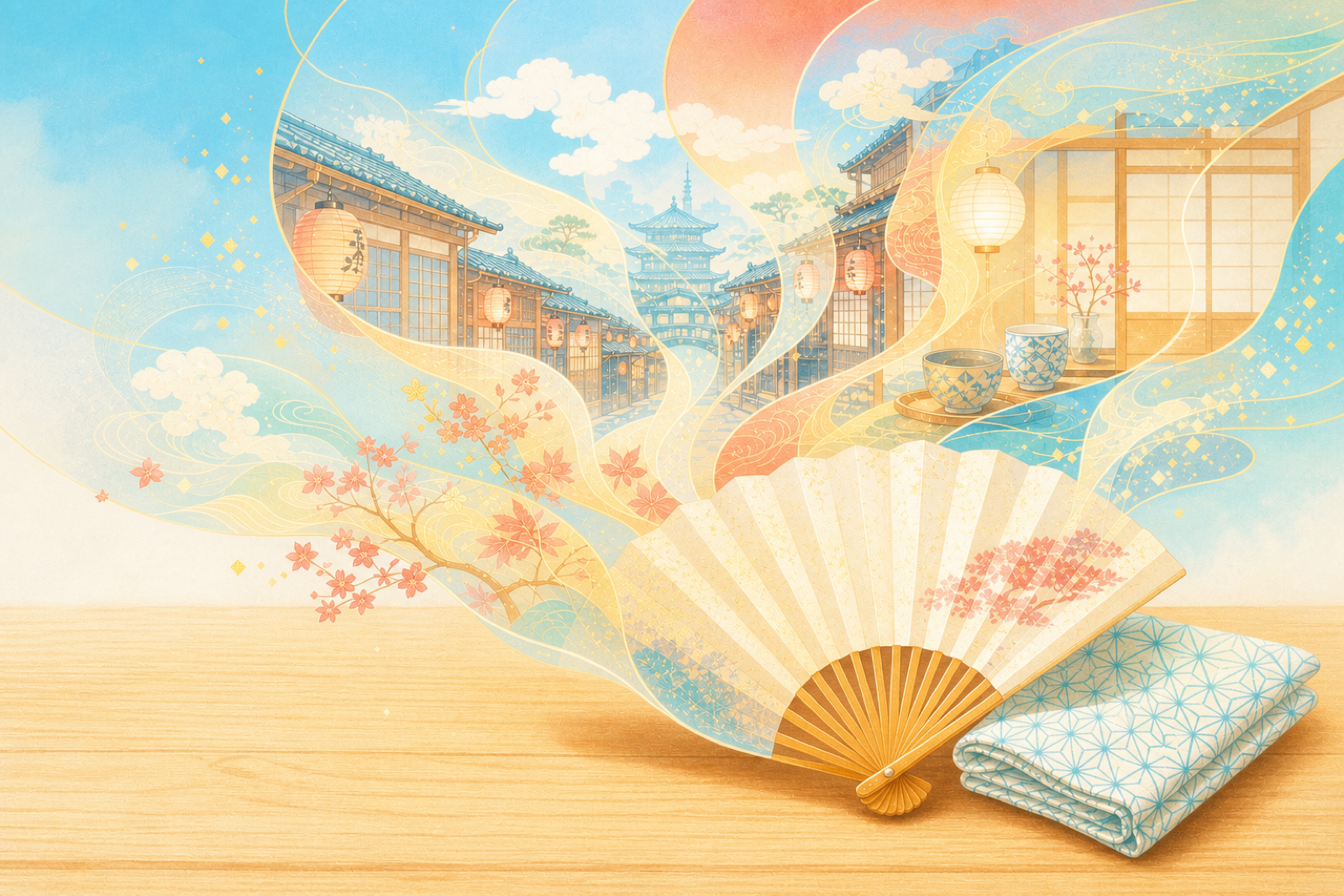
The anime changed that impression almost immediately. With little more than a fan, a hand towel, a shift of the eyes, and a carefully timed pause, one performer can create an entire room full of people. The audience begins to see characters and places that are not physically there—and before they realise it, their laughter and attention are moving exactly where the storyteller wants them to go.
Yet the part of Akane-banashi that stayed with me most was not the technique. It was the world surrounding the stage: the lifelong bond between master and apprentice, the fellow disciples who become something like siblings, and the quiet responsibility of passing an art from one generation to the next.
That cultural background gives the series depth, but you do not need to know anything about rakugo to enjoy it. At heart, this is an energetic coming-of-age story about a determined girl finding her own voice in an art built on voices inherited from others.
The Story
Akane-banashi is written by Yuki Suenaga and illustrated by Takamasa Moue. It began serialization in Shueisha’s Weekly Shonen Jump in 2022.
The story follows Akane Osaki, a high school student determined to become a professional rakugo performer. Her love of the art began with her father, Toru Osaki, who performed under the stage name Shinta Arakawa.
Shinta had spent years working toward promotion to shin’uchi, the highest professional rank in Tokyo rakugo. During his promotion examination, however, senior master Issho Arakawa made a shocking decision: every candidate failed, and all of them were expelled from the school.
Akane witnessed the moment from the audience. Her father subsequently left rakugo behind and began living as an ordinary office worker, but Akane never forgot the performance that had once seemed magical to her.
Six years later, she is secretly training under Shiguma Arakawa, her father’s former master. Akane intends to reach shin’uchi herself, confront the man who ended her father’s career, and discover whether Shinta’s art truly deserved to be rejected.
That goal gives the series its initial momentum, but Akane-banashi soon grows beyond a simple revenge story. Every performance forces Akane to ask a harder question: is she telling rakugo to defend her father, to defeat Issho, or because she has something of her own that she wants an audience to hear?
The Characters
Akane Osaki
Competitive, observant, and almost impossible to discourage, Akane has been imitating her father’s rakugo since childhood. Her natural ability is obvious, but the series never treats talent as enough. She learns by listening to audiences, studying rivals, accepting criticism, and recognising that a performance built entirely around proving someone else wrong can only take her so far.
Shinta Arakawa / Toru Osaki
Akane’s father and the performer who first made rakugo feel like magic to her. After being expelled during the shin’uchi examination, he leaves the profession rather than seeking another master. To an outsider, that choice may seem difficult to understand. Within the rakugo world, however, choosing a master is closer to entering a lifelong artistic family than changing teachers or employers.
Shiguma Arakawa
Shinta’s former master and Akane’s teacher. Shiguma is warm without being indulgent. He rarely hands Akane a complete answer; instead, he places her in situations that force her to observe, think, fail, and find the lesson for herself.
Issho Arakawa
The formidable master who expelled Shinta and the other candidates. To Akane, he begins as the person who destroyed her father’s dream. But Issho is not written as a convenient villain. His uncompromising view of rakugo—and the reason behind his decision—forms one of the story’s central mysteries.
Shiguma’s disciples
Akane’s growth depends heavily on the senior apprentices around her. Kyoji teaches her the discipline hidden inside apparently ordinary work. Koguma gives her the historical and technical knowledge needed to understand a story rather than merely memorize it. Guriko is a more immediate senior figure, while Maikeru helps hold the school together. Each has a different personality and performance style, allowing Akane to learn from more than one model of what a rakugo artist can be.
Karashi Nerimaya and Hikaru Koragi
Akane’s most important young rivals approach rakugo from very different directions. Karashi is analytical and inventive, while Hikaru draws on formidable acting ability to make characters emotionally vivid. Their performances demonstrate one of the series’ most compelling ideas: two people can tell the same traditional story and create completely different experiences.
Why Readers Keep Coming Back
- Rakugo feels like a shonen battle. There are no weapons, scoreboards, or supernatural powers, yet every entrance, pause, change of gaze, and audience reaction carries the tension of a decisive match.
- The series makes an invisible art visible. Manga panels and anime sequences show the imaginary world taking shape around a performer, helping newcomers understand when a storyteller has captured the room.
- Tradition does not erase individuality. Rakugo stories are passed down, but they are not reproduced mechanically. A performer’s interpretation, experience, rhythm, and understanding of the characters can transform familiar material.
- Akane never grows alone. Her talent matters, but so do the master who guides her, the senior disciples who correct her, the rivals who unsettle her, and the audiences who expose the gap between intention and result.
- The apprenticeship system raises fascinating questions. Why is choosing a master treated as a lifelong commitment? Why would a master spend years training disciples when the immediate reward is so small? Why do fellow apprentices speak of one another as siblings? The series lets these questions emerge naturally through the characters rather than stopping the story for a cultural lecture.
The last point is what made the series especially memorable for me. Apprenticeship traditions exist far beyond Japan, but rakugo brings together a stage name, a school, oral instruction, seniority, backstage work, and an enduring personal bond with one master. The result is a professional structure that often feels like a family—and sometimes carries all the warmth, loyalty, pressure, and conflict that the word implies.
Anime Adaptation: What Is Confirmed
The first season of the Akane-banashi TV anime began airing in April 2026 and ran for 12 episodes. It follows Akane from the event that ended her father’s career through her early training with Shiguma’s school and the Karaku Cup student rakugo competition.
Ayumu Watanabe directs the adaptation, with animation production by ZEXCS. Professional rakugo performer Kikuhiko Hayashiya serves as rakugo supervisor. Anna Nagase voices Akane, Jun Fukuyama voices Shinta, Masaki Terasoma voices Shiguma, and Akio Otsuka voices Issho.
A second season has officially been confirmed for January 2027. The announcement matters because the first season gives viewers Akane’s foundation: how she enters Shiguma’s school, what she learns from her senior disciples, and how rival performers begin widening her idea of rakugo. The next stage can move further into the professional world and the larger artistic conflict surrounding Issho.
Current broadcast and streaming details are available on the official TV anime website.
Where the Manga Stands Now
Akane-banashi remains in serialization in Weekly Shonen Jump. As of July 31, 2026, 22 collected volumes have been released in Japan, with volume 23 scheduled for August 4, 2026.
The manga continues far beyond the first anime season as Akane faces larger stages, more experienced professionals, and increasingly difficult questions about what makes a performance truly her own.
The anime and manga also create rakugo in different ways. Animation gives the performances voices, music, silence, and the audible response of a crowd. The manga relies on panel composition, facial detail, page turns, and the reader’s own sense of timing. Experiencing both makes it easier to appreciate how carefully the series translates a live oral art into two very different visual forms.
Publication updates and volume information can be found on the Akane-banashi page at Weekly Shonen Jump.
Should You Watch Akane-banashi If You Know Nothing About Rakugo?
Yes. In fact, discovering rakugo alongside Akane is one of the pleasures of the series.
You gradually learn why a storyteller’s gaze matters, how silence can control anticipation, why everyday backstage work belongs to an artist’s training, and how the same story changes in another performer’s hands. The explanations arrive through a competition, a failed attempt, a senior disciple’s example, or a room full of listeners whose mood suddenly shifts.
Akane-banashi is a story about a girl pursuing the highest rank in rakugo. It is also a story about listening, teaching, inheritance, and the difficult process of turning something received from others into an art that is unmistakably your own.
You may begin the series knowing nothing about rakugo. By the end of the first season, you may find yourself watching the angle of a performer’s eyes, waiting through a deliberate silence, and wondering how an empty stage came to feel so full.