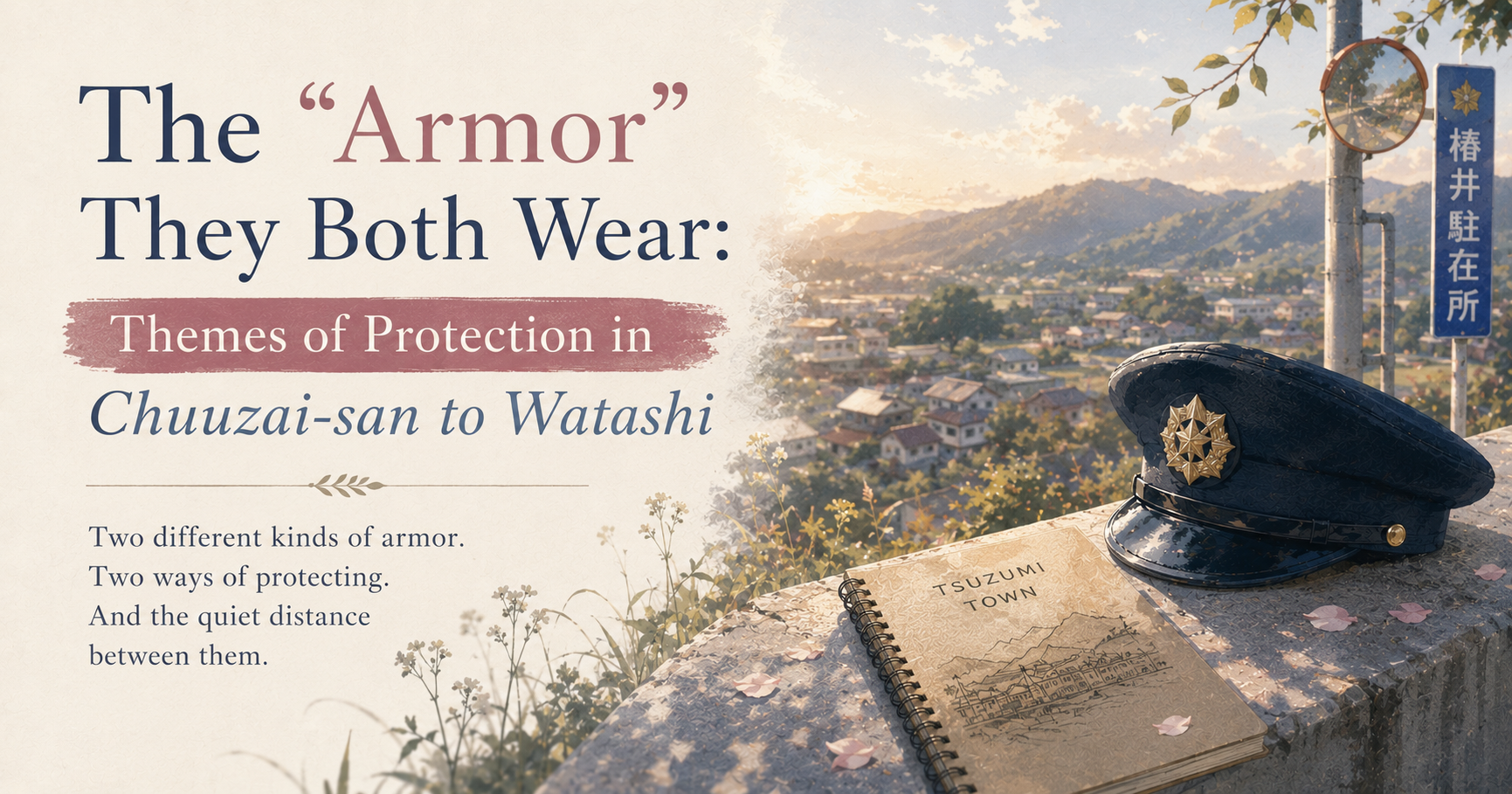
There are two people wearing armor in this story.
One is a high school girl who dresses like a delinquent — using toughness as a shield against a world she has learned not to trust.
The other is a serious, dedicated police officer — whose instinct to protect others may itself be a kind of armor.
Chuuzai-san to Watashi is not a romance story. At least, not at first.
It is a story that asks, from two completely different perspectives:
What does it really mean to protect someone?
✅New to this manga? Start here: What Is Chuuzai-san to Watashi? Plot, Characters & Why It Went Viral
Theme 1 — Armor as Self-Defense
Urara’s armor
Urara’s delinquent image is not a fashion choice.
It is a defense system.
Don’t show weakness. Don’t rely on anyone. Don’t get hurt.
That has been her definition of strength for a long time.
Keep people far enough away, and they can’t disappoint you.
✅ For a deeper look at Urara’s emotional journey: Why Urara Hates the New Officer — and Why That Changes Everything
Sousuke’s armor
Sousuke’s case is different — but worth examining.
He is serious, trustworthy, and genuinely dedicated to the people around him. He is not hiding weakness in the way Urara is.
But his instinct to protect — the way he can’t walk past someone who seems to be struggling, the way he quietly, persistently shows up — could be read as its own kind of armor.
When you are always focused on protecting others, you don’t have to spend as much time with your own feelings.
That is one way to read him. And as the story continues to unfold, it may become a more significant one.
✅ For a full character analysis: Before the Romance: What Makes Sousuke Tatsumi So Different
The difference between their armor
| Urara | Sousuke | |
|---|---|---|
| Form of armor | Delinquent image / keeping distance | Dedication / protecting others |
| Purpose | Avoid being hurt | Fulfill his sense of responsibility |
| Blind spot | Can’t rely on anyone | May struggle to face his own feelings |
Theme 2 — Two Definitions of Protection
At the heart of this story is one question:
What does it mean to protect someone?
For Urara, protection means protecting herself:
- Don’t be looked down on
- Don’t get hurt
- Don’t need anyone
For Sousuke, protection means protecting others:
- Be there when it matters
- Don’t control — just stay
- Take responsibility without overstepping
These two definitions pull in opposite directions.
Urara protects herself by creating distance. Sousuke protects others by closing it.
That tension — quiet, unspoken, persistent — is what drives the story forward.
Theme 3 — Distance and Trust
What sets Chuuzai-san to Watashi apart from most romance manga is how carefully it handles distance.
Most romance stories treat distance as a problem to be solved. Get the two people closer. Remove the obstacles. Resolve the tension.
This story treats distance as something worth understanding.
Why does Urara keep people away? Why does Sousuke respect that distance — while still refusing to disappear? And when the distance begins to change — what does that actually mean?
The answer is trust.
The way the distance between Urara and Sousuke shifts over time is a map of how trust forms — slowly, unevenly, without announcements.
When Urara begins to let Sousuke a little closer, she is not just changing how she feels about him.
She is changing how she understands what it means to rely on someone.
Theme 4 — The Town That Won’t Let You Disappear
The setting of Tsuzumi Town is not incidental to these themes.
In a city, difficult relationships can be reset. Move. Change jobs. Find new people.
In a small rural town, that is not an option.
The same people. The same streets. The same faces — every day.
For Urara, that has always felt like a trap. No anonymity. No fresh start. No escape.
But Sousuke’s presence begins to reframe that feeling.
The town that wouldn’t let her disappear slowly becomes the place where someone always notices her.
And that is a very different thing.
Theme 5 — Where Does Responsibility End and Feeling Begin?
One of the most quietly compelling tensions in this story is a question that never gets answered directly:
Is Sousuke’s care for Urara professional — or personal?
For Urara, this matters enormously.
If his kindness is just his job, then accepting it means nothing. If it’s something more — then what does she do with that?
The story doesn’t resolve this cleanly. It lets the ambiguity sit.
And that ambiguity — that refusal to define the relationship too quickly — is part of what makes this manga feel real.
Real feelings don’t come with clear labels. Real trust doesn’t announce itself.
It just accumulates. Quietly. Until one day you realize it was already there.
Final Reflection — What This Story Is Really Asking
Chuuzai-san to Watashi leaves its readers with questions, not answers.
What is the difference between protecting someone and controlling them?
Is keeping your distance the same as protecting yourself?
Can simply having someone nearby — someone who stays — be enough to change a person?
The story doesn’t rush toward resolution.
Instead, it lets the relationship between Urara and Sousuke shift gradually — and trusts the reader to feel what that shift means.
That patience is rare. And it is exactly what makes this story stay with you.
I also share the small manga moments that stay with me long after reading—the pauses, glances, and choices that never fully leave.
You can follow those weekly reflections on Substack.
✅ My Substack Here!