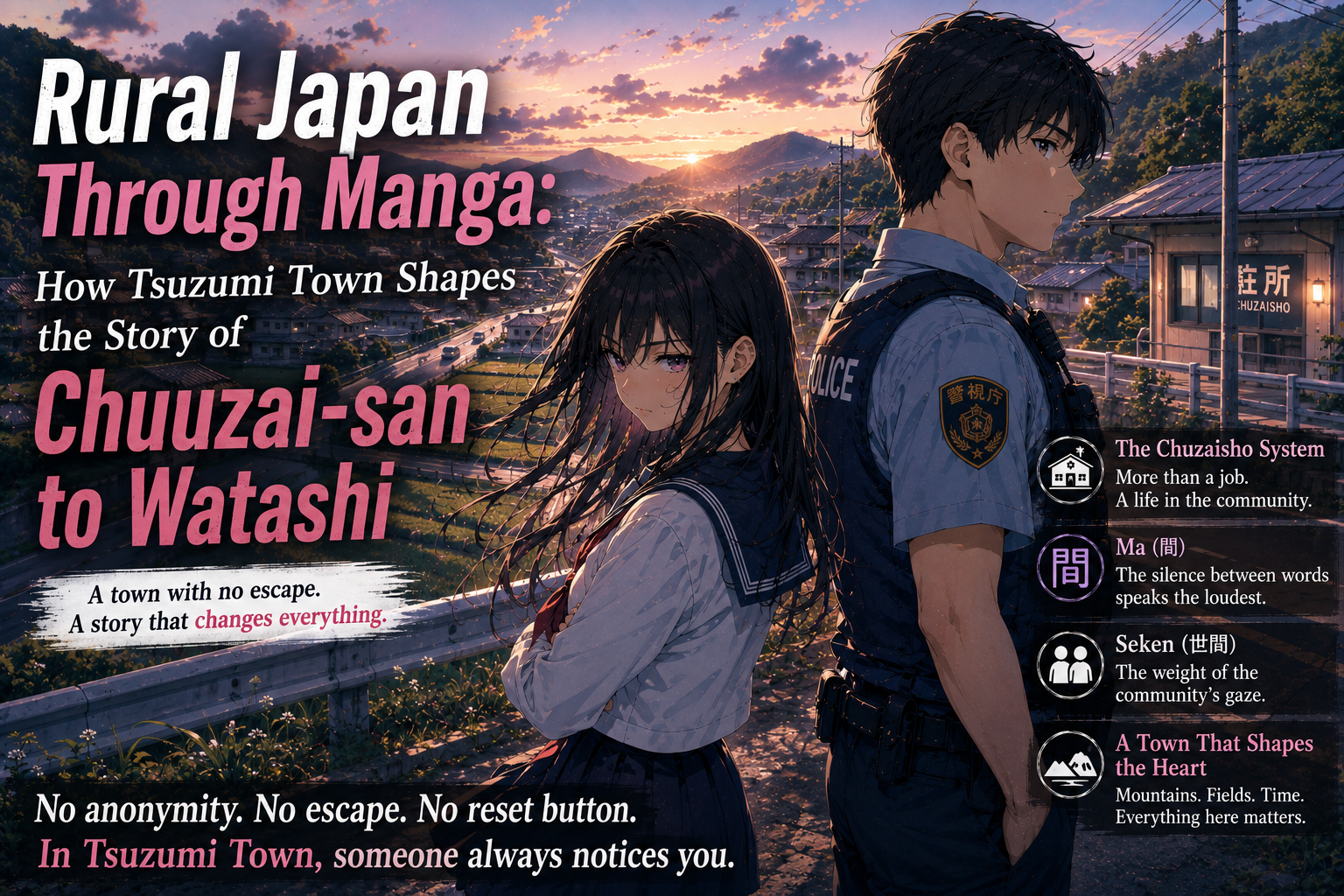
If this story were set in a city, it would be a completely different manga.
Urara could have reset her relationships. She could have avoided Sousuke without much effort. The person she didn’t like? Easy enough to never see again.
But Tsuzumi Town doesn’t work that way.
A small rural town, sandwiched between mountains and a national highway. No anonymity. No escape. No reset button.
That sense of being unable to run — built into the setting itself — deepens every theme this story explores.
And beneath that setting is something equally important:
Japanese culture itself.
✅ New to this manga? Start here: What Is Chuuzai-san to Watashi? Plot, Characters & Why It Went Viral
What Is a “Chuuzai-san”? — A Uniquely Japanese Institution
Before going further, there is something international readers should know.
The word chuuzai-san — the title of this manga — refers to a type of police officer that does not exist in most Western countries.
The Chuzaisho System
In Japan, rural communities are served not by police stations, but by chuzaisho — small residential police posts.
Unlike urban koban (police boxes), a chuzaisho is not just a workplace.
The officer assigned there lives in the community.
Not a commute. Not a shift. A life — shared with the people of that town.
Sousuke Tatsumi didn’t just get assigned to Tsuzumi Town. He moved there. He became a resident. His job and his daily life became the same thing.
Why This Matters for the Story
This context reframes everything about how Sousuke relates to Urara.
When he notices that she is always alone — that is not just personal concern. Paying attention to the people around him, knowing their routines, caring about their wellbeing — that is his job.
And that is exactly what makes the central tension of this story so compelling.
Is Sousuke watching out for Urara because it’s his responsibility? Or because he genuinely can’t stop thinking about her?
The line between the two is impossible to draw cleanly.
And the chuzaisho system is the reason that line exists at all.
Ma — The Japanese Art of Saying Nothing
International readers sometimes find themselves wondering:
Why don’t these characters just say what they feel?
The answer lies in a concept called ma (間).
What Is Ma?
Ma is one of the most distinctly Japanese ideas in the language — and one of the hardest to translate.
It refers to the meaningful pause. The space between words. The silence that communicates something words cannot.
In Japanese culture, what is not said is often as significant as what is. Sometimes more so.
Sousuke never tells Urara he is watching out for her. Urara never admits that something has started to change.
But the air between them shifts. Slowly. Quietly. Undeniably.
Ma in This Manga
This is one of the reasons Chuuzai-san to Watashi resonates so deeply with readers.
The emotions are never announced. They accumulate in the space between scenes — in a glance, in a pause, in the fact that someone showed up again without being asked.
The distance between Urara and Sousuke is not just physical. It is a ma — a meaningful silence that both of them are learning, slowly, to inhabit together.
Seken — The Weight of the Community’s Gaze
What Is Seken?
Seken (世間) is another concept with no clean English equivalent.
It refers to the collective gaze of the community you belong to — the sense that the people around you are always, in some way, watching and evaluating.
Phrases like seken-tei ga warui (“this looks bad to others”) reflect how deeply this awareness shapes behavior in Japanese society.
It is not quite peer pressure. It is more like a constant, ambient awareness of how you are perceived by the world around you.
Seken in Tsuzumi Town
In a small town like Tsuzumi, seken is inescapable.
Everyone knows everyone. Who is close to whom. Who is struggling. Who has changed.
The fact that Urara is always alone — that is not invisible here. It is noticed. It becomes part of the town’s awareness.
In a city, solitude is anonymous. In Tsuzumi Town, solitude stands out.
And that visibility — that gentle, persistent pressure of being seen — is part of what makes it harder and harder for Urara to keep her distance.
The Landscape That Sets the Emotional Temperature
Mountains on one side. A national highway on the other. Rice fields that change color with the seasons. The stillness of a rural evening.
Tsuzumi Town’s landscape is not just backdrop. It sets the emotional temperature of the entire story.
There is no urban noise here. No speed. No distraction.
Time moves slowly.
And because time moves slowly, the changes between Urara and Sousuke — small as they are — have room to breathe.
In a faster setting, those changes might go unnoticed. Here, they are everything.
The “nothingness” of rural Japan is not a flaw in this story.
It is the story’s rhythm.
Tsuzumi Town as a Mirror of Urara’s Inner World
In this manga, Tsuzumi Town is more than a setting.
It is a reflection of Urara herself.
Closed off. Hard to leave. Quietly warm underneath.
That description fits the town. It also fits Urara perfectly.
She appears shut down from the outside. But there is warmth inside — carefully hidden, carefully protected.
She keeps trying to create distance. But somewhere underneath that, she wants someone to stay.
The choice to set this story in a place like Tsuzumi Town was not just practical.
It was thematic.
Final Reflection
In Chuuzai-san to Watashi, Tsuzumi Town is not background.
It is the story.
The chuzaisho system blurs the line between Sousuke’s duty and his feelings. The concept of ma gives silence and distance their own language. The weight of seken makes Urara’s solitude impossible to overlook. The rural landscape gives the story room to breathe.
A place with no escape becomes, slowly, a place where someone always notices you.
A town that felt like a trap begins to feel like something else entirely.
That shift — from closed to open, from trapped to held — is the quiet miracle at the heart of this story.
And it could only happen here.
In a small town. Between mountains and a highway. Where everyone stays.
Explore more about this story:
✅ The “Armor” They Both Wear — Themes of Protection in Chuuzai-san to Watashi
✅ Before the Romance: What Makes Sousuke Tatsumi So Different
I also share the small manga moments that stay with me long after reading—the pauses, glances, and choices that never fully leave.
You can follow those weekly reflections on Substack.
✅ My Substack Here!