There is a particular kind of pain that does not come from failure alone.
It comes from failing at something you loved.
Something you gave yourself to completely.
Something that once felt like the most natural thing in the world.
When that breaks — when the thing you trusted most becomes the thing you fear most — it changes you in ways that are difficult to explain.
That is where Minato Narumiya begins.
Not as someone who lost a competition.
But as someone who lost trust in himself — inside the one place that used to feel like home.
If you are new to the series, you may want to start here first:
✅ Tsurune: More Than Archery — A Story About Facing Yourself Through Kyudo
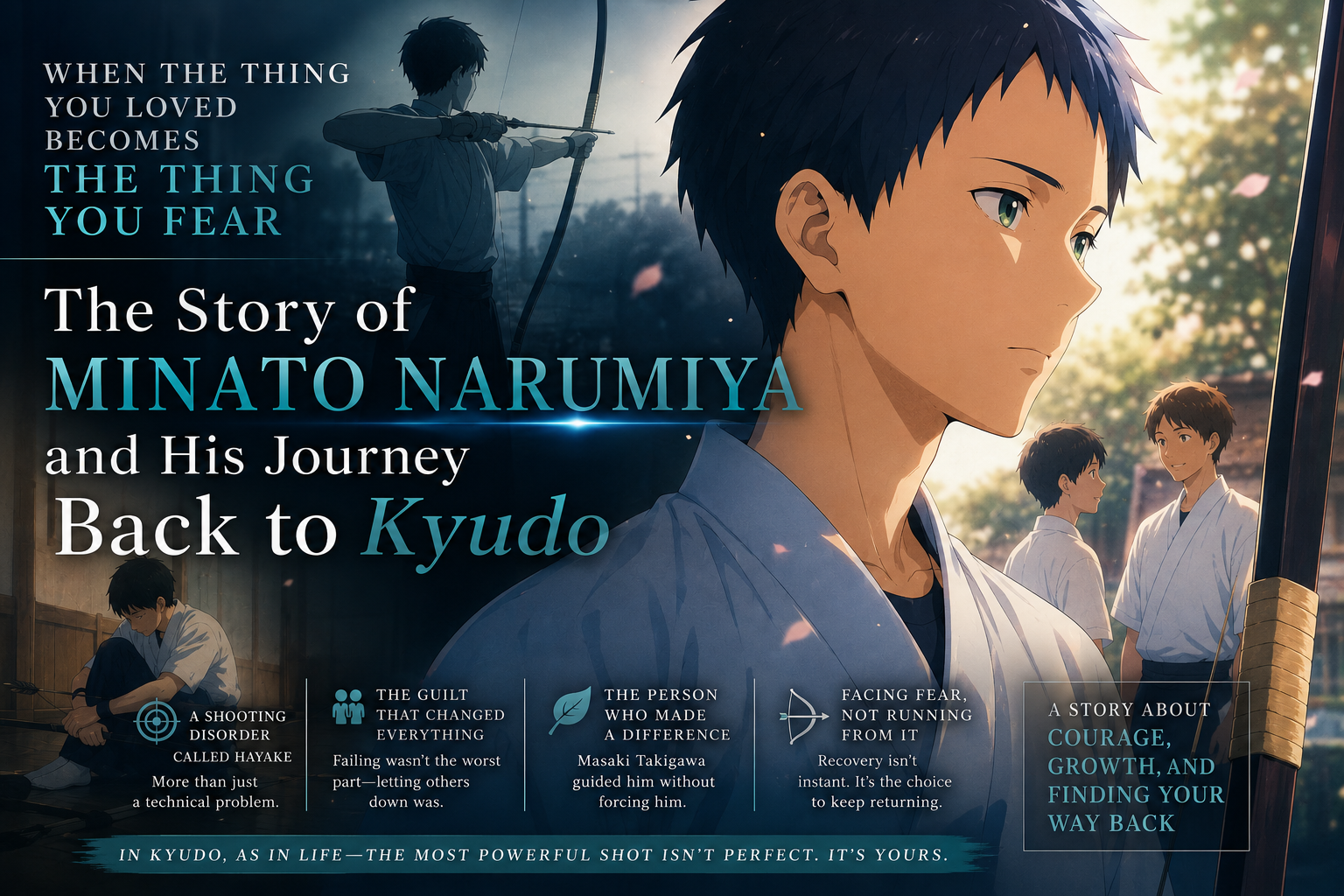
What Hayake Really Is — And Why It Broke More Than His Technique
Hayake is a shooting disorder in kyudo.
In simple terms, it means releasing the arrow too early — before the archer has fully drawn, settled, and found stillness.
Technically, it can be described as a timing problem.
But for anyone who has experienced something similar — in music, in sport, in performance — hayake is never really just technical.
It is what happens when the mind and body stop trusting each other.
When anxiety becomes so strong that the body acts before the person is ready.
When the pressure of a moment overrides everything a person has trained for.
For Minato, hayake did not simply affect his accuracy.
It broke the connection between him and the thing he loved most.
And that is what made it so devastating.
✅ What Is Hayake? The Psychology Behind Tsurune’s Central Conflict
The Day Everything Changed
Minato did not develop hayake quietly, alone, in a practice session.
It happened during a competition.
In front of people.
At a moment that mattered.
And it did not only affect him.
His teammates were there.
His performance was part of something shared.
That detail matters — because for Minato, the memory of that day was never only about missing the shot.
It was about the weight of feeling like he had let people down.
People who trusted him.
People who were counting on him.
That guilt settled into him quietly.
And it changed the way he thought about kyudo entirely.
Because it is one thing to fail privately.
It is another to feel like your failure became someone else’s burden.
That combination — losing trust in himself, layered with guilt toward others — is what made walking away feel like the only option.
What It Really Means to Step Away From Something You Still Love
After that day, Minato stopped practicing kyudo.
And it would be easy to call that giving up.
But that is not really what happened.
Minato did not stop caring about kyudo.
He stopped feeling safe inside it.
There is a difference.
Giving up means the feeling fades.
What Minato experienced was something more painful — the feeling never left, but the place where it lived became frightening.
He still loved the draw of a bow.
The stillness before release.
The quiet discipline of the dojo.
But every time he approached that world, something else came with it.
The memory of that competition.
The feeling of losing control at the worst possible moment.
The guilt of knowing others had been affected.
So he kept his distance.
Not because he stopped loving kyudo.
But because loving it had become too painful to hold.
How Masaki Takigawa Changed Everything — Without Saying Much
When Minato meets Masaki Takigawa, something begins to shift.
But not because Masaki pushed him back toward archery.
Not because he offered solutions, or told Minato to try harder, or explained how to overcome hayake.
Masaki did something much quieter.
He created a space where returning felt possible.
He noticed Minato without overwhelming him.
He waited without pressuring.
And slowly, without fully realizing it, Minato began to find his way back.
This is one of the most emotionally honest moments in Tsurune.
Because in real life, people rarely return to painful things because someone forces them.
They return when something begins to feel safe again.
Masaki gave Minato that safety — not by fixing anything, but simply by being the kind of person who did not need him to be ready before he was.
✅ Masaki Takigawa — The Person Who Guided Without Controlling
Facing Hayake — Not Fixing It, But Staying With It
Once Minato returns to kyudo, the story does not become simple.
Hayake does not disappear because he decided to try again.
It stays.
It reappears at difficult moments.
It reminds him, again and again, that recovery is rarely a straight line.
But what changes is Minato’s relationship with it.
In the beginning, hayake felt like something that defined him.
Something that proved he was not strong enough.
Something to be ashamed of.
But gradually, Minato begins to face it differently.
Not by pretending it is not there.
Not by forcing it away through sheer willpower.
But by staying with it.
By continuing to show up, even when the fear was still present.
He came back to the dojo.
And again.
And again.
That quiet repetition — that choice to keep returning — is one of the most understated forms of courage in the entire series.
Because it does not look dramatic from the outside.
There is no single moment where everything changes.
There is only Minato, still trying.
Why Minato Feels Different From Other Sports Anime Protagonists
Most protagonists in sports anime grow by becoming stronger.
They train harder.
They push past limits.
They win.
Minato’s growth looks completely different.
He does not simply become a better archer.
He becomes someone who can stand inside the thing that once hurt him — and stay.
That is a different kind of strength entirely.
It is the strength of someone who understands what it means to be afraid of something you love — and chooses to move toward it anyway.
Not because the fear disappeared.
But because something inside him decided that loving kyudo was worth the risk of being hurt by it again.
What Minato Leaves With You
Long after the series ends, Minato stays with you.
Not because he is the most talented archer.
Not because he overcame everything dramatically.
But because his struggle feels quietly familiar.
Many people know what it is like to step away from something they once loved.
A sport.
A creative pursuit.
A relationship.
Something that once brought joy — until one painful moment changed the way it felt.
And many people also know the particular loneliness of still caring about that thing.
Of carrying it quietly, from a distance.
Minato understands that feeling.
And through him, Tsurune quietly reminds us of something important:
Returning to something that once hurt you — is not weakness.
It is one of the most honest forms of courage there is.
Related Reading:
✅ Tsurune: More Than Archery — A Story About Facing Yourself Through Kyudo
✅ Masaki Takigawa — The Person Who Guided Without Controlling
✅ Why Adults Who Wait Feel More Powerful Than Adults Who Control
✅ Seiya Takehaya — The Person Who Carried Too Much Responsibility