

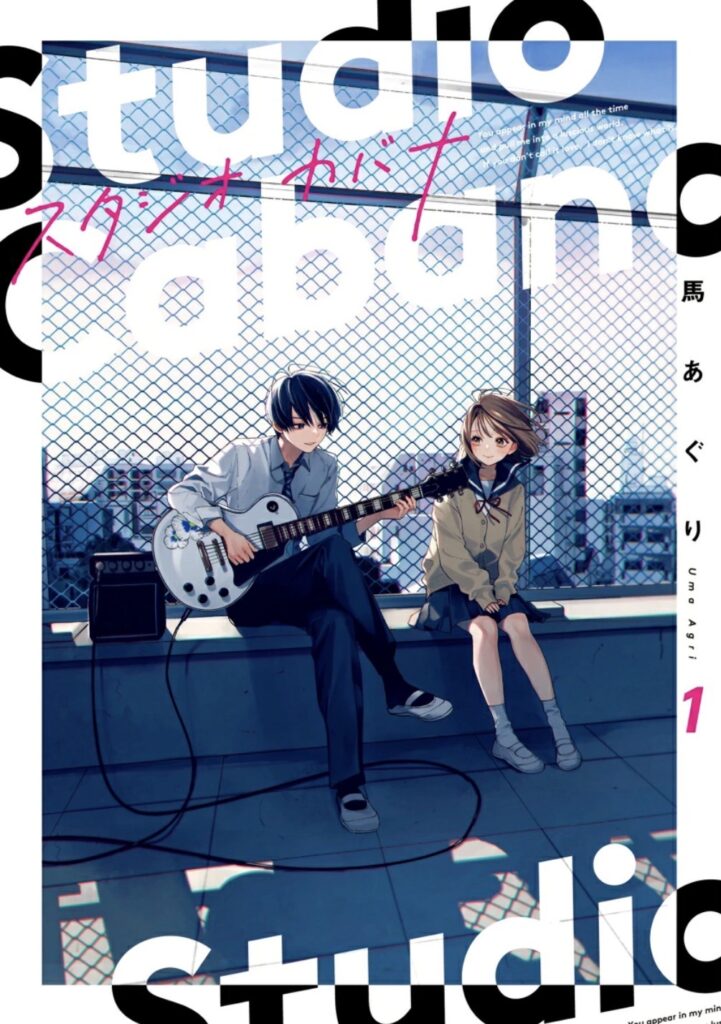
Some stories are built on dramatic confessions.
Others move forward through what remains unsaid.
Studio Cabana is a manga that belongs to the latter.
At first glance, it may look like a story about music, youth, and first love. But beneath that surface, it quietly explores something deeper: how difficult it is to understand one’s own feelings, and how easily those feelings can hurt others.
Rather than rushing toward romance, the story lingers in moments of hesitation, distance, and emotional uncertainty.
Basic Information
Title: Studio Cabana (スタジオカバナ)
Author: Uma Aguri
Publisher: KADOKAWA
Status: Ongoing
Volumes: 8 volumes (as of 2025)
Story Overview
The story follows Yukari Maki, a serious and responsible high school student who is known for always doing the right thing.
Her classmate, Yusuke Kusaka, is the complete opposite.
At school he is seen as a delinquent—distant, rebellious, and uninterested in the expectations placed on him by teachers or classmates. Yet one day Yukari accidentally discovers another side of him.
She follows him to a small music studio called Studio Cabana, where he sings.
The songs he performs are filled with raw emotion—far removed from the cold, detached boy she sees in the classroom.
From that moment on, Yukari begins to see Yusuke differently. What starts as curiosity slowly grows into something more complicated.
Relationship Structure
The story revolves around three emotional threads.
Yukari’s quiet admiration for Yusuke.
Yusuke’s unresolved attachment to an older woman named Haruyuki.
And the space between them where neither of them fully understands their own feelings.
Rather than presenting a straightforward romance, the manga carefully shows how emotions overlap and conflict.
Yusuke’s music becomes the place where these feelings surface. His songs carry the emotions he cannot express directly, especially those tied to Haruyuki.
For Yukari, witnessing this creates a complicated realization: the person she cares about may already belong emotionally to someone else.
Stories like Studio Cabana often focus on emotions that are difficult to express directly.
A similar theme of hesitation and emotional distance appears in Pink to Habanero, another manga that explores how young people struggle to understand their feelings before acting on them.
Moments of Restraint
One of the most striking aspects of Studio Cabana is how often characters hold themselves back.
Yukari frequently suppresses her own feelings. She tries to remain “the responsible one,” prioritizing school, expectations, and the future others imagine for her.
Yusuke, on the other hand, struggles with a different kind of restraint. His emotions are intense, but he lacks the ability to handle them directly. Instead, they spill out through music.
Because of this imbalance, the story rarely moves forward through direct confrontation. Instead, it advances through quiet realizations—moments when characters understand something but choose not to say it out loud.
This kind of quiet restraint also appears in Gazing at the Star Next Door, where characters often choose to support each other without pushing their feelings forward.
✅ Gazing at the Star Next Door
Emotional Responsibility
A central theme of Studio Cabana is the realization that love does not exist in isolation.
Caring about someone inevitably affects other people.
As Yusuke begins to confront his lingering feelings toward Haruyuki while also growing closer to Yukari, he is forced to face a difficult truth: moving forward with one person may mean hurting another.
The story does not present this as a dramatic moral lesson. Instead, it quietly asks a question that many coming-of-age stories avoid:
What does it mean to take responsibility for the emotions we create in others?
Music as Emotional Language
Music plays an important role in the story.
The band’s performances, especially Yusuke’s vocals, allow readers to experience emotions that the characters themselves cannot articulate.
Even though the story is told through manga panels, the live scenes are drawn with such energy that they almost feel audible. Lyrics, lighting, and the rhythm of the page create a sense of atmosphere similar to standing in a small live house.
In many ways, the stage becomes the one place where Yusuke can be completely honest.
Final Thoughts
Studio Cabana may initially appear to be a typical “band romance” story.
However, what makes the manga memorable is not the music or the romantic tension, but the emotional restraint woven throughout the narrative.
Characters hesitate.
They misunderstand themselves.
They move forward slowly, sometimes painfully.
Rather than offering easy answers, the story portrays the fragile space between adolescence and adulthood, where people begin to realize that feelings alone are not enough—choices, responsibility, and timing matter as well.
For readers who appreciate manga that explores distance, silence, and emotional complexity, Studio Cabana is a quietly powerful work.
Stories about emotional responsibility also appear in other manga.
For example, Starting Over at the Magic Academy with My Ex explores how characters must live with the consequences of the choices they make in relationships.